Talk:Triangular prism
It seems that there are two faces that are triangles and the other three are parallelograms, thus I removed the parts that talked about when the parallelogram f

 | This article is rated C-class on Wikipedia's content assessment scale. It is of interest to the following WikiProjects: | ||||||||||||||||||||
| |||||||||||||||||||||


It seems that there are two faces that are triangles and the other three are parallelograms, thus I removed the parts that talked about when the parallelogram faces are triangles. —Preceding unsigned comment added by 144.92.166.209 (talk) 18:10, 14 October 2009 (UTC)
I removed this section, didnd't seem very clear or useful as written. Tom Ruen 22:41, 12 September 2006 (UTC)
To get the surface area of a triangular prism, you need to find the base area(0.5*bh) of the triangle. This is known as A1 in the following formula. The rectanges are known as A2, A3, and A4 in this formula.
The formula for an equilateral triangular base in the prism is:
- A1×2+A2×3
The formula for an isosceles triangular base in the prism is:
- A1×2+A2×2+A3
The formula for a scalene triangular base in the prism is:
- A1×2+A2+A3+A4
To get the volume of a triangular prism you need to find the base area of the triangle(0.5*bh) and the length of the prism.
The General formula that is commonly used is: Base Area*length or 0.5*base*height*length
- Yeah that's not as clear as it could be. I don't think it's very good that this article has been left without a volume formula though.
- I've tried to add one in again. Something a bit more succinct than the above. Needs work still though. Ideally someone needs to draw a little diagram showing the width height length measurements. I suppose talking about width implies that the prism would be lying on it's side, unlike in the top-right diagram. -- Nojer2 12:25, 15 December 2006 (UTC)
Prisms
Prisms are shapes that have no meaning —Preceding unsigned comment added by 24.189.44.136 (talk) 01:38, 27 February 2009 (UTC)
- 3.16.16 is t0,1{8, 3}.

- 3.14.14 is t0,1{7, 3}.
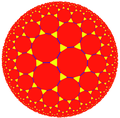
- 3.12.12 is t0,1{6, 3}.

- 3.10.10 is t0,1{5, 3}.

- 3.8.8 is t0,1{4, 3}.

- 3.6.6 is t0,1{3, 3}.

- 3.4.4 then logically would be t0,1{2, 3}.


I added that into the article, see also truncated hexagonal tiling. --Professor FiendishMWAHAHAHA!! 03:27, 21 August 2009 (UTC)
- Looks good! Tom Ruen (talk) 23:44, 22 August 2009 (UTC)
Repeated section
Paragraph? startng with This polyhedron is topologically related as a part of sequence of repeated twice... Jumpow (talk) 16:25, 1 November 2015 (UTC)
tetracombs
- The triangular prism exists as cells of a number of four-dimensional tessellation.
It occurs as cells of some uniform 4-polytopes, some of which may be in "tetracombs" (I have not searched the reference), but this is like saying squares exist in some n-dimensional polytopes. Is it really worth mention? —Antonissimo (talk) 02:30, 14 July 2026 (UTC)
Content Disclaimer
Informasi ini disarikan dari Wikipedia dan disajikan kembali untuk tujuan edukasi. Konten tersedia di bawah lisensi CC BY-SA 3.0. Kami tidak bertanggung jawab atas ketidakakuratan data yang bersumber dari kontribusi publik tersebut.
- The information displayed on this website is sourced in part or in whole from Wikipedia and has been adapted for the purpose of restating it. We strive to provide accurate and relevant information, however:
- There is no guarantee of absolute accuracy. Wikipedia is an open, collaborative project that can be edited by anyone, so information is subject to change.
- It is not intended to constitute professional advice. The content displayed is for informational and educational purposes only. For important decisions (e.g., medical, legal, or financial), please consult a professional.
- Content copyright. Wikipedia is licensed under the Creative Commons Attribution-ShareAlike License (CC BY-SA). This means that content may be reused with appropriate attribution and shared under a similar license.
- Responsible use. Any risk arising from the use of information from this website is entirely the responsibility of the user.