Talk:Triangular distribution
The article says: a (location), b (scale) and c (shape) are the triangular distribution parameters. I would have said that c was a more natural location parame

 | This article is rated C-class on Wikipedia's content assessment scale. It is of interest to the following WikiProjects: | ||||||||||||||||||||
| |||||||||||||||||||||


The article says: a (location), b (scale) and c (shape) are the triangular distribution parameters. I would have said that c was a more natural location parameter as the mode, b−a the scale (or range and something like best for the shape, being related to the idea of skewness. --Henrygb 03:31, 25 Mar 2005 (UTC)

Kurtosis and kurtosis of Triangular distribution?
The kurtosis excess given 12/5 appears to be the 'true' kurtosis?
[@http://mathworld.wolfram.com/TriangularDistribution.html Wolfram ]give the kurtosis excess as -3/5.
which suggests that the value given as excess is in fact the 'true' excess 12/5 (kurtosis excess + 3 = 15/5 -3/5 = 12/5)
Paul A Bristow 18:34, 7 December 2006 (UTC) Paul A Bristow
- Right, thanks. Its fixed. PAR 19:31, 7 December 2006 (UTC)
Formulae for pdf cause divide by zero if a or b = mode
Formulae for pdf cause divide by zero if a or b = c (the mode) (c-a = 0 if c == a). This are the two right angle triagle cases.
In these cases the value is the apex value of 2/(b-a)?
Should this specified separately?
Paul A Bristow 10:27, 11 December 2006 (UTC) Paul A Bristow
- With the formulation
- when c=a the first form produces your problem, but the second is fine, even for x=c. I wouldn't bother adding more. --Henrygb 11:26, 11 December 2006 (UTC)
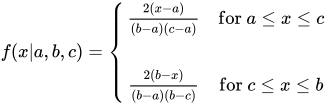
- Paul is right−the pdf should look like this:
- For the same reason, the cdf should be fixed: F(c) = (c-a) / (b-a).
- I'll make these changes if nobody objects. -- UKoch (talk) 13:14, 2 May 2012 (UTC)
![{\displaystyle f(x|a,b,c)={\begin{cases}0&\mathrm {for\ } x<a,\\{\frac {2(x-a)}{(b-a)(c-a)}}&\mathrm {for\ } a\leq x<c,\\[4pt]{\frac {2}{b-a}}&\mathrm {for\ } x=c,\\[4pt]{\frac {2(b-x)}{(b-a)(b-c)}}&\mathrm {for\ } c<x\leq b,\\[4pt]0&\mathrm {for\ } b<x,\end{cases}}}](https://wikimedia.org/api/rest_v1/media/math/render/svg/be41fd9349d133c1a68aeebe2a6515d551743009)
Is the median correct?
I have a feeling that the two cases for the median should be separtated by c = (b+a)/2 rather than c = (b-a)/2 as given on the page. —Preceding unsigned comment added by 143.53.57.46 (talk) 09:09, 28 March 2008 (UTC)
I agree that the median formula does not appear to be correct. Does anyone have a link or reference for a derivation somewhere? 207.34.120.71 (talk) 20:40, 19 August 2009 (UTC)
Link
Can somebody please create the page Triangular Distribution and redirect it here. I keep searching for that page, and get nothing every time. —Preceding unsigned comment added by 192.91.171.36 (talk) 14:21, 28 May 2008 (UTC)
example should cite Bates distribution?
The mean of two standard uniform r.v.'s is called Bates(2), apparently.146.186.250.171 (talk) 17:28, 15 April 2011 (UTC)
Unclear edit
In this edit, part of the article was changed to read as follows:
- to model events which take place within an interval defined by a minimum, most often
- and maximum value. The triangle distribution is better as it provide a more accurate statistics to complete the task in delay as well as early completion of a task which can be zero, unlike the normal distribution.
Is the following interpretation of the above correct?
- to model events which take place within an interval defined by a minimum and maximum value. The triangle distribution is better suited than the normal distribution, as it provides a more accurate statistics if either the minimum or the maximum time needed to complete the task is equal to the most probable time.
-- UKoch (talk) 19:19, 29 April 2018 (UTC)
- Better yet might be:
- to model events which take place within an interval defined by a minimum and maximum value. The triangle distribution is better suited than the normal distribution, as it provides a more accurate statistics if either the minimum or the maximum time needed to complete the task is close or equal to the most probable time.
- However, since it's not clear what was meant, I've undone the edit in question for the time being. -- UKoch (talk) 18:21, 1 May 2018 (UTC)
Beamforming
Is the ref in question really about the triangular distribution? I highly doubt it. -- UKoch (talk) 18:28, 16 July 2021 (UTC)
Content Disclaimer
Informasi ini disarikan dari Wikipedia dan disajikan kembali untuk tujuan edukasi. Konten tersedia di bawah lisensi CC BY-SA 3.0. Kami tidak bertanggung jawab atas ketidakakuratan data yang bersumber dari kontribusi publik tersebut.
- The information displayed on this website is sourced in part or in whole from Wikipedia and has been adapted for the purpose of restating it. We strive to provide accurate and relevant information, however:
- There is no guarantee of absolute accuracy. Wikipedia is an open, collaborative project that can be edited by anyone, so information is subject to change.
- It is not intended to constitute professional advice. The content displayed is for informational and educational purposes only. For important decisions (e.g., medical, legal, or financial), please consult a professional.
- Content copyright. Wikipedia is licensed under the Creative Commons Attribution-ShareAlike License (CC BY-SA). This means that content may be reused with appropriate attribution and shared under a similar license.
- Responsible use. Any risk arising from the use of information from this website is entirely the responsibility of the user.