Talk:Square root algorithms

 | This article is rated C-class on Wikipedia's content assessment scale. It is of interest to the following WikiProjects: | ||||||||||
| |||||||||||


Merge "Approximations that depend on the floating point representation" into "Initial estimate"
I believe the section "Approximations that depend on the floating point representation" should be merged into "Initial estimate", since it is a special case of "Binary estimates". Merging would clear up the fact that the floating point trick gives an initial rough approximation, which is then typically iteratively improved.
I also believe the "Initial estimate" section should appear after the section on Heron's method, as the reader is likely more interested in the general idea of iterative refinement than in the details of how to obtain a good initial estimate in all possible ways.
Additionally, in my opinion the entirety of the article could benefit from some trimming/rewriting, as many sections contain redundant information, unnecessary details, and awkward formulations. BlueRavel (talk) 14:54, 4 December 2023 (UTC)
- Your proposition makes sense to me, and I dont necessarily disagree. That said though, as a pure mathematician, I am uninclined to blur the lines between programmatical issues and mathematical problems. I think maintaining a distinction is appropriate. An analysis of the pure mathematical problem of initial estimation in these abstract reiterative processes is a decidedly distinct discussion from considerations in this programming language, or that programming language, or this architecture, or that architecture. The former is future-proofed, the latter is not. CogitoErgoCogitoSum (talk) 21:09, 11 February 2024 (UTC)
Useful addition??
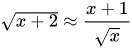
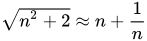
Not sure if its useful, but I have found that, in general, , and if x=n2 we get .
Similarly .
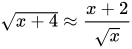
I sometimes use this for quick pencil and paper calculations, if Im close enough to a convenient value.
Not sure if this is a known or established property, proven, bounded, or if its already in the article in some alternative capacity, or if its even appropriate for this article. I do know the taylor series approximation with two terms connects these expressions. CogitoErgoCogitoSum (talk) 21:05, 11 February 2024 (UTC)
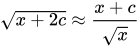
- There is nothing special about 2 and 4: provided that c is small compared to x. This is, in fact, just the first two terms of the series given in the article under the section heading "Taylor series". JBW (talk) 01:45, 13 February 2024 (UTC)
- I don't think they are useful. In the first, you have replaced a square root and an addition with a square root, an addition, and a division to get an approximate answer. Bubba73 You talkin' to me? 08:02, 13 February 2024 (UTC)
Python tweak needed
I noticed the interesting Python example and thought I had better look at it before a gnome removes it as OR or whatever. There is a syntax error in the following line: the inner "..." should use apostrophes not quotes because of the quotes on the overall string.
print(f"2) {sqrt_Heron(Decimal("3.1415926535897932384626433832795028841971693993"))}")
Johnuniq (talk) 03:42, 21 October 2025 (UTC)
- Fixed. Changed to
print(f"2) {sqrt_Heron(Decimal('3.1415926535897932384626433832795028841971693993'))}")
Halley's method versus Heron's method
Halley's method should not be mixed into Heron's method, but put into a separate section.
Halley's method requires one division and two multiplications per iteration (the squaring in the numerator can be re-used in the denominator). I do not count the factor of 3 in the denominator because that can be done by a shift and an addition which are negligible compared to multiplication. The 3S in the numerator need only be done once at the outset, so it is negligible also. After the initial division, the quotient is known to sufficient precision that we only need to do one step of the division algorithm which amounts to three multiplications. Thus the cost of one iteration of Halley's method amounts to five multiplications. Five iterations would be 25 multiplications for a 243-fold increase in precision.

By contrast, Heron's method only requires one division. (Multiplication by one half is just a shift and the addition is also negligible.) So it costs three multiplications per iteration. Eight iterations of Heron's method would thus cost 24 multiplications for a 256-fold increase in precision. So Heron's method costs less while giving you more precision. (revised once) JRSpriggs (talk) 02:39, 8 November 2025 (UTC)
Pseudo-code for a possible implementation of Heron's method:
- Input S as a real number.
- If S < 0, then raise an exception (error=out).
- If S = 0, then return 0.
- Let X = 1. current estimate of the square-root of S
- Let R = 1. current estimate of the reciprocal of X
- Begin loop.
- Let X = ½(X + R·S). one step of Heron's method
- Let T = max (½, 2 - R·X). first half of updating R
- If (1 - tolerance) < T < (1 + tolerance), then return X. testing whether we are done while avoiding another multiplication
- Let R = R·T. second half of updating R to complete one step of division algorithm
- End loop.
OK? JRSpriggs (talk) 19:02, 8 November 2025 (UTC)
One might think that the errors introduced by only using one step of the division algorithm per iteration of Heron's method would slow the convergence. However, the steps of the division algorithm under estimate R while Heron's method over estimates X, so the effects tend to cancel out and speed it up. JRSpriggs (talk) 15:18, 10 November 2025 (UTC)
Similar pseudo-code for a possible implementation of Halley's method:
- Input S as a real number.
- If S < 0, then raise an exception (error=out).
- If S = 0, then return 0.
- Let 3S = 2S + S. shift and add to multiply by three
- Let X = 1. current estimate of the square-root of S
- Let XSQ = 1. current estimate of X squared
- Let R = ¼. current estimate of the reciprocal of D
- Begin loop.
- Let X = X·R·(XSQ + 3S). one step of Halley's method
- Let XSQ = X·X.
- Let D = 2XSQ + XSQ + S. shift and add to get 3XSQ without multiplying and thence the denominator
- Let T = max (½, 2 - R·D). first half of updating R
- If (1 - tolerance) < T < (1 + tolerance), then return X. testing whether we are done while avoiding another multiplication
- Let R = R·T. second half of updating R to complete one step of division algorithm
- End loop.
OK? JRSpriggs (talk) 23:59, 20 November 2025 (UTC)
To avoid an explosive change in the value of the estimate of the square-root in Halley's method, we should put a bound on the change. I suggest:
- .

OK? JRSpriggs (talk) 16:53, 26 November 2025 (UTC)
Pseudo-code for a possible implementation of Halley's method with bounded change:
- Input S as a real number.
- If S < 0, then raise an exception (error=out).
- If S = 0, then return 0.
- Let X = 1. current estimate of the square-root of S
- Let XSQ = 1. current estimate of X squared
- Let R = ¼. current estimate of the reciprocal of D
- Begin loop.
- Let X = X·(1 + 2 median (-¼, R·(S - XSQ),½)). one step of Halley's method with bounded change
- Let XSQ = X·X.
- Let D = 2XSQ + XSQ + S. shift and add to get 3XSQ without multiplying and thence the denominator
- Let T = max (½, 2 - R·D). first half of updating R
- If (1 - tolerance) < T < (1 + tolerance), then return X. testing whether we are done while avoiding another multiplication
- Let R = R·T. second half of updating R to complete one step of division algorithm
- End loop.
OK? JRSpriggs (talk) 18:48, 26 November 2025 (UTC)
Edit Request: Add Iyengar Square Root Method
Proposed Addition: Please consider adding the following subsection under the "Rational approximations" or "Iterative methods" section of the article.
Reason: The Iyengar method was published in 2024 in Parabola (a peer-reviewed journal published by the University of New South Wales). It provides an elementary, calculus-free recurrence relation for square root approximations using bounding perfect squares.
Wikitext:
Iyengar Method
Published in 2024 by Nishant Iyengar and Anju Iyengar, the Iyengar Method is an elementary, calculus-free iterative algorithm designed to generate rational approximations for positive square roots.[1] The method relies solely on primary-school arithmetic operations (addition, multiplication, and division) to form a self-correcting fraction ladder, avoiding derivatives or arbitrary initial guesses required by Newton's method.[1]
- Algorithm
To approximate $\sqrt{a}$ for a positive real number $a$ that is not a perfect square:
1. Determine Bounding Squares: Identify the nearest perfect squares $s^2$ and $S^2$ such that:
:$s^2 \le a \le S^2$
2. Compute Initial Parameters: Define the relative offset $N$, span $D$, and initial fractional factor $A$:
  :$N = a - s^2$
  :$D = S^2 - s^2$
  :$A = \frac{N}{D}$
3. Iterative Step: Construct the sequence of rational corrections $P_n$ for $n \ge 1$:
  :$P_1 = \frac{N}{D - 1 + A}$
  :$P_n = \frac{N}{D - 1 + P_{n-1}} \quad \text{for } n \ge 2$
The $n$-th rational approximation of the square root is given by:
- $R_n = s + P_n \approx \sqrt{a}$
- Convergence and Properties
The sequence $R_n$ strictly converges to $\sqrt{a}$ as $n \to \infty$.[1] Because the initial state parameters are explicitly calculated from the nearest integer bounds, the iteration does not require manual trial-and-error initial guesses.[1] For multi-digit inputs, the algorithm exhibits accelerated numerical convergence, capable of achieving up to 9 to 12 decimal places of accuracy within 4 to 5 iterations.[1] ~2026-41315-37 (talk) 08:58, 23 July 2026 (UTC)
- It is extremely hard to read your suggestion above. Please re-write it in wikipedia's version of LaTeX, so that it will be legible. JRSpriggs (talk) 13:56, 23 July 2026 (UTC)
- Sir my submission
- Iyengar's square root method is an iterative numerical technique for approximating the square root of a positive real number using elementary arithmetic operations (addition, multiplication, and division). Proposed by Nishant Iyengar and Anju Iyengar in 2024, it is classified as a "bottom-up" algorithm because it achieves rapid convergence and high precision—comparable to "top-down" techniques like Newton's method—while relying only on middle-school mathematical concepts.
- == Background ==
- Methods for calculating non-negative square roots are broadly categorized into two types:
- Top-down methods: Algorithms like Newton's method or Taylor series expansions, which utilize advanced calculus and undergraduate-level concepts to compute square roots.
- Bottom-up methods: Pedagogical algorithms that rely solely on basic arithmetic operations taught at the elementary or middle-school level.
- While traditional bottom-up methods are often slow to converge or computationally tedious, the Iyengar method provides a rational approximation that converges rapidly with minimal computational overhead.
- == Previous Method ==
- In a prior paper, the authors proposed a single-step interval-weighted denominator approximation:
- 1. For a given positive real number , find perfect squares and such that:
- 2. Define the intermediate terms:
- 3. Calculate the single-step rational approximation:
- == The Modified Iterative Method ==
- The updated algorithm modifies the third step by introducing an iterative relation for :
- === Algorithm Steps ===
- 1. Bound Selection: Find integer or exact values and such that .
- 2. Compute Intermediate Values:
- 3. Iterative Formula: Define as:
- For , calculate recursively:
- 4. Rational Approximation: The -th approximation of the square root is:
- As , the sequence converges to the exact value:
- == Example ==
- To calculate :
- 1. Choose bounding perfect squares () and ().
- 2. Calculate terms:
- 3. Since , the recurrence relation simplifies to:
- Iterating up to yields:
- Comparing with the actual value , the method achieves 9 decimal places of accuracy in just 5 iterations.
- == See also ==
- == References ==


- Iyengar, Nishant; Iyengar, Anju (2024). "A modified method for calculating square roots". Parabola, UNSW Sydney, Vol. 60, Issue 3.
- ~2026-41315-37 (talk) 06:46, 27 July 2026 (UTC)
- Sir I made a mistake defining D. Kindly consider again.
- Iyengar's square root method is an iterative numerical technique for approximating the square root of a positive real number using elementary arithmetic operations (addition, multiplication, and division). Proposed by Nishant Iyengar and Anju Iyengar in 2024, it is classified as a "bottom-up" algorithm because it achieves rapid convergence and high precision—comparable to "top-down" techniques like Newton's method—while relying only on middle-school mathematical concepts.
- == Background ==
- Methods for calculating non-negative square roots are broadly categorized into two types:
- Top-down methods: Algorithms like Newton's method or Taylor series expansions, which utilize advanced calculus and undergraduate-level concepts to compute square roots.
- Bottom-up methods: Pedagogical algorithms that rely solely on basic arithmetic operations taught at the elementary or middle-school level.
- While traditional bottom-up methods are often slow to converge or computationally tedious, the Iyengar method provides a rational approximation that converges rapidly with minimal computational overhead.
- == Previous Method ==
- In a prior paper, the authors proposed a single-step interval-weighted denominator approximation:
- 1. For a given positive real number , find perfect squares and such that:
- 2. Define the intermediate terms:
- 3. Calculate the single-step rational approximation:
- == The Modified Iterative Method ==
- The updated algorithm modifies the third step by introducing an iterative relation for :
- === Algorithm Steps ===
- 1. Bound Selection: Find integer or exact values and such that .
- 2. Compute Intermediate Values:
- 3. Iterative Formula: Define as:
- For , calculate recursively:
- 4. Rational Approximation: The -th approximation of the square root is:
- As , the sequence converges to the exact value:
- == Example ==
- To calculate :
- 1. Choose bounding perfect squares () and ().
- 2. Calculate terms:
- 3. Apply the recurrence relation:
- Iterating up to yields:
- Comparing with the actual value , the method achieves 9 decimal places of accuracy in just 5 iterations.
- == See also ==
- == References ==


- ^ Iyengar, Nishant; Iyengar, Anju (2024). "A modified method for calculating square roots". Parabola. 60 (3). UNSW Sydney. Cite error: A list-defined reference named "Parabola2024" is not used in the content (see the help page).
~2026-41315-37 (talk) 08:33, 27 July 2026 (UTC)
- Your method is wrong. It only works in your example because you chose s and S with S-s=1. What you should do is replace D-1 with 2s. Then when you are at the root you get:
- .
- OK? JRSpriggs (talk) 13:51, 27 July 2026 (UTC)
- Notice that the convergence is not quadratic even with this correction. JRSpriggs (talk) 15:10, 27 July 2026 (UTC)
- First of all, upon my posting the reply on the thread, the first thing you should have done was read the paper rather than post flubber about my paper, My paper explicity states that it is a recursion formula for the square roots of all positive real numbers between two positive squares s and S which are consecutive integers. Consequently, D-1=2s naturally follows rather than you "discovering" it. Further, the derivation that you magically worked out has been known to me forever. That's how I reached my formula.~2026-41315-37 (talk) 06:16, 28 July 2026 (UTC)
- I would say Mr. Spriggs that your addition is not a correction:it was a known result to me and my recursion formula was designed this way so that D-1 = 2s. Its no accident. It was done on purpose. So I deny all the changes you miraculously cane up with which were already known to me. Plus as far as convergence is concerned, my method may not match Newton but it is the fastest non-calculus method out there. ~2026-41315-37 (talk) 07:01, 28 July 2026 (UTC)
- You could reject my entry: At this point, I don't care. ~2026-41315-37 (talk) 10:01, 28 July 2026 (UTC)
- I would say Mr. Spriggs that your addition is not a correction:it was a known result to me and my recursion formula was designed this way so that D-1 = 2s. Its no accident. It was done on purpose. So I deny all the changes you miraculously cane up with which were already known to me. Plus as far as convergence is concerned, my method may not match Newton but it is the fastest non-calculus method out there. ~2026-41315-37 (talk) 07:01, 28 July 2026 (UTC)
- First of all, upon my posting the reply on the thread, the first thing you should have done was read the paper rather than post flubber about my paper, My paper explicity states that it is a recursion formula for the square roots of all positive real numbers between two positive squares s and S which are consecutive integers. Consequently, D-1=2s naturally follows rather than you "discovering" it. Further, the derivation that you magically worked out has been known to me forever. That's how I reached my formula.~2026-41315-37 (talk) 06:16, 28 July 2026 (UTC)
- Notice that the convergence is not quadratic even with this correction. JRSpriggs (talk) 15:10, 27 July 2026 (UTC)

- What you proposed to add to the article never said that s and S are consecutive integers. Even if they are this would not work if s=0 and S=1 as would be the case if a=0.28 . You should allow a greater range of values for s and S, but subject to a constraint such as S2≤5·s2. JRSpriggs (talk) 13:40, 28 July 2026 (UTC)
- I would start by apologizing Mr. Spriggs. I should have been more specific. But I would also like to comment on your remarkable quality of decoding the mechanism of the formula, no matter how trivial for you with what I believe was a cursory reading on an afternoon by you. However, compliments apart, I submit the following:
- 1) I developed this method thinking this was one day going to be put in an easy and fast code (since the iterant of one step is put directly into the next with no further calculation of any other quantity). Since many inexpensive libraries of the square roots of integers are available and fixing s would auomatically ensure S=s+1, this was very attractive and practical. I did not pusue S>s+1 and I sincerely believe it would complicate the simplicity of this formula.
- 2) Further, while I don't ever see this as surpassing the quadratically convergent Newton Method, a few things do stand out from other non-calculus methods. I think while it is the fastest and perhaps pound-for-pound the best non-calculus method owing to east-to-use tools and fast speed. Also, it enjoys the same advantages as calculus methods. For example the simple trick of expressing sqrt(2) as sqrt(200)*0.1 increases the convergence rate dramatically followed by a small step of multiplication, a scaling up advantage it shares with Newton and Secant Methods. Scaling up smaller numbers significantly means it can put out scores of decimal places accuracy in a single pass. This scaling up only reduces the effort load for non-calculus methods. Thus my method while being a non-calculus method shares all the advantages of calculus methods while removing all the disadvantages of non-calculus methods.
- 2) Padagogical advantage: Sir, I believe that my method bridges a big gap in school teaching. You see, on the topic of square roots, students generally go from long-drawn long division methods to calculus which is a pretty large step. However, the former method is slow while the latter is difficult to understand. I believe my method is both easy to understand and fast-paced. It bridges a huge huge gap in school teaching.
- I believe for all these reasons that my submission be considered favourably by your self. ~2026-41315-37 (talk) 06:17, 29 July 2026 (UTC)
- Sir, further on your point of finding the square roots of 0.28, you are right my method is applicable for all real numbers > 1. This can be surmounted by multiplying the number less than 1 by 10^(2k) and dividing by the same, of course, k being any natural number. But I don't think that should be reason enough to reject it. Excellent observation from you and hats off. Final Judgement is of course yours. ~2026-41315-37 (talk) 06:27, 29 July 2026 (UTC)
- Yes, re-scaling small numbers is a good idea. To get a pedagogical advantage, I think you should focus on justifying the method (showing why it works, not just that it works by examples) rather than just simplicity of execution. Rote learning is not very helpful.
- You need to show two things: (1) that when applied to the actual root, you get the root back again; and (2) that absolute value of the derivative of Pn+1 with respect to Pn is less than 1 so that the mapping is a contraction towards the root. If you want to avoid calculus, then show that the change in Pn+1 is smaller than the change in Pn. JRSpriggs (talk) 13:01, 29 July 2026 (UTC)
- Respected Sir,
- I propose the two part of your questions as follows: 1) That the root according to the Iyengar Square Root Method actually converges to the actual root and 2) That the mapping is a contraction to the root.
- == Mathematical Setup & Fixed Point Derivation ==
- For a given positive number bounded by consecutive perfect square integers , let:
- The sequence of rational corrections is generated by the iteration , where:
- Setting to find the fixed point:
- Solving for the positive root :
- Since , this simplifies directly to:
- == Part 1: Proving the Banach Contraction Statement ==
- Let equipped with the standard metric . For any two points :
- Combining over a common denominator:
- Since and , the denominator is strictly minimized at and :
- Thus:
- Since , we define the contraction constant as:
- This establishes the contraction mapping condition:
- == Part 2: Proving Strict Error Reduction ==
- By definition, and . Substituting and into the contraction inequality yields:
- Since :
- By induction over iterations:
- This guarantees that every iteration reduces the error by at least 50%.
- == Part 3: Convergence to the Exact Square Root ==
- Taking the limit as :
- The overall rational approximation in the Iyengar method is . Taking the limit on both sides:
- Furthermore, the overall approximation error shrinks strictly monotonically at every step:
- Thus not only the error reduces successively at each step also the method ultimately converges to the root thereby satisfying the conditions laid out in the Banach Fixed Point Theorem. Sir, I hope I have addressed your questions. I hope to hear back favourably from you. ~2026-41315-37 (talk) 08:03, 30 July 2026 (UTC)





Break for editing convenience
- I notice two problems:
- You said "For a given positive number bounded by consecutive perfect square integers , let:".
- To that you should add " and ".
- You said "Since , we define the contraction constant as:".
- This requires that N and thus a be integer.
All you can infer otherwise is that k<1 which undermines the rest of your argument.JRSpriggs (talk) 15:18, 30 July 2026 (UTC)- Respected Sir,
- I accept both your corrections which were extremely critical for the proof and I highly appreciate it. I have incorporated the two corrections. Sir, while analyzing the entire proof, I caught one small mistake of my own which wasn't consequential to the final result but had to be re-worked to hopefully make the proof more air-tight. Sir, I present the re-worked proof incorporating your corrections and one of my own:
- == Mathematical Setup & Fixed Point Derivation ==
- For a given positive real number bounded by consecutive perfect square integers with , let:
- The sequence of rational corrections is generated by the iteration , where:
- Setting to find the fixed point:
- Solving for the positive root :
- Since , this simplifies directly to:
- == Part 1: Proving the Banach Contraction Statement ==
- Let equipped with the standard metric . For any two points :
- Combining over a common denominator:
- Since and , the denominator is strictly minimized at and :
- Thus:
- Since , the real ratio satisfies:
- This establishes the contraction mapping condition with a real constant :
- == Part 2: Proving Strict Error Reduction ==
- By definition, and . Substituting and into the contraction inequality yields:
- Since :
- By induction over iterations:
- This guarantees that every iteration strictly reduces the error by a factor of at least 25%.
- == Part 3: Convergence to the Exact Square Root ==
- Taking the limit as :
- The overall rational approximation in the Iyengar method is . Taking the limit on both sides:
- Furthermore, the overall approximation error shrinks strictly monotonically at every step:
- Sir, additionally thanks to your mathematical rigor, I got two insights directly from the proof:
- 1) Why s, which we restricted as integer values, can take only natural number values.
- 2) Why, as we increase s, the convergences increases extremely fast.
- Sir, submitting you the re-worked proof in hopes of a favorable reply. ~2026-41315-37 (talk) 08:11, 31 July 2026 (UTC)


- As you said, the method converges faster when s is larger. If a≥36 (i.e. s≥6), then you can gain more than one correct decimal digit per iteration. But at the cost of increasing difficulty in the initial step of determining the value of s. So re-scaling a into the range [36, 3600) might be desirable. I think that it is ready to be inserted into the article when you wish to do that. JRSpriggs (talk) 14:37, 31 July 2026 (UTC)
- Perhaps you could insert it after the section on Digit-by-Digit calculation and just before the section on the Exponential identity. Bear in mind that once it is in the article it no longer belongs to you. It will be edited mercilessly by other people, and they might even delete it entirely. JRSpriggs (talk) 14:06, 1 August 2026 (UTC)
- Respected Sir,
- I apologize profusely for my late reply. Sir, actually internet is unavailable over the weekend at my home and I am only able to use the internet only on weekdays when I travel to the city. Sir, that is also the reason why I am unable to respond to you when I am at my home even on weekdays. Sir, as far as the insertion of the entry into the article, I am in full acceptance of it asap. Sir, I request you earnestly to kindly insert the entry, as per your kind discretion with my full agreement on my side. Sir, I give below the reasons for the same:
- 1) Sir, believe contributors/editors from certain geographies are not up to the standards that Wikipedia expects. I fully agree with you that Wikipedia is a dynamic platform. Thus, my editing might attract increased scrutiny. Sir, I don’t want to be caught in this editorial crossfire. Sir, getting a block/ban over the geographical issue would further impede my ability to contribute to Wikipedia/interact with you even further. Sir, further, my primary aim of coming to Wikipedia was to be able to communicate with intellectuals such as yourself working under whom I can learn more about my findings that I knew to begin with. Like a student/teacher relationship.
- 2) Sir, you being vastly more knowledgeable about the math and about the underpinnings of the editorial process know fully well what to add and what to omit from any article you edit. Sir, with your insertion, every word of my submission is in safe hands. I fully trust your editorial and I believe our present relation as one between a contributor and editor at a publication.
- Sir, I thus plead that the insertion be made by you, at a place and of the matter of your discretion. I hope to hear favourably from you. Sorry again for my late reply but the internet issue is really persistent. ~2026-41315-37 (talk) 06:14, 3 August 2026 (UTC)
- Respected Sir,
- Beautiful entry. Brilliant example. Amazing clarity. Sir, thank you again for your kindness, patience and intellectually insightful mentorship. I hope to work under your guidance in the future again. Thank you again. ~2026-41315-37 (talk) 06:55, 4 August 2026 (UTC)
Content Disclaimer
Informasi ini disarikan dari Wikipedia dan disajikan kembali untuk tujuan edukasi. Konten tersedia di bawah lisensi CC BY-SA 3.0. Kami tidak bertanggung jawab atas ketidakakuratan data yang bersumber dari kontribusi publik tersebut.
- The information displayed on this website is sourced in part or in whole from Wikipedia and has been adapted for the purpose of restating it. We strive to provide accurate and relevant information, however:
- There is no guarantee of absolute accuracy. Wikipedia is an open, collaborative project that can be edited by anyone, so information is subject to change.
- It is not intended to constitute professional advice. The content displayed is for informational and educational purposes only. For important decisions (e.g., medical, legal, or financial), please consult a professional.
- Content copyright. Wikipedia is licensed under the Creative Commons Attribution-ShareAlike License (CC BY-SA). This means that content may be reused with appropriate attribution and shared under a similar license.
- Responsible use. Any risk arising from the use of information from this website is entirely the responsibility of the user.