Talk:Spectral radius
Someone should really start cleaning up the math-related articles on wikipedia. This one is very unclear, especially for the people who are most likely to be r

 | This article is rated C-class on Wikipedia's content assessment scale. It is of interest to the following WikiProjects: | ||||||||||
| |||||||||||

Not clear at all
Someone should really start cleaning up the math-related articles on wikipedia. This one is very unclear, especially for the people who are most likely to be reading wikipedia. The proof at the beginning should be more detailed. —Preceding unsigned comment added by 66.49.227.118 (talk) 23:21, 2 February 2011 (UTC)
There is also a TeX formatting error near the bottom, I'd have a go at fixing it but I'm not certain what that step is supposed to contain. Slacr (talk) 16:44, 17 February 2014 (UTC)
Proofs
Much of the content of this article should be moved to a proof page, as per Wikipedia:WikiProject Mathematics/Proofs. See Category:Article proofs for examples of how other articles have done this. linas 15:12, 4 December 2005 (UTC)
Mistake?
I believe there is a mistake in proving the upper bound for gelfand's theorem p(A)<¦A^k¦^{1/k}+e , but it is easily fixed since an upperbound exists from the first lemma.
What is the source for the proof of Gelfand's Fomula? Please cite! —Preceding unsigned comment added by 81.172.140.37 (talk) 09:23, 14 February 2008 (UTC)
Planar graphs
I don't think that the given definition of spectral radius of a graph has to be limited to PLANAR graph. Do you? --achab 06:37, 19 April 2007 (UTC)
Mistake
The follwing statement
Gelfand's formula leads directly to a bound on the spectral radius of a product of finitely many matrices, namely

is definitely not valid. Gelfand's formula cannot imply the specified bound on the spectral radius of a product of matrices simply because such a bound is not valid.
Example.
Let

Then
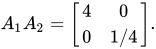
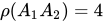
So, while . Thus, --79.139.218.53 (talk) 04:43, 15 May 2008 (UTC)


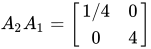
Ah but: so , don't commute, which is assumed in the main text. 78.105.183.186 (talk) 12:20, 7 October 2008 (UTC)


Mistake
if the spectral radius is the supremum of the absolute values of a matrix than the 1 st formula should be changed accordingly (write sup(...) instead of max(....)). regards مبتدئ (talk) 19:28, 31 August 2009 (UTC)
- Since it is a supremum over a finite set, the difference is meaningless.--84.161.219.86 (talk) 20:46, 5 January 2013 (UTC)
Mistake
In the beginning of the proof of Gelfand's formula, is not restating of the theorem's statement. For example, it could happen that or something else with subexponential growth instead of . Maybe we should delete from "In other words" to "proof"? Andrey Petrov (talk) 19:05, 20 August 2010 (UTC)



I agree with this. I'm getting rid of the statement, which is misleading. Bengski68 (talk) 23:16, 10 June 2015 (UTC)
Content Disclaimer
Informasi ini disarikan dari Wikipedia dan disajikan kembali untuk tujuan edukasi. Konten tersedia di bawah lisensi CC BY-SA 3.0. Kami tidak bertanggung jawab atas ketidakakuratan data yang bersumber dari kontribusi publik tersebut.
- The information displayed on this website is sourced in part or in whole from Wikipedia and has been adapted for the purpose of restating it. We strive to provide accurate and relevant information, however:
- There is no guarantee of absolute accuracy. Wikipedia is an open, collaborative project that can be edited by anyone, so information is subject to change.
- It is not intended to constitute professional advice. The content displayed is for informational and educational purposes only. For important decisions (e.g., medical, legal, or financial), please consult a professional.
- Content copyright. Wikipedia is licensed under the Creative Commons Attribution-ShareAlike License (CC BY-SA). This means that content may be reused with appropriate attribution and shared under a similar license.
- Responsible use. Any risk arising from the use of information from this website is entirely the responsibility of the user.