Talk:Slide rule

| This is the talk page for discussing improvements to the Slide rule article. This is not a forum for general discussion of the subject of the article. |
Article policies
|
| Find sources: Google (books · news · scholar · free images · WP refs) · FENS · JSTOR · TWL |
Archives: 1, 2Auto-archiving period: 12 months  |
 | Slide rule was nominated as a Engineering and technology good article, but it did not meet the good article criteria at the time (July 27, 2013). There are suggestions on the review page for improving the article. If you can improve it, please do; it may then be renominated. |
 | This  level-5 vital article is rated B-class on Wikipedia's content assessment scale. level-5 vital article is rated B-class on Wikipedia's content assessment scale.It is of interest to the following WikiProjects: | |||||||||||||||||||||||||||
| ||||||||||||||||||||||||||||


Popular Culture
♥ In Season 4 of The Avengers, John Steed uses a slide rule... But now I can't figure out which episode! I should have written it down. Damn.
♠ In Season 2 Episode 2 of The Wire, at 31m35s, a slide rule is used by the coroner's assistant to calculate how long 13 murdered girls were able to breathe in a closed shipping container.
Duplex
The entire section "Multiplication" has not one reference, and thus I must assume that it is forbidden "original research". I will post a reference as soon as the original document arrives on my doorstep in a few days. I was taught to use a slide rule in the eighth grade. I used it until my junior year in college, a total of seven years. I was surrounded by classmates, all with slide rules. I every slide rule I ever saw was duplex, as in the image I uploaded. Therefore all of the discussion of "going of scale" is deeply in error. I challenge someone to produce an actual non-duplex slide rule made before 1970. It must be a straight engineering slide rule, not a special purpose one. It must not contain the duplex A and B rules, but only contain the C and D rules. I do not think such a slide rule exists. Nick Beeson (talk) 17:46, 10 August 2022 (UTC)
- Thanks for your observation. The use of "duplex" in that section was incorrect and I have removed the term. As the article states elsewhere, duplex means the slide rule has scales on both sides. You are correct that the inclusion of the A/B scales was pretty much universal. I believe double scales go back to the earliest days. Single sided slide rules ("simplex") were common at the low end of the price range. See e.g. https://www.sphere.bc.ca/test/cheap.html The Multiplication section is somewhat misleading. Proper use of a slide rule to multiply e.g. 2 X 7 does not require using he A/B scales, only the C/D scales would normally be used and that should be explained. Using the A/B scales for this needlessly sacrifices accuracy. And yes, a reference would be helpful.--agr (talk) 19:15, 10 August 2022 (UTC)
- Slide rule scale has a bit to say about this. Thincat (talk) 19:32, 10 August 2022 (UTC)
- Entirely an aside, but I did want to note that in the early days of Wikipedia, there was little attention paid to adding sources and citations. In fact, the 'citation needed' template didn't exist before 2005 - and this article was started in 2001. So I think it's less a matter of 'original research' (even though yes, it is) and more a matter of inertia, so to speak...cheers! Anastrophe (talk) 22:17, 10 August 2022 (UTC)
Walter Shawlee
Walter Shawlee is described in a February 2024 obit in the NYT as being responsible for a resurgence of interest in slide rules. Maybe someone with access to the article (around 9 Feb.) can see if he is worth mentioning. 02:26, 10 February 2024 (UTC) Kdammers (talk) 02:26, 10 February 2024 (UTC)
Sub-optimal multiplication example
The 7x2 example is done in a suboptimal way that would have lead to a failing mark in my school in the 1960s. The two-decade scale should only be used when squares are involved. Using it for multiplication leaves you with a suboptimal result (half accuracy resolution vs single decade scale). The correct way to do the multiplication is to use the single decade scale as follows. On the single-decade scale you'll notice that setting top left number 1 on top of bottom number 2 would lead top number 7 to be out of range. So instead we'll set *right* number 1 on top of bottom number 2 and read the result 1.4 from where top number 7 now lands. Using right number 1 on top has a multiplier of 10, so the result is 1.4*10 is approximately 14.0 (any result you get on a slide rule is *always* an approximation; you always need to have a mental image on how many calculations you have in a cascade and how accurate your result is supposed to be). Using the single decade scale gives twice as accurate results as using the two-decade scale. 79.134.103.35 (talk) 11:04, 13 March 2025 (UTC)
- Oh, and the same goes for the 88x20 example, it has exactly the same mistake. This is *not* what the double-decade scale was meant for and it also goes against what was shown in the first example 2x3 where the correct single-decade scale was used. Whoever did these examples obviously did their own research but didn't do it properly. Looking at *any* slide rule instruction manual would have sufficed. A random example: https://www.sliderule.ca/k12-prep-p6-7.jpg says of multiplication: "To multiply two factors, set the index of the C scale (either the left or right end) so that it is directly above one of the factors on the D scale." Note the "left or right end" part, and that C and D scales are single decade scales. 79.134.103.35 (talk) 11:14, 13 March 2025 (UTC)
Maximum precision of typical slide rules?
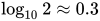
The article mentions that 20 inch slide rules have more precision but not how many digits that is. I found a book which mentions that ten inch Mannheim slide rules have three digits of precision with a fourth one approximated. Does the precision increase by one each time the length is doubled? And was 20 inch the most precise typically available? B9 (talk) 18:54, 27 March 2025 (UTC)
- Every time you double the length of the decade the spacing of everything is doubled, so you should get approximately double the precision (that is, more digits of precision), assuming your eyesight and manufacturing precision is the same. For example the Fuller calculator has a scale about 1000 inches long, which should be about 2 digits more precise than a 10-inch scale. –jacobolus (t) 22:04, 27 March 2025 (UTC)

untouched
The article talks about using a slide rule in some cases without moving the slide, but it doesn't explain how answers can be obtained this way. An explanation is called for -- especially in an article that seems to think it is necessary to tell us that 1.5 times 30 is 45. (I certainly never got any answers without moving the slide when I used slide rules.) Kdammers (talk) 05:49, 10 May 2026 (UTC)
- Do you mean this passage?
When performing a sequence of multiplications or divisions by the same number, the answer can often be determined by merely glancing at the slide rule without any manipulation.
- It's implying moving the slide one time to set a particular constant multiple, and then using that fixed position to repeatedly multiply numbers by that constant by comparing numbers at the same horizontal position on the two rules. –jacobolus (t) 06:04, 10 May 2026 (UTC)
Content Disclaimer
Informasi ini disarikan dari Wikipedia dan disajikan kembali untuk tujuan edukasi. Konten tersedia di bawah lisensi CC BY-SA 3.0. Kami tidak bertanggung jawab atas ketidakakuratan data yang bersumber dari kontribusi publik tersebut.
- The information displayed on this website is sourced in part or in whole from Wikipedia and has been adapted for the purpose of restating it. We strive to provide accurate and relevant information, however:
- There is no guarantee of absolute accuracy. Wikipedia is an open, collaborative project that can be edited by anyone, so information is subject to change.
- It is not intended to constitute professional advice. The content displayed is for informational and educational purposes only. For important decisions (e.g., medical, legal, or financial), please consult a professional.
- Content copyright. Wikipedia is licensed under the Creative Commons Attribution-ShareAlike License (CC BY-SA). This means that content may be reused with appropriate attribution and shared under a similar license.
- Responsible use. Any risk arising from the use of information from this website is entirely the responsibility of the user.