Talk:Sigma-additive set function
\mu(nullset) = 0 does not follow from finite additivity. It's an added condition to make \mu nontrivial. That is, if \mu(nullset) \ne 0, then \mu(E) = \infty f

 | This article is rated Start-class on Wikipedia's content assessment scale. It is of interest to the following WikiProjects: | ||||||||||
| |||||||||||

Error in the "Basic Properties" section
\mu(nullset) = 0 does not follow from finite additivity. It's an added condition to make \mu nontrivial. That is, if \mu(nullset) \ne 0, then \mu(E) = \infty for all sets E. — Preceding unsigned comment added by 74.192.26.106 (talk) 15:36, 19 February 2013 (UTC)
Merging into measure (mathematics)
Hmmm... I see you've intentionally and knowingly changed this from a redirect to Measure (mathematics) to an independent article, but I don't understand why, since that article also has as its major topic a definition and elementary properties of countable additivity. It's possible that the content here is easier to follow for the uninitiated, but having two definitions in different articles is just asking for them to be expanded in independent, overlapping and confusing ways.
In short, I move that this content be merged back into Measure (mathematics). And if not, the redirects at countable additivity and so forth should probably be changed. —Blotwell 03:08, 27 August 2005 (UTC)
- I created this article because I thought that the topic "sigma additivity" was deserving of its own article. Here are my reasons:
- When I follow a link of some term like "sigma additivity", because I want to know what it means, I would rather be sent to an article just about that term, which defines that term right at the top, instead of being directed to an article about a different topic and having to read down into the article, for the definition I'm seeking.
- The definition of the property in this article is more general than the one given in Measure (mathematics) (In fact it is not entirely clear to me that you could actually say that Measure (mathematics) actually defines a "sigma additive function", rather it defines a "countably additive measure".)
- This article has content which is not now in and does not necessarily belong in Measure (mathematics).
- This article has the possibility of expanding further beyond what would necessarily be appropriate for the article Measure (mathematics). For example it could have a section on the history of and motivation of the property. It could describe possible uses of the concept outside of Measure theory. It could explore generalizations or restrictions of the property. It could discuss the relationship between this property and other related properties like subadditivity.
- So for these reasons I would prefer to leave this article here. I have, for the time being, redirected countable additivity here. However I really am by no means an expert in this area and I would appreciate, the views of more knowledgeable editors. I will see if I can round some up ;-)
- Paul August ☎ 19:03, August 27, 2005 (UTC)
- I agree with Paul's reasoning. There is of course some overlap with measure (mathematics) but that's OK. I don't really like super articles containing a lot of stuff when you just want to look up a single thing. That is, I'd vote to keep this article separate. Oleg Alexandrov 22:35, 27 August 2005 (UTC)
- I would be fully convinced into agreeing with you both if I saw evidence that the notion of σ-additivity has application outside the definition of a measure specifically (or at least, outside trivial generalizations thereof). My concern is precisely that it has not and cannot have, basically because if you look at the axioms for a measure you'll see that σ-additivity is the only axiom, and hence "σ-additive function" and "measure" are actually the same concept. —Blotwell 04:03, 28 August 2005 (UTC)
- Well as defined in Sigma additivity μ can have negative values. Whereas in Measure (mathematics) μ is required to be non-negative, that was what I meant by my point 2 above. And what about the other reasons given above? Paul August ☎ 04:49, August 28, 2005 (UTC)
- Ah, yes, nonnegativity—I was afraid I was overlooking something. Very well, then I agree that there is a place for as many articles as currently exist and I withdraw my merge nomination. I'm still confused though: is this meant to be a page about σ-additivity (the axiom which may or may not be used in a context with other axioms) or about the class of σ-additive functions? Especially from your argument 4 (and the page title) I infer the former, but (assuming that σ-additive functions which aren't measures are ever notable) shouldn't we have a separate page for the latter? And Measure (mathematics) already does have a section on "Generalizations": your philosophy expressed in 4 seems to suggest it doesn't belong; I feel that it's fine (and should include a sentence linking to sigma-additive functions, since they're clearly a generalization of measures). As for history—I'm speculating, but my guess is that measures were invented first and other σ-additive functions a subsequent generalization, in which case my preference would be to put the history in the Measure (mathematics) page. Anyway, those are my thoughts, I don't want to contest this more, do whatever you think best. —Blotwell 04:33, 29 August 2005 (UTC)
- Well as defined in Sigma additivity μ can have negative values. Whereas in Measure (mathematics) μ is required to be non-negative, that was what I meant by my point 2 above. And what about the other reasons given above? Paul August ☎ 04:49, August 28, 2005 (UTC)
- I would be fully convinced into agreeing with you both if I saw evidence that the notion of σ-additivity has application outside the definition of a measure specifically (or at least, outside trivial generalizations thereof). My concern is precisely that it has not and cannot have, basically because if you look at the axioms for a measure you'll see that σ-additivity is the only axiom, and hence "σ-additive function" and "measure" are actually the same concept. —Blotwell 04:03, 28 August 2005 (UTC)
Agree with Oleg & Paul. However, one mistake was to not link sigma-additive in the the article measure (mathematics) once this article was written. That link is critical: it will encourage editors to expand/expound in this article, not the other. Twice, now, in two days, I've written expanded sections in one article only to discover shortly afterwards that what I wrote was already covered in another article, but that other article hadn't been wikilinked to the one I was editing! Its no loss, its just a shame. linas 03:50, 30 August 2005 (UTC)
- Yes of course, it should have been linked. Paul August ☎ 04:04, August 30, 2005 (UTC)
It can take −∞ as a value
So... again, why did you revert my edit? Why do you think it gives "nothing but headaches"? Please answer here. --Fibonacci 23:31, 9 December 2005 (UTC)
- It might be useful to explain that the measure is often taken to be non-negative, but that the rpinciples of sigma-additivity work just as well for an extended (negative) measure as well. Just so that those of us expecting a positive measure aren't surprised. linas 00:37, 10 December 2005 (UTC)
- Not only (nonnegative) measures are σ-additive. Measures have their own article. This one should discuss σ-additivity only.
- But the point of the question was that the article was written as if a σ-additive function could only take values in (−∞, +∞]; I changed it to the whole extended real line, and Oleg Alexandrov changed it back. I just wanted to ask him why. And... I was expecting Oleg to answer... --Fibonacci 01:00, 10 December 2005 (UTC)
- Fibonacci, you know very well that a measure can't take both +∞ and −∞ as values, as then you can't add up the two. You either explain this in the article, or you restrict yourself to an interval not containing both of those. Oleg Alexandrov (talk) 01:20, 10 December 2005 (UTC)
- And you know that the definition allows it (in principle) to take both values, but then it is proven that you cannot possibly have both. I'd go for the former option. --Fibonacci 01:52, 10 December 2005 (UTC)
- May I ask the purpose of the degree symbol appearing after the parenthetic describing your clarification? TricksterWolf (talk) 21:45, 26 January 2020 (UTC)
additive but not sigma-additive
The following is not additive, not when defined on the power set of the reals anyway.
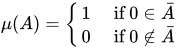
(-1,0) and (0,1) are disjoint, and their closures contain 0
u((-1,0))+u((0,1))=2
restricting the function to the power set of the positive reals won't work either...
(0,1) - rationals
and
(0,1) intersect rationals
both contain 0 in their closure.
defining the function as
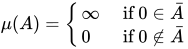
fixes the problem. An example not involving would be nice.

-- Yeah, I agree this example is so blatently flawed it should be removed.. I will put your edit in for now, and attempt to come up with a different example next time Im bored... --TM-77 18:15, 27 October 2006 (UTC)
- Ok added example, but its very late here, and it probaby contains some kind of error. It definitly needs to be written more clearly.. still, it works (I think). It basically tries to fix the original example given in such a way as to not allow for sets which aren't intervals around 0, and thus you can't have two disjoint measure 1 sets.
--TM-77 23:54, 27 October 2006 (UTC)
- Oops, my adjustment only works by only considering intervals as subsets of R. I has managed to make sure that you could only consider an interval in order to get a measure 1 set, however as it was defined on the powerset of R (i.e. all possible subsets of R), you can have a=(0,1)-rationals and b=(0,1)intersect rationals, and this is not additive.
- To fix this problem I had considered trying to define the function on only intervals of R, I can't actually remember if that is allowed in terms of /mu being a measure.. but then Is suppose this is only a general function... hmm could someone check that please...
- --TM-77 12:07, 28 October 2006 (UTC)
The (current) example of an additive function on the powerset of the reals that is not sigma additive is wrong. By the given formula, the measure of the irrationals is 1 and the measure of the rationals is 1, but the measure of their union is again 1. — Preceding unsigned comment added by 128.187.97.19 (talk) 14:43, 6 September 2013 (UTC)
More general definition?
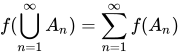
Could sigma-additivity be defined more generally:
X a set
A a set of subsets of X
f a function from A to the reals
for all A1, A2... disjoint sets contained in A
if then -unsigned

- Yeah, one could, but this defintion is not so interesting. You could as well deal with A being a sigma-algebra to start with. Oleg Alexandrov (talk) 03:40, 25 October 2006 (UTC)
There ought to at least be at least an explicit mention of Finite Additivity in this article
There ought to at least be at least an explicit mention of Finite Additivity in this article since Finite additive and Finitely additive redirect here. —Preceding unsigned comment added by 76.191.212.109 (talk) 22:27, 7 July 2008 (UTC)
I agree. As a novice, I want a quick definition. —Preceding unsigned comment added by 81.101.143.230 (talk) 01:04, 21 December 2008 (UTC)
Other definitions?
Kolmogorov's original defining axiom AIUI was that for any sequence A1, A2, ... of sets in such that and we have . Is that the same as sigma additivity? How is that proven? ciphergoth (talk) 20:04, 18 July 2009 (UTC)


A possible mistake
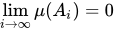
"..The union of these sets is the interval (0, 1) whose closure is [0, 1] and μ applied to the union is then infinity,..."
in my opinion, the word "infinity" in this sentence must be replaced with the word "one".
- You are correct. I've fixed this now. Paul August ☎ 09:25, 27 March 2013 (UTC)
- Actually the definition had been recently changed from

- to

- But that makes the function non-additive, see the section "additive but not sigma-additive" above. I've now fixed this (I hope). Paul August ☎ 09:50, 27 March 2013 (UTC)
Content Disclaimer
Informasi ini disarikan dari Wikipedia dan disajikan kembali untuk tujuan edukasi. Konten tersedia di bawah lisensi CC BY-SA 3.0. Kami tidak bertanggung jawab atas ketidakakuratan data yang bersumber dari kontribusi publik tersebut.
- The information displayed on this website is sourced in part or in whole from Wikipedia and has been adapted for the purpose of restating it. We strive to provide accurate and relevant information, however:
- There is no guarantee of absolute accuracy. Wikipedia is an open, collaborative project that can be edited by anyone, so information is subject to change.
- It is not intended to constitute professional advice. The content displayed is for informational and educational purposes only. For important decisions (e.g., medical, legal, or financial), please consult a professional.
- Content copyright. Wikipedia is licensed under the Creative Commons Attribution-ShareAlike License (CC BY-SA). This means that content may be reused with appropriate attribution and shared under a similar license.
- Responsible use. Any risk arising from the use of information from this website is entirely the responsibility of the user.