Talk:Schur complement
To-do list for Schur complement: edit · history · watch · refresh · Updated 2014-09-02

 | This article is rated Start-class on Wikipedia's content assessment scale. It is of interest to the following WikiProjects: | ||||||||||
| |||||||||||

|


Untitled
Should it be mentioned that Schur's complement is produced by Gauss-reducing the matrix M for all the pivots in D? That's what it is about isn't it, what linear regression does to the variance matrix - Martin Vermeer
"conditional variance" in the applications section
There, it is claimed that:
the conditional variance of X given Y is the Schur complement of C in V:

To me, is a function of the random variable ; hence a random variable itself. I don't' see any -dependence above, so to me, the implication is that this function is constant for all values of ; is this a consequence of the normality assumption? Btyner 22:18, 10 February 2006 (UTC)


- It's a consequence of joint normality. See multivariate normal distribution. Of course one can easily construct other -- non-normal examples in which the conditional variance does not depend on Y, but differs from the unconditional variance. But in a more general setting, the conditional variance given Y would depend on Y. Michael Hardy 01:19, 11 February 2006 (UTC)
- The definition used in the article is pretty standard. I can't see mention of any alternative in "The Schur Complement and Its Applications", although that goes into detail about the history and notation in Section 0.1. (I have taken the liberty of adding a heading to your comment. I hope you don't mind.) LachlanA (talk) 22:02, 19 January 2008 (UTC)
This article's definition implies both of the following: Let
![{\displaystyle M=\left[{\begin{matrix}A&B\\C&D\end{matrix}}\right]}](https://wikimedia.org/api/rest_v1/media/math/render/svg/06975df014f40e74936e5d74d528ec791a10d21e)
so that M is a (p+q)×(p+q) matrix.
Then the Schur complement of the block D of the matrix M is the p×p matrix
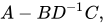
and the Schur complement of the block A of the matrix M is the q×q matrix
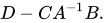
I'll dig out Strang's book on Tuesday and see what it says. Michael Hardy (talk) 23:42, 19 January 2008 (UTC)
- I checked Strang, and his example says
- and that the final block, is called the Schur complement. He doesn't specify what block it's the complement of. I assume from common usage that it is the complement of A though.
- Unknown (talk) 00:40, 23 November 2009 (UTC)
![{\displaystyle \left[{\begin{array}{r|r}I&0\\\hline -CA^{-1}&I\\\end{array}}\right]\left[{\begin{array}{r|r}A&B\\\hline C&D\\\end{array}}\right]=\left[{\begin{array}{r|r}A&B\\\hline 0&D-CA^{-1}B\\\end{array}}\right]}](https://wikimedia.org/api/rest_v1/media/math/render/svg/df12a77b152fad9fcec7660c5797a642a4f018e2)

another feature
It'd be nice to setup Ax=b, for a 2x2 matrix, and then use the schur complement to show what the values of x_1 and x_2 are -- 131.215.105.118 (talk) 18:48, 16 November 2007 (UTC)
Star-mesh transform
Star-mesh transform states:
- The equivalence follows from the Schur complement identity applied to the Kirchhoff matrix of the network.
My visit here didn't help me much, not having done any linear algebra for thirty years. — MaxEnt 13:51, 2 April 2014 (UTC)
Quotient notation
Does anyone have a reference for the quotient notation,

which entered into the article here? Is it standard? I have not seen this before and have been working with Schur complements for a long time. I'm not particularly for or against it, but it does seem non-standard. One potential point of confusion for readers is that it conflicts with the notation in Matlab/Octave, wherein means . 128.62.208.237 (talk) 19:18, 9 April 2019 (UTC)


- Hi! I modified the notation in order to be compatible with the notation used in "Haynsworth inertia additivity formula". To the best of my knowledge, this notation is not standard, but is used for instance in the book "The Schur Complement and Its Applications". What do you think of adding a footnote in the article pointing out that this notation is not the same of the notation used in MATLAB? - Saung Tadashi (talk) 22:19, 18 April 2019 (UTC)
Duplicate material within the article
The Section "Application to solving linear equations" and the second part of "Background" (introduced in https://en.wikipedia.org/w/index.php?title=Schur_complement&oldid=1009008699) seem to overlap significantly and repeat each other. I am not sure about the added value of the new material in the 2nd part of "Background", but I am not going to butcher it. However, I think the 2nd part of "Background" should be curtailed to several written sentences and refer extensively to "Application to solving linear equations" section, and all additional equations from the 2nd part of "Background" should be moved to "Application to solving linear equations" if appropriate. Any comments, @Hnsymjh:? AVM2019 (talk) 19:21, 26 June 2021 (UTC)
- The suggestion has been kindly implemented in this edit: https://en.wikipedia.org/w/index.php?title=Schur_complement&oldid=1030722463 AVM2019 (talk) 05:04, 28 June 2021 (UTC)
The conditions for definiteness section looks a bit "backwards" arguing
This section: https://en.wikipedia.org/wiki/Schur_complement#Conditions_for_positive_definiteness_and_semi-definiteness . One thing is that it works with Hermitean matrices too ... But on to the argument, it appleals to Haynsworth, but behind the scenes I think that would use a factorization that effectively puts the carriage before the horse?
Besides I think this direct approach - that is only mentioned later in the section - is straightforward and requires much less pre-knowledge from the reader:
- Start with the associated quadratic form of X, namely uTAu + 2vTBu + vTCv. By choosing either u or v as null, it follows that positive (semi-) definiteness implies that both A and C must necessarily be positive (semi-) definite.
- If A is known to be positive definite, then fixing v and min over u yields a nec./suff. FOC: u=-A-1Bv, insert to get -vTBTA-1Bv + vTCv and we have positive (semi-) definiteness iff C-BTA-1B is positive (semi-) definite (which is stronger than the (semi-) definiteness of C).
- Analogously follows that if C is known to be positive definite, ...
- Leaves us with a gap: if A and C are both singular pos.semidef., what is the set of additional conditions for X to be positive semidefinite? That is the latter part, which just refers to Zhang.
Also I think it should be not just "a generalized inverse", but "the Moore--Penrose pseudoinverse"? Could someone find the actual theorem number from Zhang? ~2026-34042-03 (talk) 10:20, 9 June 2026 (UTC)
Content Disclaimer
Informasi ini disarikan dari Wikipedia dan disajikan kembali untuk tujuan edukasi. Konten tersedia di bawah lisensi CC BY-SA 3.0. Kami tidak bertanggung jawab atas ketidakakuratan data yang bersumber dari kontribusi publik tersebut.
- The information displayed on this website is sourced in part or in whole from Wikipedia and has been adapted for the purpose of restating it. We strive to provide accurate and relevant information, however:
- There is no guarantee of absolute accuracy. Wikipedia is an open, collaborative project that can be edited by anyone, so information is subject to change.
- It is not intended to constitute professional advice. The content displayed is for informational and educational purposes only. For important decisions (e.g., medical, legal, or financial), please consult a professional.
- Content copyright. Wikipedia is licensed under the Creative Commons Attribution-ShareAlike License (CC BY-SA). This means that content may be reused with appropriate attribution and shared under a similar license.
- Responsible use. Any risk arising from the use of information from this website is entirely the responsibility of the user.