Talk:Ratio test
It says at the bottom of the section "The Test", one of the bullet points, if the ratio is larger than or equal to 1 for ALL n large enough, regardless of r. I

 | This article is rated Start-class on Wikipedia's content assessment scale. It is of interest to the following WikiProjects: | ||||||||||
| |||||||||||

Redundancy?
It says at the bottom of the section "The Test", one of the bullet points, if the ratio is larger than or equal to 1 for ALL n large enough, regardless of r. Isnt this just a reiteration of the condition that if r>1 we have divergence?
I dont see the mathematical difference between "for all n large enough" and the limit inferior.
Yes, the ratio includes the possibility of being 1 exactly, while the limit inferior excludes the 1. But really, what? Cant we just say that the limit inferior r can also be 1? We might need to add the stipulation that the limit superior is greater than 1 (therefore the limit doesnt exist).
I find the condition (the bullet point), as written, to be quite confusing and indeed equivalent.
24.16.199.186 (talk) 10:40, 11 February 2012 (UTC)
- The series may diverge or converge when r=1. See the subsection "Inconclusive because L=1" (note that as L=1, we necessarily have r=1 as well). The suffocated (talk) 12:42, 11 February 2012 (UTC)
radius of convergence
I removed anything about the radius of convergence because it wasn't clear. This test has a similar form when used for radius of convergence but aren't the same. Fresheneesz 01:58, 29 March 2006 (UTC)
I hate to ask but is there a test that is similar to the ratio test (you state) but without the Absolute values? I only ask because in my text this is called the "Ratio test for absolute convergence." I realize this is only convention, but should there be a mention of the "ratio test of regular convergence"? -Nightwindzero 14:46, 20 April 2007 (UTC)
- If a sequence or series is absolutely convergent, it is (in your case, "regularly") convergent. In other words, absolute convergence is, if you like, "stronger" than convergence. x42bn6 Talk 23:52, 20 April 2007 (UTC)
unclarity
The edits by user:Fresheneesz made the article very unclear. It said:
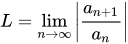
- In mathematics, the ratio test is a test (or "criterion") for the convergence of a series whose terms are real or complex numbers. The test was first published by Jean le Rond d'Alembert and is sometimes known as d'Alembert's ratio test. The ratio test is defined as:
- where
- lim denotes the limit as n goes to infinity,
- an and an+1 are the nth and (n+1)th terms of an infinite series
- and
- L is a label for the result of the ratio test.
- The results of the ratio test show that:
- if the series converges absolutely, or
- if the series diverges, or
- if the test is inconclusive (there exist both convergent and divergent series that satisfy this case).
- The results of the ratio test show that:


- For example, any series in the form:

- can be applied to the ratio test.
So it began by saying that the test is a particular number. That is nonsense.
It said "the results of the test show that" when it meant "the test states that".
It said "or" where it meant "and".
It said that a series can be applied to the test, where it meant the test can be applied to a series.
It said of a particular form, and offered this as an example, but the particular form was not a particular form, but completely general: ALL series are of that form. This does not constitute an "example". But the sentence began by saying "For example, ...".
It said "... where ... an and an+1 are the nth and (n+1)th terms of an infinite series". That infinite series was the topic of the whole account of what the test says; to relegate this to a "where..." clause that appears only AFTER the limit L is mentioned is objectionable on several levels, logical and pedagogical.
I mention all this here lest anyone consider reverting my edits.
I was led to this by a comment at talk:radius of convergence under the heading "odd wording". That led me to edit root test and then to edit the present article. Michael Hardy 22:14, 31 October 2006 (UTC)
Weaker conditions?
Isn't this ratio test's condition slightly too strong? I learnt the following as the "ratio test":
If there exists a number M < 1 such that for all sufficiently large n, then converges absolutely.


So if that ratio keeps oscillating between, say, 0.1 and 0.9, I should still be able to say the series converge absolutely, even though the limit of that ratio won't exist.
Similar thing if there's some number M > 1 so that the ratio is not less than M for all sufficiently large n... -- 203.171.200.81 (talk) 13:52, 17 November 2007 (UTC)
- Don't they, semantically, mean the same thing? "For sufficently large n" seems semantically equivalent to limits. x42bn6 Talk Mess 17:17, 17 November 2007 (UTC)
- If the limit exists they mean the same thing, but the test can still be used in some cases where the limit doesn't exist. I updated the definition to the slightly stronger version. LamilLerran (talk) 09:37, 11 October 2008 (UTC)
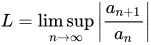
L>1
The ratio test states that:
- if L > 1 then the series diverges.
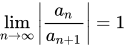
Above one reads
and
Which definition of L is meant? --NeoUrfahraner (talk) 11:27, 18 November 2008 (UTC)
limit-free version
The article as it is is nicely written, so 'm hesitant to change anything. However, the version of the criterium without limits (with M as above or q) is also quite common and should be mentioned in a prominent place. One natural place would be after the limsup-liminf generalizations. However, this would make this section very lengthy. The proof in the article is essentially a transformation of the limit version to the limitless version with q=(1+L)/2 and then proving the latter.--LutzL (talk) 10:46, 12 November 2013 (UTC)
Centralized discussion on proofs
See WT:MATH#Proofs, revisited — Arthur Rubin (talk) 17:58, 29 September 2015 (UTC)
Wrong?
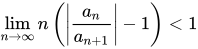
In this edit, GreenKeeper17 converted a bunch of statements from signed versions to positive versions, calling them "incorrect". There's definitely a citation issue with those statements (MathWorld, the current source, lists the positive versions; but also why are we citing MathWorld for this kind of thing, surely there is a decent textbook source somewhere), but are they actually incorrect in the signed versions? I am skeptical. At least, the two minutes I spent thinking about the signed version of Raabe's theorem convinced me it should be ok. --JBL (talk) 21:04, 20 April 2018 (UTC)
- Joel, the previous version claimed that if and , then diverges. This is false, take for example (this example is given at https://www.encyclopediaofmath.org/index.php/Raabe_criterion, feel free to change the source if you want). On second though, the condition shouldn't be there (although it holds in all the interesting cases), so I removed it (I also added clarification that R can be infinite). GreenKeeper17 (talk) 18:13, 23 April 2018 (UTC)
- Aha, yes, I stopped reading carefully before I got to that part and only checked the absolute convergence part of the claim. Thanks. (By the way, it is completely unnecessary to add "\displaystyle" in LaTeX on wiki, it is the default: vs. .) --JBL (talk) 22:32, 23 April 2018 (UTC)



Lede
The lede says:
In mathematics, the ratio test is a test (or "criterion") for the convergence of a series
where each term is a real or complex number and an is nonzero when n is large. The test was first published by Jean le Rond d'Alembert and is sometimes known as d'Alembert's ratio test or as the Cauchy ratio test.[1]

However, if I am remembering correctly, a series can only converge when an is zero when n is large. I don't want to edit the page without consensus since I don't usually edit mathematics-related pages. African Mud Turtle (talk) 01:40, 30 May 2026 (UTC)
- If there are zero entries for arbitrarily large indices, then the ratio will be undefined if you try to put them in the denominator, so the limit will not be defined and you can't use the ratio test as defined here. –jacobolus (t) 05:10, 30 May 2026 (UTC)
a series can only converge when an is zero when n is large
is false; for example, the geometric series 1/2 + 1/4 + 1/8 + 1/16 + … converges. ~2026-28259-76 (talk) 09:32, 30 May 2026 (UTC)- @~2026-28259-76 "can only A when B" is to be interpreted as B ⇒ A here; not A ⇒ B. Malparti (talk) 10:58, 30 May 2026 (UTC)
- @Malparti: hmm, do you think? Perhaps African Mud Turtle will clarify their question and whether the comments so far have resolved it. ~2026-28259-76 (talk) 11:37, 30 May 2026 (UTC)
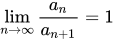
- I misinterpreted the section as saying that the ratio test is used when . African Mud Turtle (talk) 12:36, 30 May 2026 (UTC)
- Ah, I see. Yes, right, it’s about whether the individual terms are nonzero, not about the limit value of the sequence of terms. ~2026-28259-76 (talk) 12:43, 30 May 2026 (UTC)
- So you were indeed correct that "can only converge when [...]" was to be interpreted as "can converge only when [...]". I missed the possibility that " is zero when is large" could be confused with and got slightly annoyed because I thought you were turning a legitimate question into a trivial one. My bad. Malparti (talk) 11:55, 31 May 2026 (UTC)
- Oh, no worries! ~2026-28259-76 (talk) 14:34, 1 June 2026 (UTC)
- So you were indeed correct that "can only converge when [...]" was to be interpreted as "can converge only when [...]". I missed the possibility that " is zero when is large" could be confused with and got slightly annoyed because I thought you were turning a legitimate question into a trivial one. My bad. Malparti (talk) 11:55, 31 May 2026 (UTC)
- Ah, I see. Yes, right, it’s about whether the individual terms are nonzero, not about the limit value of the sequence of terms. ~2026-28259-76 (talk) 12:43, 30 May 2026 (UTC)
- Would it be best to mention that (i.e. saying that an approaches 0 as n is large)? African Mud Turtle (talk) 17:26, 30 May 2026 (UTC)
- The ratio test still applies when the limit isn't zero, it just always gives either an inconclusive result of 1 or a result of non-convergence. Sesquilinear (talk) 19:35, 30 May 2026 (UTC)
- I misinterpreted the section as saying that the ratio test is used when . African Mud Turtle (talk) 12:36, 30 May 2026 (UTC)
- @Malparti: hmm, do you think? Perhaps African Mud Turtle will clarify their question and whether the comments so far have resolved it. ~2026-28259-76 (talk) 11:37, 30 May 2026 (UTC)
- @~2026-28259-76 "can only A when B" is to be interpreted as B ⇒ A here; not A ⇒ B. Malparti (talk) 10:58, 30 May 2026 (UTC)


Content Disclaimer
Informasi ini disarikan dari Wikipedia dan disajikan kembali untuk tujuan edukasi. Konten tersedia di bawah lisensi CC BY-SA 3.0. Kami tidak bertanggung jawab atas ketidakakuratan data yang bersumber dari kontribusi publik tersebut.
- The information displayed on this website is sourced in part or in whole from Wikipedia and has been adapted for the purpose of restating it. We strive to provide accurate and relevant information, however:
- There is no guarantee of absolute accuracy. Wikipedia is an open, collaborative project that can be edited by anyone, so information is subject to change.
- It is not intended to constitute professional advice. The content displayed is for informational and educational purposes only. For important decisions (e.g., medical, legal, or financial), please consult a professional.
- Content copyright. Wikipedia is licensed under the Creative Commons Attribution-ShareAlike License (CC BY-SA). This means that content may be reused with appropriate attribution and shared under a similar license.
- Responsible use. Any risk arising from the use of information from this website is entirely the responsibility of the user.