Talk:Quadratic integer
Dear User:TakuyaMurata,

 | This article is rated Start-class on Wikipedia's content assessment scale. It is of interest to the following WikiProjects: | ||||||||||
| |||||||||||

In mathematics, quadratic integers are the integer solutions of the equations of the form:
Dear User:TakuyaMurata,
integer or integral, that is the question.
I believe that it should be integer: as the solutions should be integer numbers.
Integral is an adjective and means (among other things)"necessary to complete something, something that cannot be left out". But I do not believe that it is an adjective describing integers.
TomyDuby (talk) 12:33, 18 April 2009 (UTC)
- Assuming you're a native English speaker, maybe I shouldn't argue more. But I still think "integral solution" (by this we mean solutions are integers) is correct as "integral" means something related to integers. In fact, I found some uses of this: [1] [2] [3] . This makes sense, since one rarely says "integer equation" as opposed to "integral equation". The context usually makes it clear that one doesn't mean an equation involving integrals. But if you insist, I'm not going to oppose the change. It's a minor issue, after all. -- Taku (talk) 23:28, 18 April 2009 (UTC)
- Dear Taku,
- Thanks for your comments. It seems to me that you are right: the quotations and even Wiktionary under http://en.wiktionary.org/wiki/integral says that as an adjective in "(mathematics) Of or relating to an integer."
- Great discussion!!!
- TomyDuby (talk) 00:16, 22 April 2009 (UTC)
Chapter 3, Class number not defined.
This term, though used in this section, has never been defined.
TomyDuby (talk) 03:31, 19 April 2009 (UTC)
- Class number is the order of the ideal class group. This definition of course begs the question: what is ideal class group? The point I'm trying to get is that somehow you first need to know Dedekind domain to understand this kind of stuff. I don't know how much (commutative) ring theory should be covered here. -- Taku (talk) 21:49, 21 April 2009 (UTC)
- I think that I resolved this issue by adding a link to class number where this term is defined. This stuff is way above my current knowledge. Again, thanks for your contribution.
- TomyDuby (talk) 00:27, 22 April 2009 (UTC)
ring of integers in Q[\sqrt{-19}]
the ring of integers in Q[\sqrt{-19}] is incorrectly identified as Z[\sqrt{-19}], but -19 is congruent to 1 mod 4. —Preceding unsigned comment added by 165.91.100.161 (talk) 16:10, 4 November 2009 (UTC)
The "[as of?]" in the last section
I think in the last sentence, by after a hundred years the original author meant a hundred years since the idea about the whole class group thing begins, but I found no reference. Could someone point me some good books on this topic? Tony Beta Lambda (talk) 03:39, 16 June 2013 (UTC)
Problems with the definition
The Definition section currently reads
- Quadratic integers are solutions of equations of the form:
- x2 + Bx + C = 0
- for integers B and C.
The next sentence refers to a quantity D and then in parentheses states that D is a square-free integer. There's no definition of D, although it is clear that it is supposed to be the discriminant, in this. However, even granted that, there is no requirement for D to be square free. For example, √5 satisfies the equation with B=0, C=−5 and D=20 is not square-free. Even worse, we probably want to include rational integers in the class too, for which we might have D=0. Deltahedron (talk) 18:09, 19 April 2014 (UTC)
- I would suggest the following.
- Quadratic integers are solutions of equations of the form:
- x2 + Bx + C = 0
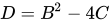
- for integers B and C. The discriminant and a quadratic integer is termed real if D>0 and imaginary if D<0. We call integers "compatible" if the discriminants differ by a square factor.
- Quadratic integers are solutions of equations of the form:
- The set of all quadratic integers is not closed even under addition. But the set of quadratic integers with compatible D forms a ring, and it is these quadratic integer rings which are usually studied. Medieval Indian mathematicians had already discovered a multiplication of quadratic integers of D, which allows one to solve some cases of Pell's equation.
- I invented the term "compatible" ad hoc. Is there a reliable source to quote for this approach, and for the historical remarks? Deltahedron (talk) 18:22, 19 April 2014 (UTC)
PID & D>0 => euclidean; examples for euclidean, but not norm-euclidean quadratic integer fields
Please add someone the references: https://www.researchgate.net/publication/268442914_On_Euclidean_rings_of_algebraic_integers, http://www.mast.queensu.ca/~murty/harper-murty.pdf and http://www.math.clemson.edu/~jimlb/CourseNotes/AbstractAlgebra/EuclideanNotNormEuclidean.pdf I don't know the standard way to do this here. 132.230.30.102 (talk) 14:52, 2 May 2016 (UTC)
- Thanks for providing these references. The two first links that you have provided are not really useful for the article, but I have copied from the second one the references to Weinberger and Harper. For Clark, I have copied the reference from the first page of the article, and added the link. You could have done this yourself. D.Lazard (talk) 15:48, 2 May 2016 (UTC)
Discriminant of x2 − D
@D.Lazard: the discriminant of x2 − D = 0 is 4D as we have B := 0, C := −D – note two sign reversals in −4 × −D. The discriminant is not (and may not be) −4D – −4 is not a square number! I wouldn’t consider [4] a benign copyedit ☺ Incnis Mrsi (talk) 14:11, 4 September 2019 (UTC)
New section "Determining the ring of integers"
This new section is confusing on several aspects.
Firstly, it is not said that the section is devoted to the proof of the result stated in the last-but-one paragraph of the preceding section. A reader must already well know the subject for understandinf that witout reading the new section in details. It could be worth to prove this result, but what is to be proved must clear.
Secondly, an encylopedic article is not a course nor a textbook. This implies that one must say what one is going to prove before each proof. That is because, the readers my have very different levels, and a reader must know whether it may be useful for him to read any part of the text. For the same reason, the heading of the section is not convenient.
As the new section and the preceding one are strongly related, the notation must be coherent between the sections. In particular D must be either uppercase of lower case in both sections. Probably the preceding setion must be edited for avoiding upper case variables (except, maybe, for D, for which upper case is rather common).
The use of "basis", congruence notation, and other technical words must be avoided or explained.
The three subsections are more confusing than useful, as, after getting the equation one could say simply: "A square is congruent modulo 4 either to 0 or to 1. So this equation implies that either m and n are both even, or they are both odd and " This suffices to get the conclusion immediately. This conclusion must be clearly stated, which is not the case the case with the proposed version. D.Lazard (talk) 17:36, 12 May 2020 (UTC)


Todo
Ah, this is helpful. Let me create a small todo list, which you can add anything to, so I can get this material on the page.
- Add explanation of section
- State result
- State proof
- Fix notation within the section (meaning both the previous part and the proof)
- Add explanation of basis and congruence notation, also add references
- Clearly state the conclusions in each d=4k+l section
Wundzer (talk) 18:02, 12 May 2020 (UTC)
- I have edited the article by moving the result in its own section. This makes easy to add the proof without problems of coherencies. If you are doing so, please separate in different edits possible improvements of the existing text and addition of a new text. This would allow improving your edits without reverting them in the whole. D.Lazard (talk) 10:35, 13 May 2020 (UTC)
Response about partitioning
I'm not sure having such brevity in your last statement is the clearest way to go about the rest of the proof. I do agree it's simpler, but I'm not sure this makes it more accessible for the reader. If I make the concluding statements more clear, then can these three parts of the proof remain? If not, do you have any other suggestions? Wundzer (talk) 18:02, 12 May 2020 (UTC)
- Clearly, I have written the statement as a sketch. For implementing in the article, this must be expanded for solving explicitly the modular equation. In any case, this would be confusing to consider three cases, as most authors consider only two cases (D – 1 multiple of 4 or not) D.Lazard (talk) 10:27, 13 May 2020 (UTC)
Usual integers
I stumbled over the phrase "with b and c (usual) integers." To make it more clear, I inserted "usual" in "generalizations of the integers" in the first sentence of the lead. I would prefer something like "ordinary" instead of "usual". Thoughts? -- Elphion (talk) 21:04, 1 June 2021 (UTC)
Norm as Euclidian function
In order to use the norm as a Euclidian function, its values must be non-negative. When D is positive, the field-theoretic norm will not have this property, and it is necessary to take its absolute value. In the case that D is positive, in the literature people talk about being Euclidian with respect to the norm, but they really mean with respect to the absolute value of the norm. I found this confusing when I was reading. I have changed the definition of N to make clear that you must take the absolute value. I am not totally happy with this because means that N is no longer the actual field-theoretic norm. I am happy if someone has a clearer way to express this; what we were doing (pretending that you could really use the field theory norm for positive D) is, in my opinion, a worse option. CTourneur (talk) 06:31, 21 March 2022 (UTC)
Content Disclaimer
Informasi ini disarikan dari Wikipedia dan disajikan kembali untuk tujuan edukasi. Konten tersedia di bawah lisensi CC BY-SA 3.0. Kami tidak bertanggung jawab atas ketidakakuratan data yang bersumber dari kontribusi publik tersebut.
- The information displayed on this website is sourced in part or in whole from Wikipedia and has been adapted for the purpose of restating it. We strive to provide accurate and relevant information, however:
- There is no guarantee of absolute accuracy. Wikipedia is an open, collaborative project that can be edited by anyone, so information is subject to change.
- It is not intended to constitute professional advice. The content displayed is for informational and educational purposes only. For important decisions (e.g., medical, legal, or financial), please consult a professional.
- Content copyright. Wikipedia is licensed under the Creative Commons Attribution-ShareAlike License (CC BY-SA). This means that content may be reused with appropriate attribution and shared under a similar license.
- Responsible use. Any risk arising from the use of information from this website is entirely the responsibility of the user.