Talk:Pulse compression
Doesn't pulse compression improve the signal to clutter ratio and not the signal to noise ratio as stated on the first line? Greenshed 21:20, 18 May 2007 (UTC)R

 | This article has not yet been rated on Wikipedia's content assessment scale. It is of interest to the following WikiProjects: | |||||||
| ||||||||

Signal to noise or signal to clutter
Doesn't pulse compression improve the signal to clutter ratio and not the signal to noise ratio as stated on the first line? Greenshed 21:20, 18 May 2007 (UTC)
I believe there's some confusion here. Pulse compression does indeed improve the signal to noise ratio, as explained below in the main article. This is because pulse compression is only a particular application of the matched filtering theory. A matched filter is optimal (in the least squares sense) for enhancing the signal to noise ratio, when detecting a signal which shape is precisely known, and that is corrupted by additive stochastic noise. In the case of radar or sonar, this can be, for instance, thermal noise (one of the origins of the "static" hiss you hear when de-tuning a radio station, for instance). Clutter, on the other hand, is a word used in radar or sonar imaging to describe "unwanted" signal that is really the image of the environment surrounding the target. This can be clouds, the atmosphere for airspace surveillance radars, the ocean for marine surveillance radar, etc. For many reasons, clutter can generally be only described statistically; first because the environment is not known "exactly" because it is too complex, second because of specific phenomena occuring in radar or sonar imaging: speckle. But, the statistical properties of clutter are rarely those of an additive process (it is more often multiplicative). The increase of resolution brought by pulse compression may however help to better see the target in the clutter. Flambe 21:09, 3 July 2007 (UTC)
Textbook theory [1] gives that the SNR generated by matched filtering of a phase- or frequency-modulated pulse received in white noise is SNR = A2T/N0, where A is the pulse magnitude, T is the pulse duration, and N0 is the noise spectral density. The result is independent of the modulation applied, and depends only on the pulse magnitude, duration, and noise spectral density. Pulse compression does not increase SNR over unmodulated pulses with equal duration and magnitude, as long as the matched filter is applied in each case. However pulse compression does allow the pulse duration to be increased without a loss of range resolution, since range resolution is inversely proportional to pulse bandwidth; that is, by increasing the pulse bandwidth via phase or frequency modulation, a pulse of longer duration can generate the same range resolution as that of a shorter unmodulated pulse. Hence for a fixed range resolution, pulse compression may be used to increase the pulse duration, T, and hence detection SNR over that of shorter duration pulses. Pulse compression is particularly advantageous in allowing the use of longer, lower power pulses instead of shorter high power pulses since it reduces the instantaneous transmitter power requirements while allowing the achieved detection SNR and range resolution to be maintained. Yaman32 (talk) 17:33, 3 September 2021 (UTC)
References
- ^ McDonough, Robert N. (1995). Detection of Signals in Noise (2nd ed.). San Diego, California: Academic Press. ISBN 0-12-744852-7.
Chirping - Basic principles
In the formula, when t = T then the frequency equals f_0. Shouldn't it equal f_0 + Delta-f? —Preceding unsigned comment added by 201.150.79.138 (talk) 04:40, 28 January 2008 (UTC)
Answer: The chirped signal is:

The phase of the chirped signal (that is, the argument of the complex exponential), is:

The instantaneous frequency is:
![{\displaystyle f(t)={\frac {1}{2\pi }}\left[{\frac {d\phi }{dt}}\right]_{t}=f_{0}-{\frac {\Delta f}{2}}+{\frac {\Delta f}{T}}t}](https://wikimedia.org/api/rest_v1/media/math/render/svg/7e18de051c6912fa2332f597c9ae65c306a71614)
Thus we readily see that and , which is what was intended in the formula given in the wiki page. Flambe (talk) 19:54, 31 January 2008 (UTC)
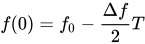
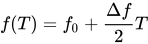
- True, but over the years several more editors have tried to "fix" it, since it wasn't written in an order that made it clear. So I rearranged it today. Dicklyon (talk) 20:48, 25 June 2012 (UTC)
Signal description
"The simplest signal a pulse radar..."
How does the article define "simple?" Is the "simplest" finite-duration signal a sinusoid multiplied by a square window? Or, is it something smoother with fewer harmonics? The complexity (or lack thereof, simplicity) could be measured by the information content, by one method or another, e.g. time-bandwidth. —Preceding unsigned comment added by 24.126.222.79 (talk) 01:49, 22 December 2010 (UTC)
Less-mathematical explanation
It would be nice to have a section, preferably at the beginning of the article, that discusses the principle in a less-mathematical, more real-world, practical manner. Jim, K7JEB (talk) 16:43, 18 January 2011 (UTC)
Graphs: Filter response time offset?
In the example "Before matched filtering" the response times are
According to the formula for the cross-relation should have its maximum (echo) for .


But in the graph "After matched filtering" the echo-times are .

What's the reason for the offset of ? — Preceding unsigned comment added by 86.33.223.67 (talk) 09:55, 15 July 2011 (UTC)

- The correlation peak is located where the reference signal and the received signal "overlap most"; this is not at the beginning of the signal but at its middle (this is "said with the hands" -- it's not a precise mathematical description but it works well for both the truncated sine wave and the chirp signal). In the examples provided in the main page the signal begins to be received at but since it lasts for one unit, the correlation peaks are only reached at . To position the correlation peak at the beginning of the signal, for this example, you'd need to artificially delay the reference signal of 0.5 units OR delay the result of the correlation by 0.5 units. Actually someone did a better job than me at explaining this using an animation with a square pulse (taken from Convolution article):


- You may wonder why the animation is taken from the convolution article, but the idea behind both convolution and correlation is the exactly the same (when doing a correlation, you just don't reflect one of the signals as is the case for convolution), and in the specific case shown in the animation, the correlation and the convolution are strictly identical. See that the "received signal" in blue is beginning at t=-0.5, yet the peak of the correlation is only reached at 0. Hope this helps.
- Flambe (talk) 22:42, 21 August 2011 (UTC)
Example of compressed pulse not merging whereas the simple pulse does?
In the simple pulse section, there is an example of the merging of pulse returns. I have read that one advantage of pulse compression is resolution. Does this mean that if a graph of the situation where the simple pulses merged were drawn for the compressed pulse case, that the correlation pulses would not be merged? If so, why not draw that graph and make the point that higher resolution results from the compression technique in contrast to the simple technique? Sorry if I am way off. I'm just trying to learn about radar signal processing. — Preceding unsigned comment added by 208.209.191.166 (talk) 15:13, 6 March 2012 (UTC)
- Yes indeed, the correlation pulses would not be merged (if separated more than the resolution after pulse compression). Doing such a graph is a nice idea. Actually re-doing the graphs in SVG would be an even better idea. I'm keeping that for future edits, if no one did it before me. Flambe (talk) 23:35, 27 November 2012 (UTC)
Content Disclaimer
Informasi ini disarikan dari Wikipedia dan disajikan kembali untuk tujuan edukasi. Konten tersedia di bawah lisensi CC BY-SA 3.0. Kami tidak bertanggung jawab atas ketidakakuratan data yang bersumber dari kontribusi publik tersebut.
- The information displayed on this website is sourced in part or in whole from Wikipedia and has been adapted for the purpose of restating it. We strive to provide accurate and relevant information, however:
- There is no guarantee of absolute accuracy. Wikipedia is an open, collaborative project that can be edited by anyone, so information is subject to change.
- It is not intended to constitute professional advice. The content displayed is for informational and educational purposes only. For important decisions (e.g., medical, legal, or financial), please consult a professional.
- Content copyright. Wikipedia is licensed under the Creative Commons Attribution-ShareAlike License (CC BY-SA). This means that content may be reused with appropriate attribution and shared under a similar license.
- Responsible use. Any risk arising from the use of information from this website is entirely the responsibility of the user.