Talk:Polynomial long division
My algebra is a bit rusty, but isn't this long division as well? I thought synthetic division involved separating out the coefficients and dividing by the addit

 | This article is rated C-class on Wikipedia's content assessment scale. It is of interest to the following WikiProjects: | ||||||||||
| |||||||||||

My algebra is a bit rusty, but isn't this long division as well? I thought synthetic division involved separating out the coefficients and dividing by the additive inverse of the constant added to the divisor. Or something like that. Bloodshedder
This isn't synthetic division. This is still Polynomial long division. I'm quite sure that synthetic division only involves the coefficients of the divisor and dividend and it only involves adding and multiplying steps.
E.g. solving
- () / (x - 1)

using synthetic division
 1  -4   6  -4  1
     1  -3   3  1
 1  -3   3  -1  0
we get the quotient:

--seav 21:42, Sep 8, 2003 (UTC)
Doh... stupid me... I'll move it then... sorry... I got them mixed up - Evil saltine 04:25, 9 Sep 2003 (EDT)
could we be more clear about how the numbers switch from (in above example):
 |1  -4   6  -4  1
 |    1  -3   3  1
 |1  -3   3  -1  0
to
??? I hate to be picky, but any help here would be hot, specifically, how do the variables and exponent thingys come in all of a sudden? hope i wasn't too vague. sorry i don't know what I'm talking about.
---QuiGonJinn
- I added a little, hopefully it makes sense. Evil saltine 06:56, 19 Dec 2003 (UTC)
I think it might be worth either including or linking to a proof of synthetic division.
Is there anywhere one can find an explanation concerning why this works, and not just how?
- I've added a gigantic section on the reasoning and development behind synthetic division. It's written in a way that is hopefully accessible to many people. Please feel free to make changes and improve on my ideas! HappyCamper 05:13, 26 Mar 2005 (UTC)
- I'd say move most of the examples to another page or maybe another project, like Wikibooks; keep only the ones fundamental to understanding the process in this article and link to the others elsewhere. - dcljr (talk) 22:47, 4 September 2005 (UTC)
Generalizing to other rings
Does anyone know how easily this algorithm generalizes to other rings? I know that it will generalize to polynomials over the integers mod p, where p is prime, because the polynomials over a field form a Euclidean domain. But what about something like polynomials over the integers mod n, where n isn't prime? Are any other generalizations possible?
Jguthrie 19:12, 17 October 2005 (UTC)
- I think the big problem is because in rings which are not fields very weird things can happen with polynomial coefficients, that is elements in the ring. Given two nonzero numbers in the ring, you can't always divide one by another. Worse, you can have two nonzero elements whose product is zero. That is to say, you run into trouble already when trying to divide constant polynomials, not to talk about polynomials actually contining X. So, I doubt polynomial long division generalizes in any way to arbitrary rings. Oleg Alexandrov (talk) 08:27, 18 October 2005 (UTC)
- You've put your finger on the right issue: a ring is called a Euclidean domain if and only if there's a (generalized) division algorithm in that ring. Buchberger's Algorithm is a pretty interesting generalization in a different direction! Jaswenso 01:27, 3 September 2007 (UTC)
- According to an algebra book I have (not publicly available), for any unitary ring R, for g and f in R[X], then, if the leading coefficient of g is a unit, then there exist unique q and r in R[X] such that f = qg + r with r = 0 or deg(r) < deg(g). Arthena(talk) 09:25, 29 October 2007 (UTC)
Length
This article is absurdly long. Is there any chance someone could cut it down a little (I am not mathematical enough to say what is worth keeping and what is not. Batmanand 11:32, 21 October 2005 (UTC)
Condition on degrees of f(x) and g(x)
I think the condition "where the degree of f(x) is greater than or equal to the degree of g(x)" is not needed. if Deg(f(x))<Deg(g(x)) then the quotient is 0, and the remainder is f(x). Trivial, but still - the condition is not needed.
- I agree, and since this has been up here for a while and it hasn't been challenged, I'll make the change. Arthena(talk) 09:10, 29 October 2007 (UTC)
- It seems that your changes got lost, I'll apply them again --Larsborn (talk) 11:41, 21 May 2012 (UTC)
Synthetic division link...
Should 'synthetic division' link here instead of where it links at the moment? 203.51.209.192 09:24, 12 June 2007 (UTC)
formula
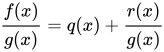
Doesn't the current formula only works for ? A more general formula is . Arthena(talk) 09:10, 29 October 2007 (UTC)


Help on synthetic division
How do you do a synthetic problem that has a number in front of your dividing variable. Such as 6f^2-11f-13/3f-4.
thanks 22:19, 22 February 2008 (UTC)
- Ok I know that Synthetic division works with problems like a2+10a+9/a+1 becasue you get the answer a+9
_____a+9_________
 a+1/a2+10a+9
     a2+ 1a
     ________________
         9a+9
       - 9a+9
       _______
0- But can you do the synthetic division for a problem with a number like(4x2+n) with n as an real number? —Preceding unsigned comment added by 24.153.239.7 (talk) 17:45, 23 February 2008 (UTC)
Yes, you just use synthetic division normally but when you get a number that will be included in the quotient, you divide it by the coefficient of the leading variable. —Preceding unsigned comment added by 173.70.81.145 (talk) 18:56, 10 January 2009 (UTC)
The quotients and remainders
Whoever wrote this article: the quotients and remainders are mixed up. Also, check the results... why would poly1/poly2 = remainder + quotient/poly2??? It's remainder + quotient * poly2! —Preceding unsigned comment added by Wj32 (talk • contribs) 05:09, 8 March 2008 (UTC)
A proof is needed
I think a proof should be sketched about the existence and uniqueness of quotient and reminder.--Pokipsy76 (talk) 08:21, 11 May 2009 (UTC)
Source for Pseudo-code
Was there a source for this pseudo-code? Does anyone know where it came from, or did a contributor just work it out themselves? A citation to a reference book would be helpful. — Preceding unsigned comment added by 72.219.240.34 (talk) 12:42, 23 January 2013 (UTC)
Need for real code
Can we add real C++ or JavaScript code instead of just using pseudo-code? People understand the same mechanism with real code for the polynomial long division algorithm, compared to the non-standard pseudo-code (which only a few does understand). Owenloveclaire (talk) 11:48, 26 November 2016 (UTC)
- I have modified the pseudo-code for avoiding multiple assignment, which is not standard. Otherwise, the only non-standard part of this pseudo-code is the use of ← instead of := for assignment (both are widely used). On the other hand, many programmers use other languages than C++ or JavaScript. Thus pseudo-code is the only way for making the algorithm understandable to everybody. Moreover, using real code would imply to define the data type polynomial (this could be done, among many possibility, with linked lists, tables or hash tables), and to provide code for addition of polynomials, multiplication by a term and extracting leading terms. This implies that the code would be less general and more confusing. D.Lazard (talk) 12:42, 26 November 2016 (UTC)
Content Disclaimer
Informasi ini disarikan dari Wikipedia dan disajikan kembali untuk tujuan edukasi. Konten tersedia di bawah lisensi CC BY-SA 3.0. Kami tidak bertanggung jawab atas ketidakakuratan data yang bersumber dari kontribusi publik tersebut.
- The information displayed on this website is sourced in part or in whole from Wikipedia and has been adapted for the purpose of restating it. We strive to provide accurate and relevant information, however:
- There is no guarantee of absolute accuracy. Wikipedia is an open, collaborative project that can be edited by anyone, so information is subject to change.
- It is not intended to constitute professional advice. The content displayed is for informational and educational purposes only. For important decisions (e.g., medical, legal, or financial), please consult a professional.
- Content copyright. Wikipedia is licensed under the Creative Commons Attribution-ShareAlike License (CC BY-SA). This means that content may be reused with appropriate attribution and shared under a similar license.
- Responsible use. Any risk arising from the use of information from this website is entirely the responsibility of the user.