Talk:Planimeter
Is it correct to say (or write) that a planimeter is a drawing instrument, while no one can draw with a planimeter? It is a measuring instrument, is it not?! �

| This is the talk page for discussing improvements to the Planimeter article. This is not a forum for general discussion of the subject of the article. |
Article policies
|
| Find sources: Google (books · news · scholar · free images · WP refs) · FENS · JSTOR · TWL |
 | This article is rated Start-class on Wikipedia's content assessment scale. It is of interest to the following WikiProjects: | |||||||||||||||||||||||||||||||||||||
| ||||||||||||||||||||||||||||||||||||||


Measuring, not a drawing instrument?!
Is it correct to say (or write) that a planimeter is a drawing instrument, while no one can draw with a planimeter? It is a measuring instrument, is it not?! — Nol Aders 23:41, 17 December 2005 (UTC)
- Perhaps, while it cannot draw, it aids in the tasks of technical drawing? Melchoir 13:48, 5 January 2006 (UTC)
Green
The application of Green's theorem lacks two things. a) It doesn't say whether it is a linear or a polar planimeter. b) The result is not relevant. Integration of (-y,x).(dx,dy) is not what the planimeter does!Nijdam 15:47, 2 July 2007 (UTC)
Huh?
Look, I'm not a moron, but I can't really come away from this page with any useful understanding of how a planimeter does what it claims to do. How encyclopedic is that? Yes, the impenetrable mathematical symbolism is cool, and probably means something, to the person who has the necessary specialized understanding, but come on, couldn't some explanatory text be provided for the rest of us?Trigley (talk) 16:18, 7 March 2009 (UTC)
- Trigley, No you are not a moron. Wikipedia has a big problem across the board with technical articles being written by technical people - and they are not always the best at dealing with people and at explaining things. I think it was Einstein who said that if you cannot explain something to a 6 year old, you haven't understood it. I hope that over the coming years Wikipedia will have a massive clean-up so that it is better at conveying information rather than just looking like a big messy reference book for mathematicians who already know the stuff. It's always going to be a compromise when you have a beautiful thing like Wikipedia which anybody can edit - the technical types all converge on the technical articles and as a result, the rest of us who want to actually find something out are frustrated beyong belief.
- One thing you can do is read, read, read, learn and experiment and then come back here and fix up the article once you know how it all works. You would be doing everybody a favour, believe me.
- And never, ever accept somebody writing "the following is hard, or difficult to understand..."
- Nothing is difficult. It just isn't taught properly. You'll remember that from school.
- Good luck. And to anybody else with the same wikipedia problems, hang in there - it'll get better.
- -Sam, UK
- WP:SOFIXIT. Find a source that describes it to your satisfaction, and add a description. Dicklyon (talk) 16:31, 7 March 2009 (UTC)
Good idea, and I would like to do as suggested, although I don't think I've learned enough about how Wikipedia works and gets edited to make contributions (yet). I did follow several of the links at the bottom of the article, and found that one of them stands out as being explanatory. I will try to grasp the essentials from that website and create a paragraph that will provide the more basic understanding that I think would improve this article. Thanks.Trigley (talk) 17:52, 7 March 2009 (UTC)
- The mathematics is actually extremely simple, but it's completely irrelevant. It is basically a presentation of Green's theorem, with absolutely no explanation of how the planimeter would compute this integral. If you want something helpful, read the 1911 EB article on measuring devices. MarcelB612 (talk) 03:11, 23 July 2009 (UTC)
basic formula
The more basic formula which forms the basis of the planimeter operation is Leibnitz's sector formula which preceeds green's theorem by about a century. Setreset (talk) 05:48, 17 November 2009 (UTC)
Reference to Green's theorem in the "polar coordinates" section doesn't make sense?
I may be missing something but it seems to me that the reference to Green's theorem in the subsection 3.1 titled "Polar coordinates" doesn't make sense. The area integral in polar coordinates makes sense, but if I follow the reasoning, you are integrating (the derivative of the area function) along the perimeter. Green's theorem says

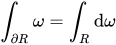
Essentially this argument is doing

So you'd need to be integrating the antiderivative of the area function along the perimeter, not the derivative of it. I might be missing the right interpretation of this, though. Ofb (talk) 03:18, 20 March 2012 (UTC)
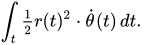
- I recommend you check out this paper, fix it up to agree, and cite it. Dicklyon (talk) 05:55, 20 March 2012 (UTC)
Hatchet (Prytz) Planimeter Suggestion
In case someone wants to make a (needed) section on the Prytz Planimeter before I get around to it, I found a decent technical article with history from the 1908 American Mathematical Monthly. Available on Jstor here: [1]. Sill looking for a free photo. --Theodore Kloba (talk) 21:03, 25 March 2014 (UTC)
I think the integral is wrong....
You have

however

and and
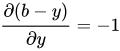
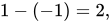
so the equation should read

In other words, the integral gives twice the area.
ZacharyFoj (talk) 21:21, 15 December 2014 (UTC)ZacharyFoj
- Quantity b is the y-component of the elbow, so b is a variable and not a constant; partial(b)/partial(y) not zero; see text below equation. Glrx (talk) 20:57, 17 December 2014 (UTC)
- True, but since we are talking about a partial derivative I thought it didn't matter....ZacharyFoj (talk) 05:59, 27 January 2015 (UTC)
- On further inspection, I've found my error. Thanks! ZacharyFoj (talk) 06:03, 27 January 2015 (UTC)
- True, but since we are talking about a partial derivative I thought it didn't matter....ZacharyFoj (talk) 05:59, 27 January 2015 (UTC)
nice CIA photos of planimeters
The CIA’s cartography department put up some nice photos of planimeters, e.g. https://www.flickr.com/photos/ciagov/30764630562/sizes/ and https://www.flickr.com/photos/ciagov/30792301801/sizes/ etc. in a whole set https://www.flickr.com/photos/ciagov/albums/72157674852500522. Someone may want to upload a few of those to wikimedia commons and include them here. –70.36.196.50 (talk) 10:25, 12 February 2017 (UTC)
Content Disclaimer
Informasi ini disarikan dari Wikipedia dan disajikan kembali untuk tujuan edukasi. Konten tersedia di bawah lisensi CC BY-SA 3.0. Kami tidak bertanggung jawab atas ketidakakuratan data yang bersumber dari kontribusi publik tersebut.
- The information displayed on this website is sourced in part or in whole from Wikipedia and has been adapted for the purpose of restating it. We strive to provide accurate and relevant information, however:
- There is no guarantee of absolute accuracy. Wikipedia is an open, collaborative project that can be edited by anyone, so information is subject to change.
- It is not intended to constitute professional advice. The content displayed is for informational and educational purposes only. For important decisions (e.g., medical, legal, or financial), please consult a professional.
- Content copyright. Wikipedia is licensed under the Creative Commons Attribution-ShareAlike License (CC BY-SA). This means that content may be reused with appropriate attribution and shared under a similar license.
- Responsible use. Any risk arising from the use of information from this website is entirely the responsibility of the user.