Talk:Orthogonal coordinates
Hi everyone I'm a student of mechanical engineering,(M.Sc) ,I'd like to know the Gradient Operator in Toroidal Coordinates. My mail is [email protected]

 | This article is rated C-class on Wikipedia's content assessment scale. It is of interest to the following WikiProjects: | ||||||||||
| |||||||||||

Student help
Hi everyone I'm a student of mechanical engineering,(M.Sc) ,I'd like to know the Gradient Operator in Toroidal Coordinates. My mail is [email protected]
Thanks, Keivan (81.12.30.4) 29 July 2006, 18:31
- Hi, Keivan, and welcome to Wikipedia!
- To answer your question, the general formula is given in this article; it's the first formula under the "Differential operators" section. To make the general formula specific for toroidal coordinates, you have to replace the q1, q2 and q3 with the toroidal coordinates, and the scale factors h1, h2, h3 with the formulae found on the page for toroidal coordinates. If this article wasn't clear, or if you have other suggestions, please let us know!
- By the way, please become a member of Wikipedia and learn to contribute constructively; it's that link in the upper right-hand corner. See you around Willow 06:55, 31 July 2006 (UTC)
addition of content
Not sure if the new sections sections including tables will be reverted... They came from Curvilinear coordinates, and were added since this article didn't include much of them (e.x. differential area/volume, and a summary of the coordinate intervals, h-scale factors, transformations from cartesian in various coordinate systems... even though there is the template:Orthogonal coordinate systems). F = q(E+v×B) ⇄ ∑ici 21:31, 30 April 2012 (UTC)
Superscripts
When it says, "q = (q1, q2, ..., qd) in which the coordinate surfaces all meet at right angles (note: superscripts are indices, not exponents)", wouldn't it be simpler to just change the superscripts to subscripts?--Solomonfromfinland (talk) 11:41, 31 January 2013 (UTC)
- Superscripts ahere to the contravariant/covariant convention, where contravariant components of vectors are indexed with superscripts and covariant components with subscripts. Using this convention and superscripts on coordinates, you get 'conservation of index height', where a subscript in the denominator equals a superscript in the numerator and vice versa, and the height should match on both sides of the equation. Chris2crawford (talk) 13:07, 28 February 2024 (UTC)
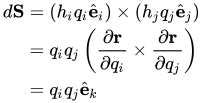
Basis vector formulae section error?
I think instead of:
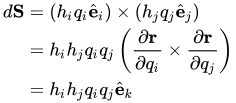
it shoul be:
— Preceding unsigned comment added by Nadapez (talk • contribs) 21:51, 31 July 2013 (UTC)
Assessment comment
The comment(s) below were originally left at Talk:Orthogonal coordinates/Comments, and are posted here for posterity. Following several discussions in past years, these subpages are now deprecated. The comments may be irrelevant or outdated; if so, please feel free to remove this section.
| Suggest to give more details for some examples, e.g., say what the h's are, and add structure to the 3d examples list. Geometry guy 12:22, 23 May 2007 (UTC) |
Last edited at 12:22, 23 May 2007 (UTC). Substituted at 02:24, 5 May 2016 (UTC)
explanation of notation not clear
In the section "Table of three-dimensional orthogonal coordinates" I am not sure what "the entries are grouped by their interval signatures, e.g. COCCCO for spherical coordinates" means, and there is no explanation or link.Chris2crawford (talk) 13:08, 28 February 2024 (UTC)
- The edit summary suggests that it refers to the closed/open nature of the ends of the coordinate ranges. It is not clear what significance this closed/openness has, and in any case it seems a little arbitrary since a different 'signature' could be obtained by, for example, taking the coordinates in a different order.
- My preference would be to list the systems in alphabetical order (and without stating the ordering criterion). catslash (talk) 17:12, 7 March 2024 (UTC)
- To symmetry the argument that the significance is arbitrary is meaningful. Up to symmetry that is. You see a translational coordinate well generally have a doubly open interval associated with it usually including an infinity, or else we restricted to the interval from 0 including zero to Infinity not including Infinity. However a rotational coordinate will have in general plus or minus pi about an included zero with the limits excluded, or else zero to 2pi with the tupai excluded... Doug Goncz (talk) 04:26, 16 June 2025 (UTC)
- This is original research and should be removed. There is no good reason for ordering the table this way. Tito Omburo (talk) 09:40, 16 June 2025 (UTC)
- It seems that nobody has heard of coordinate system interval signatures [1] and in any case, it is not necessary to explain the ordering. I shall delete the explanation. catslash (talk) 16:37, 12 July 2025 (UTC)
- Done. catslash (talk) 16:43, 12 July 2025 (UTC)
elipse, parabola coordinates
In the section "Table of two-dimensional orthogonal coordinates", the "elipse, parabola" coordinates can be generalized to: u=x^2+ky^2, y=vx^k, which are not parabolas for k!=2. This family only works for ellipses in u, not other powers of x,y, and of course any f(u) and g(v) has the same contours, so that is the most general form I could find. For k=1, you get polar coordinates with f(u)=sqrt(u) and g(v)=atan(v). Chris2crawford (talk) 13:18, 28 February 2024 (UTC)
point dipol
I think it should be 'dipole' in English. Chris2crawford (talk) 03:49, 7 March 2024 (UTC)
Content Disclaimer
Informasi ini disarikan dari Wikipedia dan disajikan kembali untuk tujuan edukasi. Konten tersedia di bawah lisensi CC BY-SA 3.0. Kami tidak bertanggung jawab atas ketidakakuratan data yang bersumber dari kontribusi publik tersebut.
- The information displayed on this website is sourced in part or in whole from Wikipedia and has been adapted for the purpose of restating it. We strive to provide accurate and relevant information, however:
- There is no guarantee of absolute accuracy. Wikipedia is an open, collaborative project that can be edited by anyone, so information is subject to change.
- It is not intended to constitute professional advice. The content displayed is for informational and educational purposes only. For important decisions (e.g., medical, legal, or financial), please consult a professional.
- Content copyright. Wikipedia is licensed under the Creative Commons Attribution-ShareAlike License (CC BY-SA). This means that content may be reused with appropriate attribution and shared under a similar license.
- Responsible use. Any risk arising from the use of information from this website is entirely the responsibility of the user.