Talk:Matrix decomposition

| This is the talk page for discussing improvements to the Matrix decomposition article. This is not a forum for general discussion of the subject of the article. |
Article policies
|
| Find sources: Google (books · news · scholar · free images · WP refs) · FENS · JSTOR · TWL |
Archives: 1Auto-archiving period: 12 months  |
 | This article is rated C-class on Wikipedia's content assessment scale. It is of interest to the following WikiProjects: | ||||||||||
| |||||||||||


LDL^t decomposition
I suggest that this page would benefit by including additional matrix decompositions, particularly the LDL^t decomposition. Does anyone have any input on this? Thanks Dwhitam (talk) 04:18, 28 April 2009 (UTC) Dwhitam
- It is already mentioned. See Matrix decomposition#Cholesky decomposition which links to LDL decomposition (which is the LDL^t decomposition). JackSchmidt (talk) 13:28, 28 April 2009 (UTC)
eigenvalue decomposition of Symmetric matrix
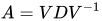
In general, we have , when A is symmetric, do we have ? Jackzhp (talk) 14:10, 7 March 2010 (UTC)

Rank factorization?
A link to Rank factorization was recently added. This looks very similar to LU decomposition, but I don't have time right now to check whether and how it is related. Should both concepts be linked separately on this page, or should they be discussed together? And should the Rank factorization page be merged with the LU decomposition page? Rinconsoleao (talk) 08:50, 21 July 2010 (UTC)
- It's different from LU decomposition -- the article says that it works for rectangular matrices (whereas LU is only for square matrices), and the first matrix in that decomposition isn't triangular. So we shouldn't merge these articles. -- X7q (talk) 14:27, 21 July 2010 (UTC)
LUP decomposition
Is it defined by PA=LU or by A=LUP? There seems to be some contradiction. —Preceding unsigned comment added by 68.102.28.107 (talk) 22:45, 10 May 2011 (UTC)
Decomposition into clans
The material just added regarding clans and petri nets appears to be original research and probably should be removed. Anita5192 (talk) 17:56, 8 April 2013 (UTC)
- I agree; journals published by scirp probably do not pass the threshold for this article, where all other decompositions are well established. Thus, I removed the material. -- Jitse Niesen (talk) 08:53, 9 April 2013 (UTC)
Generalised eigenspaces anyone?
I find it quite amazing that in the long list of decompositions, the one based on the direct sum decomposition of the space into generalised eigenspaces appears to be missing. This is one of the most basic decompositions of any linear operator on a complex vector space without additional (inner product) structure. More precisely it applies to any square matrix whose characterisitic (or minimal) polynomial splits into linear factors. While it is related to the Jordan normal form and somewhat to the Jordan–Chevalley decomposition, it is definitely not the same as either one of them. Is there a particular reason it is missing? — Preceding unsigned comment added by Marc van Leeuwen (talk • contribs) 14:12, 1 May 2013 (UTC)
Existence
"Existence: An n-by-n matrix A always has n eigenvalues" It isn't true. Matrix [0,1;-1,0] has no real eigenvalues, only complex: and . An nxn matrix over complex numbers always has n complex eigenvalues, an nxn real matrix has n eigenvalues for example when it is a symmetric matrix. Bartekltg (talk) —Preceding undated comment added 03:16, 22 February 2014 (UTC)


Cholesky decompostion
It is written :
- Decomposition: , where U is upper triangular with positive diagonal entries

Yet, in the Cholesky decomposition page, it is an lower triangular ! — Preceding unsigned comment added by Rafnuss (talk • contribs) 08:26, 6 January 2015 (UTC)
- In the Cholesky decomposition page, the decomposition is written as , where L is a lower triangular matrix. Defining , then U is upper triangular and . Thus, these affirmations are equivalent. Best regards, Saung Tadashi (talk) 12:31, 6 January 2015 (UTC)


Converting article into a "Set Index article"
The current state of the article seems to have two issues:
- The article isn't easily readable
- The content of this article doesn't seem to be of much use than those articles linked from the article.
There are two possible solutions to this,
- Making this a Set index article directing users to the more specific articles. Consequence : Allows users to identify that this page doesn't give much information by itself. Example : Inkcap
- Tabulate the sections of the article to make it more readable. Consequence : Makes article more readable. Example : Graph product
- - Kaartic correct me, if i'm wrong 13:21, 27 May 2017 (UTC)
- I think a bird-view of the matrix decompositions using a table would be more interesting as it would allow the readers to compare each decomposition. Saung Tadashi (talk) 23:34, 28 May 2017 (UTC)
External links modified (January 2018)
Hello fellow Wikipedians,
I have just modified one external link on Matrix decomposition. Please take a moment to review my edit. If you have any questions, or need the bot to ignore the links, or the page altogether, please visit this simple FaQ for additional information. I made the following changes:
- Added archive https://web.archive.org/web/20110314171151/http://www.graphlab.ml.cmu.edu/pmf.html to http://www.graphlab.ml.cmu.edu/pmf.html
When you have finished reviewing my changes, you may follow the instructions on the template below to fix any issues with the URLs.
 An editor has reviewed this edit and fixed any errors that were found.
- If you have discovered URLs which were erroneously considered dead by the bot, you can report them with this tool.
- If you found an error with any archives or the URLs themselves, you can fix them with this tool.
Cheers.—InternetArchiveBot (Report bug) 15:41, 21 January 2018 (UTC)
Content Disclaimer
Informasi ini disarikan dari Wikipedia dan disajikan kembali untuk tujuan edukasi. Konten tersedia di bawah lisensi CC BY-SA 3.0. Kami tidak bertanggung jawab atas ketidakakuratan data yang bersumber dari kontribusi publik tersebut.
- The information displayed on this website is sourced in part or in whole from Wikipedia and has been adapted for the purpose of restating it. We strive to provide accurate and relevant information, however:
- There is no guarantee of absolute accuracy. Wikipedia is an open, collaborative project that can be edited by anyone, so information is subject to change.
- It is not intended to constitute professional advice. The content displayed is for informational and educational purposes only. For important decisions (e.g., medical, legal, or financial), please consult a professional.
- Content copyright. Wikipedia is licensed under the Creative Commons Attribution-ShareAlike License (CC BY-SA). This means that content may be reused with appropriate attribution and shared under a similar license.
- Responsible use. Any risk arising from the use of information from this website is entirely the responsibility of the user.