Talk:Lists of integrals
My 25th ed. of the CRC Standard Math Tables is clearly authored by William H. Beyer and not Daniel Zwillinger. Should this be mentioned in the references sectio

 | This article is rated List-class on Wikipedia's content assessment scale. It is of interest to the following WikiProjects: | ||||||||||||||||||||
| |||||||||||||||||||||


CRC Math Tables
My 25th ed. of the CRC Standard Math Tables is clearly authored by William H. Beyer and not Daniel Zwillinger. Should this be mentioned in the references section? --M1ss1ontomars2k4 (T | C | @) 15:11, 25 June 2006 (UTC)
Need Integral
I would like to know the integral for finding the volume of a section of a cylinder, such as a tank containing a liquid. (If I have a tank r=48" and length=96" and I want to know how many gallons are in the tank at say 20" deep).
If it's a cylinder then you don't need an integral, just use the area of a cylinder formula.RageGarden 05:19, 24 April 2007 (UTC)
List of definite integrals?
Hi,what about adding another section - list of definite integrals? I think it would be very helpful. —The preceding unsigned comment was added by 147.231.80.128 (talk) 07:03, 3 May 2007 (UTC).
But definite integrals are the same as the indefinite integrals without the C...RageGarden 03:54, 4 May 2007 (UTC)
I imagine they may be asking about definite integrals for which the integrand has no closed-form antiderivative. Offhand, I don't know how useful such a collection would be. Doctormatt 04:45, 4 May 2007 (UTC)
What on earth is sin^n x doing under the heading "Definite integrals lacking closed-form antiderivatives"? —Preceding unsigned comment added by 129.16.29.75 (talk) 15:03, 12 November 2008 (UTC)
Merge?
The merge tag has been there since Jan 07, with no discussion.
I support the merge as it would put the most common integral which many people will be looking for in an easy to find place. --Salix alba (talk) 18:30, 13 May 2007 (UTC)
- Ditto for me. I intuitively searched for "tables of common integrals" first, as I was an old CRC bible user. The keyword "table" should force a redirection to the "lists" page. The most commonly needed integrals could be prominently placed. --MxBuck 16:09, 5 November 2007 (UTC)
I don't know what it was like in January 07 but I like the list as it stands right now. Sometimes you want the list of other lists and sometimes you want the whole page.
The merge makes good sense. Same content, same page. That's how encyclopedias work, right? (kaesle) —Preceding unsigned comment added by 130.76.32.181 (talk) 18:39, 26 September 2007 (UTC)
I also support a merge; especially as part of the Calculus template, the Integrals list contrasts with the Derivatives table. I think the tables should link to the pages on the "list" page as a "For more information" thing, and have the additional content at the end. King 07:41, 7 November 2007 (UTC)
- Merge Completed. --ShakataGaNai (talk) 08:38, 27 December 2007 (UTC)
Proofs
If there was anyone interested, something that I think would be neat would be to be able to click on any of the formulas from the list of integrals and get redirected to another page with the proof on it. It would be a lot of work, but if someone really liked math, or was bored enough, they could do it. —Preceding unsigned comment added by ArthurJohnJones (talk • contribs) 20:42, 9 January 2008 (UTC)
Links to sosmathematics and eqworld
On the eqworld site whenever you click a integral group from the list it just links to the sosmathematics page, i was just wondering if you knew this and weather both links are needed
Inverse trig function consistency
I noticed sometimes arc* is used and sometimes *^-1 is used. Is there a particular reason for this? --Snaxe/fow (talk) 16:44, 24 April 2008 (UTC)
References
Besavilla: Engineering Review Center, Engineering Mathmatics (Formulas), Mini Booklet (sic)
I don't think this is a good primary (or even secondary) reference. This is just review material (essentially a collection of knowledge and formulas, sometimes without context) for people who want to take the licensure exams for engineers. Iccruz (talk) 03:06, 11 August 2008 (UTC)
arcsec and arccsc
At the moment we have:


The first one is wrong, as the first plus should be a minus. Both are probably computer-generated because they contain redundancies. Wouldn't these versions be better:


Xanthoxyl < 12:29, 21 October 2009 (UTC)
In fact, couldn't we just simplify it fully:


Xanthoxyl < 15:13, 21 October 2009 (UTC)
- Proof by differentiation does not support your results.--MathFacts (talk) 21:03, 11 November 2009 (UTC)
- I've changed to the following:


--MathFacts (talk) 21:19, 11 November 2009 (UTC)
But I get for example and I can't reconcile it with those versions of the antiderivatives. Xanthoxyl < 05:38, 12 November 2009 (UTC)

I think there must be issues here (involving complex arguments) that I'm not aware of. Xanthoxyl < 05:53, 12 November 2009 (UTC)
- You are right and the second formula works only for reals. But this simpliest formula works excellent for both reals and complex numbers:


--MathFacts (talk) 14:20, 12 November 2009 (UTC)
Composed functions?
I question the title of the section Lists of integrals#Composed functions. The integrands are products of trigonometric and exponential functions. This is not what I would normally think of as composed functions. I was expecting the section to have something like
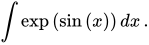
Can we not think of a better title? JRSpriggs (talk) 01:23, 21 February 2011 (UTC)
- I see that Xanthoxyl has renamed the section Lists of integrals#Products of functions proportional to their second derivatives. This is more accurate, although cumbersome. Perhaps it is the best we can expect to achieve. Thanks! JRSpriggs (talk) 10:55, 21 February 2011 (UTC)
Incorrect formulae at Lists of integrals#Absolute value functions?
It has been pointed out to me by a new User:Syed Wamiq Ahmed Hashmi that the integrals of absolute values of trigonometric functions are wrong. Does anyone have a source? I've looked in a couple of formulae books with integral tables but of all things they don't have the functions listed in that WP section. I'll keep looking around also, just thought to notify the project. Thanks, M∧Ŝc2ħεИτlk 15:03, 9 April 2013 (UTC)
- I have checked the formulas in this section. The (new) formula for |sin| looks correct, but I need more time to check it completely. I'll tag it "citation needed". The formula for |cos| is definitely wrong, as the antiderivative of a continuous function must be continuous. I'll move the "dubious" tag specifically to this formula. For the other formulas, I'll replace the fractions exp/|exp| by sgn(exp): for the |sec| and |csc| case, because the resulting formula is simpler (the fraction is undefined only at the values of x for which the integrand is undefined; for |tan| and |cot|, because the present formulas are not defined at the values of x where the integrand is zero. D.Lazard (talk) 21:32, 9 April 2013 (UTC)
- Ok, cheers again, M∧Ŝc2ħεИτlk 23:22, 9 April 2013 (UTC)
- I have edited the section, accordingly to the discussion here, there and there. However, some further work is yet needed for having similar formulas for sine and cosine, and for being sure of the value of sign(0) that makes the anti-primitives continuous. D.Lazard (talk) 10:24, 10 April 2013 (UTC)
- Ok, cheers again, M∧Ŝc2ħεИτlk 23:22, 9 April 2013 (UTC)
Notice that

as long as one does not cross any discontinuity of the step function sgn(f(x)). At those discontinuities, one should modify the value of the "constant" C to make the anti-derivatives equal, that is, the limit from the left and the limit from the right should be equal so that the whole anti-derivative is continuous. JRSpriggs (talk) 12:00, 10 April 2013 (UTC)
"If g is an anti-derivative of a continuous function f such that f(x)=0 implies g(x)=0, then..." — does it make sense? Between two adjacent roots (zeros), the continuous function f cannot change the sign, thus its integral over this interval cannot vanish (unless the function vanishes on the whole interval), therefore g cannot vanish at both endpoints. Boris Tsirelson (talk) 19:22, 11 April 2013 (UTC)
- I agree that the formulation is not very good, and the word "continuous" has to be dropped. May be the following is better: "Let f be a function which has at most one root on each interval on which it is defined, and g an antiderivative of f that is zero at each root of f, then ...". D.Lazard (talk) 22:03, 11 April 2013 (UTC)
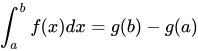
- According to our article Antiderivative#Uses and properties, "Antiderivatives are important because they can be used to compute definite integrals, using the fundamental theorem of calculus ...". However, if one crosses over a region where the given function, e.g. |tan x|, is undefined as you would do if you went from below π/2 to above π/2, then the definite integral
- would be undefined. This shows the absurdity of trying to define an indefinite integral on a disconnected domain. None-the-less, you seem to be trying to do that. JRSpriggs (talk) 20:09, 12 April 2013 (UTC)
- I have never seen any definition of "antiderivative" that supposes that the function is defined on an interval. In any case the article Antiderivative, not only defines "antiderivative" for functions whose domain is not an interval, but discuss the constant of integration for non connected domains. This article is also clear about the fact that "indefinite integral" is another name for "antiderivative". Moreover, many of the formulas in Lists of integrals give antiderivatives for functions with non-connected domain. Thus you are calling "absurdity" what all mathematicians are commonly doing.
- On the other hand, there is a common mistake, when using antiderivatives to compute definite integrals to forget to verify that there are not singularities in the interval of integration, and that the antiderivative is continuous on this interval (the problem occurs even for rational functions: W. Kahan has given an example of a continuous rational function for which most computer algebra algorithms give an discontinuous antiderivative). May be the assertion of Antiderivative#Uses and properties that you cite should be edited to emphasize that "if g is a continuous antiderivative of f in the interval [a, b], then , but this formula may be wrong in case of discontinuities". D.Lazard (talk) 10:10, 13 April 2013 (UTC)
- I think that the error is in the statement that "indefinite integral" is the same as "antiderivative". A function g is an antiderivative of f if and only if f is the derivative of g. But there are integrable functions which cannot be the derivative of any function. For example, the indicator function of the rational numbers is integrable, but it cannot be the derivative of any function because it lacks the intermediate-value property which all derivatives have. Specifically, its indefinite integral is just C a constant function, whose derivative is the constant function zero. They are only the same if you add the assumption that f is continuous and has a connected domain. JRSpriggs (talk) 19:21, 13 April 2013 (UTC)
- Can you provide a source asserting that "antiderivative" is not the same as "indefinite integral"? Also, can you provide source defining "indefinite integral" in the context of Lebesgue integration (as your example uses Lebesgue integration)? D.Lazard (talk) 20:22, 13 April 2013 (UTC)
- I think that the error is in the statement that "indefinite integral" is the same as "antiderivative". A function g is an antiderivative of f if and only if f is the derivative of g. But there are integrable functions which cannot be the derivative of any function. For example, the indicator function of the rational numbers is integrable, but it cannot be the derivative of any function because it lacks the intermediate-value property which all derivatives have. Specifically, its indefinite integral is just C a constant function, whose derivative is the constant function zero. They are only the same if you add the assumption that f is continuous and has a connected domain. JRSpriggs (talk) 19:21, 13 April 2013 (UTC)
- According to our article Antiderivative#Uses and properties, "Antiderivatives are important because they can be used to compute definite integrals, using the fundamental theorem of calculus ...". However, if one crosses over a region where the given function, e.g. |tan x|, is undefined as you would do if you went from below π/2 to above π/2, then the definite integral

A formula out of place?
In the section Lists of integrals#Definite integrals lacking closed-form antiderivatives, one finds this formula

It is equivalent to saying

which is a slight variation of the trapezoid rule for numerical integration on a uniform grid. It just leaves out the end-points, f(a) and f(b), which disappear in the limit anyway. So I wonder whether this is an appropriate thing to have in this article and section since it is about numerical integration rather than a formula for integrating some specific function. What do you-all think? JRSpriggs (talk) 03:55, 15 April 2013 (UTC)
- Two more points about that:
- Calculating it via the infinite sum is ill-conditioned because each value which is added in at some stage is then subtracted out in an infinite sequence of pieces. This encourages an accumulation of round off errors.
- Excluding both end-points conflicts with the claim that this formula is derived from the method of exhaustion, i.e. calculating a lower bound. If that were being used, f(a) should be included for increasing functions and f(b) for decreasing functions. Having neither is like replacing them with 0 which may be too big, if the function f is sometimes negative. JRSpriggs (talk) 07:37, 15 April 2013 (UTC)
- The bounded variation is not enough, if f is 0 for all rational points and 1 for all irrational points then the formula would give 0 as the integral between 0 and 1. Adding 'continuous' would do it easily. Dmcq (talk) 10:52, 15 April 2013 (UTC)
- To Dmcq: That function does not have bounded variation. For any positive integer n, pick n+1 rational points between a and b. Then pick an irrational point between each adjacent pair of those. The variation for that grid would have to be at least 2n and thus unbounded when looking at all such grids. JRSpriggs (talk) 03:50, 16 April 2013 (UTC)
- Sorry yes it means the total variation. Dmcq (talk) 08:15, 16 April 2013 (UTC)
- To Dmcq: That function does not have bounded variation. For any positive integer n, pick n+1 rational points between a and b. Then pick an irrational point between each adjacent pair of those. The variation for that grid would have to be at least 2n and thus unbounded when looking at all such grids. JRSpriggs (talk) 03:50, 16 April 2013 (UTC)
Ratings Template
I'm rating this list as high priority and assigning it to the "analysis" field (which covers calculus). Bryanrutherford0 (talk) 16:56, 17 October 2013 (UTC)
missing information on definite integral solution
in the section "definitive integrals lacking closed-form antiderivatives" one finds this formula

and the next one

Where does the variable m come from? How is one supposed to use the formula not knowing that?
Nichi-kun (talk) 09:54, 25 January 2015 (UTC)
Formatting issue - Alignment
It's my opinion that these lists of integrals would be significantly easier to read if the equality symbol for each formula was aligned in each row. I have created a short demo of how this would look (and appear in source) at User:Jounce/Integral list format.
Since this would be a large change I am merely leaving this here as a suggestion. Please comment if you agree or disagree with the change. Thank you. Jounce (talk) 19:25, 12 May 2017 (UTC)
External links modified
Hello fellow Wikipedians,
I have just modified one external link on Lists of integrals. Please take a moment to review my edit. If you have any questions, or need the bot to ignore the links, or the page altogether, please visit this simple FaQ for additional information. I made the following changes:
- Added archive https://archive.is/20121030002907/http://mathmajor.org/calculus-and-analysis/table-of-integrals/ to http://mathmajor.org/calculus-and-analysis/table-of-integrals/
When you have finished reviewing my changes, you may follow the instructions on the template below to fix any issues with the URLs.
This message was posted before February 2018. After February 2018, "External links modified" talk page sections are no longer generated or monitored by InternetArchiveBot. No special action is required regarding these talk page notices, other than regular verification using the archive tool instructions below. Editors have permission to delete these "External links modified" talk page sections if they want to de-clutter talk pages, but see the RfC before doing mass systematic removals. This message is updated dynamically through the template {{source check}} (last update: 5 June 2024).
- If you have discovered URLs which were erroneously considered dead by the bot, you can report them with this tool.
- If you found an error with any archives or the URLs themselves, you can fix them with this tool.
Cheers.—InternetArchiveBot (Report bug) 15:11, 3 January 2018 (UTC)
Content Disclaimer
Informasi ini disarikan dari Wikipedia dan disajikan kembali untuk tujuan edukasi. Konten tersedia di bawah lisensi CC BY-SA 3.0. Kami tidak bertanggung jawab atas ketidakakuratan data yang bersumber dari kontribusi publik tersebut.
- The information displayed on this website is sourced in part or in whole from Wikipedia and has been adapted for the purpose of restating it. We strive to provide accurate and relevant information, however:
- There is no guarantee of absolute accuracy. Wikipedia is an open, collaborative project that can be edited by anyone, so information is subject to change.
- It is not intended to constitute professional advice. The content displayed is for informational and educational purposes only. For important decisions (e.g., medical, legal, or financial), please consult a professional.
- Content copyright. Wikipedia is licensed under the Creative Commons Attribution-ShareAlike License (CC BY-SA). This means that content may be reused with appropriate attribution and shared under a similar license.
- Responsible use. Any risk arising from the use of information from this website is entirely the responsibility of the user.