Talk:Linear interpolation
(x-x0)/(x1-x0) is not the SLOPE! slope is rate of change in something. that is, it must have different units in numerator and denominator (ie, meters per se

 | This article is rated C-class on Wikipedia's content assessment scale. It is of interest to the following WikiProjects: | ||||||||||
| |||||||||||

(x-x0)/(x1-x0) is not the SLOPE! slope is rate of change in something. that is, it must have different units in numerator and denominator (ie, meters per second; rise/run; bps; etc). So it's misleading to call it slope. That, or i've gone crazy in the years since taking math classes.
- You're not crazy, the page was wrong. Good catch. —Blotwell 10:50, 23 Jun 2005 (UTC)
Alphas
The alphas are only equal when the slope of the line you're trying to interpolate is one. Otherwise, they're not. --Herbchronic 00:48, 29 July 2006 (UTC)
- Please explain. To me, the article seems correct on this account. -- Jitse Niesen (talk) 05:10, 29 July 2006 (UTC)
The article is correct: interpolation coefficient is different than slope
Appeal to Rolle's theorem
"It can be proven using Rolle's theorem that if f has two continuous derivatives, the error is bounded by..." I just tried this and it can't work. You have to use the mean value theorem, not Rolle's theorem - J Fellows, University of Birmingham
- The proof I know uses Rolle's theorem. This proof is for polynomial interpolation in general, not just linear interpolation. It's in Atkinson's Introduction to Numerical Analysis, and also in Suli and Mayers' book with the same title. However, the proof uses some algebraic manipulations and the difference between Rolle's theorem and the mean value theorem is just one small step, so it's well possible that it's better to appeal to the mean value theorem. I wouldn't mind if you changed it. -- Jitse Niesen (talk) 03:22, 14 February 2007 (UTC)
- Does "has two continuous derivatives" mean "has continuous first and second derivatives"? This does not say what it means, because "derivative" is ambiguous A well-behaved function f has one derivative (derivative function) and an infinite number of derivatives (of values of the derivative function at each point of its domain). — Paul G (talk) 10:20, 6 March 2008 (UTC)
- Yes, "has two continuous derivatives" means "has continuous first and second derivatives". It's the only interpretation that makes sense, so I don't think it's really ambiguous. It's also a fairly common way to put it, but perhaps rather informal and I can see that it will confuse readers, so I changed it. -- Jitse Niesen (talk) 11:00, 6 March 2008 (UTC)
Figure
can someone update the figure? the thumbnail that's used has (xy,) instead of (x,y) but the figure itself is fine, and I can't figure out how to fix this. Very confusing. Also, I think it would be more illustrative if the the point, (x,y), were not close to the midpoint of the line segment. If I don't see a fix for this in a few days I'll simply create a new figure. 108.6.2.66 (talk) —Preceding undated comment added 20:19, 26 October 2010 (UTC).
- It has to be a bug with the program Wikipedia is using to produce PNGs from SVGs. We may hope it will be fixed by itself when the bug is fixed and the PNG updated. --Berland (talk) 19:48, 29 October 2010 (UTC)
The figure is still wrong...something new about the bug fix? —Preceding unsigned comment added by 190.26.194.33 (talk) 15:01, 25 February 2011 (UTC)
Bilinear interpolation
It says "bilinear interpolation can be accomplished in two lerps", but I think it requires 3 lerps -- e.g., two in x direction and one in y direction. Can someone verify that and correct it? -Markg17 (talk) 21:11, 15 March 2011 (UTC)
αA + (1-α)B
RGBA color space refers to this article when explaining the etymology of 'alpha' in the alpha channel, citing the formula "αA + (1-α)B" - yet it doesn't appear here. (20040302 (talk))
Using the term distance in the 2nd figure
Is it correct usage? Isn't distance in this case understood as diagonal length? — Preceding unsigned comment added by 5.20.191.37 (talk) 20:34, 5 November 2017 (UTC)
- I agree, and have changed it to "horizontal length". Cai (talk) 15:41, 21 February 2018 (UTC)
Error term R_T
Where does the factor of 8 come from in
- ?

According to Taylor's theorem the remainder should be of the form
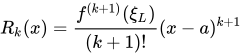
which for (linear interpolation) is

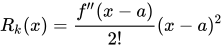
and so setting and taking the maximum over , the factor in the denominator of the above should be 2?


Content Disclaimer
Informasi ini disarikan dari Wikipedia dan disajikan kembali untuk tujuan edukasi. Konten tersedia di bawah lisensi CC BY-SA 3.0. Kami tidak bertanggung jawab atas ketidakakuratan data yang bersumber dari kontribusi publik tersebut.
- The information displayed on this website is sourced in part or in whole from Wikipedia and has been adapted for the purpose of restating it. We strive to provide accurate and relevant information, however:
- There is no guarantee of absolute accuracy. Wikipedia is an open, collaborative project that can be edited by anyone, so information is subject to change.
- It is not intended to constitute professional advice. The content displayed is for informational and educational purposes only. For important decisions (e.g., medical, legal, or financial), please consult a professional.
- Content copyright. Wikipedia is licensed under the Creative Commons Attribution-ShareAlike License (CC BY-SA). This means that content may be reused with appropriate attribution and shared under a similar license.
- Responsible use. Any risk arising from the use of information from this website is entirely the responsibility of the user.