Talk:Lanczos tensor
I think the dots need to be replaced with notation used elsewhere in gtr related pages.---CH (talk) 00:19, 15 September 2005 (UTC)Reply

 | A fact from Lanczos tensor appeared on Wikipedia's Main Page in the Did you know column on 28 October 2012. The text of the entry was as follows:
|  |
 | This article is rated Start-class on Wikipedia's content assessment scale. It is of interest to the following WikiProjects: | |||||||||||||
| ||||||||||||||
.jpg)

Notation
I think the dots need to be replaced with notation used elsewhere in gtr related pages.---CH (talk) 00:19, 15 September 2005 (UTC)
Fix or delete?
What to do, what to do... User:Markdroberts has not been heard from since Sept 23, and this article is inadequate as it stands (no clear motivation for either "Lanczos tensor", or how the Lanczos potential is related to the rank three tensor from Hawking & Ellis, etc). ---CH 09:20, 23 December 2005 (UTC)
I might add that neither notion of Lanczos tensor seems to be widely used (Mark Roberts cited his own preprint, one of only two I can find, both by him, which use the Lanczos potential, not even in gtr but another theory). ---CH 18:53, 24 December 2005 (UTC)
Formatting the article so it isn't a giant stub
Recent improvements by User:Teply have helped immensely, but I think the article would look even better with a proper lead paragraph. It would be very informative to sum up the main significance in that lead before diving into the details. Rschwieb (talk) 13:47, 11 October 2012 (UTC)
- I see you went ahead and did that. That's what I had in mind... looks good! Rschwieb (talk) 13:02, 12 October 2012 (UTC)
Origin Incorrect?
I just found Nathalie Deruelle, John Madore's "On the quasi-linearity of the Einstein-'Gauss-Bonnet' gravity field equations" arXiv:gr-qc/0305004, which suggests Lanczos tensor originates in the article:
- Cornel Lanczos, "Elektromagnetismus als natürliche Eigenschaft der Riemannschen Geometrie." Zeitschrift für Physik A Hadrons and Nuclei 73 No 3-4 (1932), 147-168. DOI:10.1007/BF01351210
Unfortunately, I can't read German to verify the validity of Deruelle and Madore's claim. But I thought it ought to be mentioned...
A different version of the story is presented in P. O'Donnell and H. Pye "A Brief Historical Review of the Important Developments in Lanczos Potential Theory" eprint, which dates it back to 1938 as the discovery date, but it entered use in 1949.
Just some preliminary research...-Pqnelson (talk) 02:34, 15 October 2012 (UTC)
- That arXiv link actually seems to be referring to the quadratic Lovelock tensor, which in 4D is just zero. They also point out that this was already known in the 1921 Bach paper. For a laugh, see equation 60 of [1]. See also the English language version of the 1932 paper. The 1932 paper seems to be an important stepping stone, and the 1938 paper comes really close but just shy of the mark. Teply (talk) 07:28, 15 October 2012 (UTC)
Confusing Notation in the Weyl-Lanczos Equations
The Weyl-Lanczos equations are given as

But the subscript indicates what? Why is it in vertical brackets like that? Is that a typo, or some important indicator? -Pqnelson (talk) 03:10, 15 October 2012 (UTC)

- After some thought, I think what they meant was
- and so on, but couldn't figure out some slick way to do it (and didn't want to hastle with juggling minus signs everywhere). Could someone (a) double check the Weyl-Lanczos equations to make sure my guess is correct, and in any event (b) clean up the notation used in the equations? -Pqnelson (talk) 03:14, 15 October 2012 (UTC)

- Indices between vertical bars get skipped when you symmetrize. The notation is standard (e.g. [2]) even if not yet well documented in the corresponding Wikipedia article. In this case you'd have
- I chose the former way of expressing the Weyl-Lanczos equations (which should match O'Donnell now that I've fixed the typo) because it makes it a little more obvious that these four terms and the last one vanish in the Lanczos algebraic gauge as it's defined here. It doesn't matter much either way, though, because clearly you can permute the indices in the gauge condition, too. The remaining terms look like
- which obviously reduce to the simpler equation in the Lanczos differential gauge. Teply (talk) 05:10, 15 October 2012 (UTC)
- Indices between vertical bars get skipped when you symmetrize. The notation is standard (e.g. [2]) even if not yet well documented in the corresponding Wikipedia article. In this case you'd have

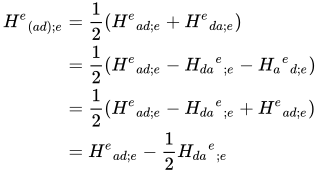
- I've documented the use of vertical bars to skip indices in Ricci calculus, but I'm not entirely comfortable with EOM as the sole reference and have not included it there. Should someone wish to, adding suitable references to that article would be appreciated. — Quondum 04:53, 16 October 2012 (UTC)
Wave equation
The "wave equation" could do with a little reformatting for readability, I think, such as by using the Cotton tensor instead its full expression. The equation looks a like an inhomogenous Klein–Gordon equation, making it a bit more complicated than a typical wave equation. It might help if the trailing terms could be replaced by a single tensor contracted into the Lanczos tensor (the mass-squared term in the Klein–Gordon equation). Would this make sense? If we're going to make a statement that it is a wave equation (in the non-vacuum case), it should be made clear why this is so. — Quondum 13:58, 15 October 2012 (UTC)
- I have made the Cotton tensor more explicit as per my suggestion above. I do not have the references to be able to tackle the trickier matter of making it look more obviously like a wave equation. — Quondum 09:54, 17 October 2012 (UTC)
Unnecessary complexity of statement
AFAICT, the phrase "depends only on covariant derivative of the Ricci tensor and Ricci scalar" includes redundancy, since the covariant derivative of the Ricci scalar is an algebraic function of the covariant derivative of the Ricci tensor (non-mention of the metric tensor is already implicit). So we can simply drop "and Ricci scalar" without any inaccuracy. — Quondum 19:10, 18 October 2012 (UTC)
Content Disclaimer
Informasi ini disarikan dari Wikipedia dan disajikan kembali untuk tujuan edukasi. Konten tersedia di bawah lisensi CC BY-SA 3.0. Kami tidak bertanggung jawab atas ketidakakuratan data yang bersumber dari kontribusi publik tersebut.
- The information displayed on this website is sourced in part or in whole from Wikipedia and has been adapted for the purpose of restating it. We strive to provide accurate and relevant information, however:
- There is no guarantee of absolute accuracy. Wikipedia is an open, collaborative project that can be edited by anyone, so information is subject to change.
- It is not intended to constitute professional advice. The content displayed is for informational and educational purposes only. For important decisions (e.g., medical, legal, or financial), please consult a professional.
- Content copyright. Wikipedia is licensed under the Creative Commons Attribution-ShareAlike License (CC BY-SA). This means that content may be reused with appropriate attribution and shared under a similar license.
- Responsible use. Any risk arising from the use of information from this website is entirely the responsibility of the user.