Talk:Isomorphism

 | The content of Isomorphism class was merged into Isomorphism on 29 October 2024. The former page's history now serves to provide attribution for that content in the latter page, and it must not be deleted as long as the latter page exists. For the discussion at that location, see its talk page. |
 | This  level-4 vital article is rated C-class on Wikipedia's content assessment scale. level-4 vital article is rated C-class on Wikipedia's content assessment scale.It is of interest to the following WikiProjects: | ||||||||||
| |||||||||||


Equality versus Isomorphism
I removed some of the misleading or confused parts of the equality versus isomorphism part. For instance the discussion of natural isomorphism was confusing as it made it seem as if whether an isomorphism was natural or not was somehow a feature of only the two structures and was the suggestion that category theory doesn't produce equal objects (it's a less useful notion but it exists in some formalizations).
However, I suggest cutting more or almost everything to just include a brief paragraph about this point. If one wants to go into this level of detail perhaps a new page where one can give the appropriate context (are we talking about this from a foundations of math perspective, working mathematican's perspective a philosophical perspective) which isn't very clear. I'm not ready to just do this without more feedback as someone obviously put a lot of effort into this and I don't want to just yank it if I'm getting something wrong. Peter M. Gerdes (talk) 02:46, 4 July 2024 (UTC)
- General speaking, my thought is that the article should just stick to the discussion of an isomorphism (a morphism that happens to have an inverse), and not get too deep into the philosophical matter of equality vs isomorphism. Especially tricky is a matter of a canonical isomorphism. It is often the case that a canonical isomorphism is treated as an equality (e.g., are canonically isomorphic to but we treat them as the same). This is a delicate hard-to-source matter. A better place for a discussion like that might be in canonical map or a place that discusses equality in mathematics, including a new article suggested above. —- Taku (talk) 06:01, 11 July 2024 (UTC)


- As a related matter, I have proposed the merger of isomorphism class into the article. I think that is a type of materials that should be emphasized in this article; i.e., an isomorphism is an equivalence relation. —— Taku (talk)

 Merge completed Klbrain (talk) 14:32, 29 October 2024 (UTC)


Short description
The main purpose of short description is to help readers to identify whether the article may be interesting to them without open it. Farkle Griffen changed twice the short description of isomorphism from "Inversible mapping (mathematics)" to "Structure-preserving map in mathematics". This amount to change a description specific to this article to a short description that applies also to homomorphism and morphism; this may confuse many readers.
Therefore, I'll install again the previous stable version. As it is the rule for every controversial change, a consensus is required for changing it again. D.Lazard (talk) 08:57, 25 March 2025 (UTC)
- @D.Lazard
"[...] a consensus is required for changing it again."
- There is no established consensus. This is a minor dispute between exactly two editors. Unless a group of editors comes out to form an explicit consensus, no rules are being broken here. I'll go ahead and revert to the more stable version "In mathematics, invertible homomorphism" that lasted from 2019–2024."This amount to change a description specific to this article to a short description"
- The opposite, actually. The version "Inversible mapping (mathematics)" is much broader than homomorphisms since it applies to any bijective function on a set. On the ring , for example, there are bijective functions, but only 5 homomorphisms. In terms of confusion, any reader looking for homomorphism or morphism isn't likely to be confused by that (except possibly in the brief window having learned about homomorphisms before isomorphisms). This is not the case for invertible function. (Not to mention, morphisms don't have to preserve structure, nor do they need to be mappings.)The main purpose of short description is to help readers to identify whether the article may be interesting to them without open it.
- This seems to disagree with WP:Short description. The description is mostly for disambiguation between similarly titled articles (e.g. Isomorphism (sociology) or Isomorphism (crystallography)), and summarizing the field and scope. In this sense, all that's really necessary for clarity is "Concept in mathematics", and in terms of summarizing the scope, as above, your advocated version is much less specific.- Lastly, that version contains the term "inversible", which doesn't seem to appear in most dictionaries, nor in this article. – Farkle Griffen (talk) 15:22, 25 March 2025 (UTC)
- Problems with the current version
- After reverting to the more stable version "In mathematics, invertible homomorphism", I still have one issue. The term "Homomorphism" would fall under WP:SDJARGON. Which is why I'm advocating for my previous version "Structure-preserving map in mathematics". – Farkle Griffen (talk) 15:27, 25 March 2025 (UTC)
- The short description "In mathematics, invertible homomorphism" is fine, and much more convenient that the SD that OlliverWithDoubleL introduced four months ago. Sorry to have missed the typo ("inversible" instead of "invertible").
- About WP:SDJARGON: It is clear that a SD like "Invertible homomorphism" would fall under it. The prefix "In mathematics" makes clear that "homomorphism" is not jargon but a technical term. Moreover, the concept of homomorphism is a prerequesty for accurately speaking of isomorphisms. So, "In mathematics, invertible homomorphism" says to readers who do not like mathematics that the article is not for them. It says to readers who have never heard of homomorphism that they have to learn what is a homomorphism before reading this article. For the other readers, it gives a good indication of the subject of the article.
- The short description "Structure-preserving map in mathematics" does not disambiguate between the similar terms of "homomorphism" and "isomorphism". This goes against WP:SDPURPOSE which contains "Short descriptions provide: [...] a disambiguation in searches, especially between similarly titled subjects [...]", and may confuse many readers. D.Lazard (talk) 18:04, 25 March 2025 (UTC)
- I agree insofar as would disagree with "[...] they have to learn what is a homomorphism before reading this article." Isomorphisms as a concept aren't very complicated, and they're pretty good example of how mathematicians think of mathematics. I think this article could do some good if it was written for a high-school-level audience (or at least an introduction for it). But until then, I agree to leave the SD as is.
- One minor note:
"[...] is not jargon but a technical term"
- That's the definition of jargon – Farkle Griffen (talk) 18:36, 25 March 2025 (UTC)


Is a citation really needed for the phrase "up to isomorphism"?
Sam(A Horrible Person) (talk) 01:48, 14 May 2025 (UTC)
- A citation is needed, but only in the linked article (up to). I removed the tag, and, by the way, fixed other unsourced assertions that are inaccurate. D.Lazard (talk) 08:45, 14 May 2025 (UTC)
Notation
@D.Lazard I agree with the sentiment that having no standard notation is a problem from a consensus point of view, but in my opinion, there needs to be something said about notation. The symbol \cong appears out of the blue in the examples section without explanation, and that, in my view, is unacceptable from the point of view of a beginner or someone out-of-field. Perhaps a section is not appropriate, but a few sentences at the end of the lede would be? Alsosaid1987 (talk) 13:07, 18 October 2025 (UTC)
- I have added 7 words in the lede. D.Lazard (talk) 13:29, 18 October 2025 (UTC)
- Yes, that's fine, but I was referring to the issue of notation. I still think something needs to be said about it, instead of having it appear out of nowhere, and it's common Wikipedia practice to have a brief discussion of how various sources differ in their usage. I will add a briefer version of what I wrote yesterday. Alsosaid1987 (talk) 14:02, 18 October 2025 (UTC)
- Nevermind, I saw what you added now and it's fine. Alsosaid1987 (talk) 15:26, 18 October 2025 (UTC)
- A reason for which I am against notation such as is that it is somehow anti-constructive: It postulates an existence without any indication of how this existence is proved. I would always prefer
is a group isomorphism
- to
,
- since the latter does not provides any useful information outside the similar stucture of the abstract groups.
- I am quite sure that, for almost all occurence of in Wikipedia, the article would be improved, if edited for avoiding the notation. D.Lazard (talk) 15:53, 18 October 2025 (UTC)
- A reason for which I am against notation such as is that it is somehow anti-constructive: It postulates an existence without any indication of how this existence is proved. I would always prefer
- Nevermind, I saw what you added now and it's fine. Alsosaid1987 (talk) 15:26, 18 October 2025 (UTC)
- Yes, that's fine, but I was referring to the issue of notation. I still think something needs to be said about it, instead of having it appear out of nowhere, and it's common Wikipedia practice to have a brief discussion of how various sources differ in their usage. I will add a briefer version of what I wrote yesterday. Alsosaid1987 (talk) 14:02, 18 October 2025 (UTC)

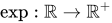

A good reference
The paper Buzzard, Kevin (16 May 2024). "Grothendieck's Use of Equality". The Mathematical and Philosophical Legacy of Alexander Grothendieck. arXiv:2405.10387. was added by Alsosaid1987 (talk · contribs) a couple weeks ago and then later removed by D.Lazard. While I don't think it was an ideal reference about notation specifically, I do think it's an excellent discussion that surely would be worth using for something in this (currently quite lightly cited) article. --JBL (talk) 23:35, 29 October 2025 (UTC)
Content Disclaimer
Informasi ini disarikan dari Wikipedia dan disajikan kembali untuk tujuan edukasi. Konten tersedia di bawah lisensi CC BY-SA 3.0. Kami tidak bertanggung jawab atas ketidakakuratan data yang bersumber dari kontribusi publik tersebut.
- The information displayed on this website is sourced in part or in whole from Wikipedia and has been adapted for the purpose of restating it. We strive to provide accurate and relevant information, however:
- There is no guarantee of absolute accuracy. Wikipedia is an open, collaborative project that can be edited by anyone, so information is subject to change.
- It is not intended to constitute professional advice. The content displayed is for informational and educational purposes only. For important decisions (e.g., medical, legal, or financial), please consult a professional.
- Content copyright. Wikipedia is licensed under the Creative Commons Attribution-ShareAlike License (CC BY-SA). This means that content may be reused with appropriate attribution and shared under a similar license.
- Responsible use. Any risk arising from the use of information from this website is entirely the responsibility of the user.