Talk:Intermodulation
Can't "intermodulation" apply to other things such as audio? Also it can be a signal in a piece of electronics, such as intermodulation distortion in an amplifi

 | This article is rated Start-class on Wikipedia's content assessment scale. It is of interest to the following WikiProjects: | ||||||||||||||||||||
| |||||||||||||||||||||
.jpg)


 | The content of IMD3 was merged into Intermodulation on 12 February 2020. The former page's history now serves to provide attribution for that content in the latter page, and it must not be deleted as long as the latter page exists. For the discussion at that location, see its talk page. |
Not just radio
Can't "intermodulation" apply to other things such as audio? Also it can be a signal in a piece of electronics, such as intermodulation distortion in an amplifier (or electromechanical IMD in a loudspeaker), not just broadcasted radio. I think it needs some work to broaden the article. --Howdybob 13:18, 1 July 2006 (UTC)
Agreed
It does apply and I've added a bit of what I know on the subject under the "Intermodulation Distortion" header.
--- jason | sterly 20:44, 8 July 2006 (UTC)
Thanks. I wrote that comment in part because this article mentioned "radio signals" which I later changed to just "signals." I'm wondering about the new material though, which I'll discuss at Talk:Intermodulation distortion. --Howdybob 21:53, 8 July 2006 (UTC)
IMD in music? Really?
Both IMD and harmonic distortion occur in music signals, AND instruments. Although instruments are more prone to harmonic distortion.
In my opinion, anything else is baloney.
Here's one reason why. For instruments; they are not tuned exactly on pitch frequencies, but slightly off. This is done to reduce the number of notes in the scale to 12. It is called "temperament," and is represented in Bach's "Well Tempered Clavier."
From my experiments when I started in this radio business in the late 50s, I found that a little bit of IMD (say under 1%) in a receiver is annoying, while 2% harmonic distortion is barely noticeable, and is not annoying.
More than two-tone IMD can even be worse. In the mid 80s I was asked about this and found that 4-tone IMD in a receiver has about 6 dB more energy than 2-tone IMD. The reason is there is more energy in 4-tone IMD, as it can be composed of fundamental signals rather than the classic 2-tome which contains a harmonic and fundamental. More energy in = more energy out.
Jim Ussailis
— Preceding unsigned comment added by 96.233.188.84 (talk) 00:55, 17 July 2013 (UTC)
Is it really IMD per se that is used in music and so forth, rather than just harmonic distortion in general? --Howdybob 02:30, 28 November 2006 (UTC)
A nonlinearity produces harmonic distortion when driven by a single pure sine wave. The same nonlinearity produces IMD when driven by anything more complex than a single pure tone. IMD is what 'harmonic distortion' becomes in the real world with real signals, but it's easier to understand by first understanding pure harmonic distortion, which only exists in isolation in the single tone case.
This also means that the section on Intermodulation in Audio Application is somewhat incorrect. IMD is not a special kind of distortion or fundamentally different from harmonic distortion. They are the same thing viewed and used different ways, different cases of the same nonlinearity. When an audio engineer purposely introduces harmonic distortion, (s)he is also inescapably introducing IMD. The math is very clear on this. ) Xiphmont (talk) 21:46, 18 January 2010 (UTC)
Yes, and no. A real-world device passing a signal will have some non-linearities, which result in distortion to some extent, both harmonic distortion and IMD will always be present. But these distortion names, along with SID and TID and so on, are just ways of quantifying aspects of the effects of non-linearity. Harmonic distortion is simply what harmonic distortion tests (sinewave into amplifier, followed by spectral analysis etc) measure! Admittedly, you don't get IMD while you are doing THD tests, because you are feeding it with just one frequency, but a real amplifier, speaker, etc will have distortion generation properties that people usually only measure with THD tests (and even then, often only at one frequency, one steady-state power level, and into an unnaturally "pure" resistive load). The point that probably needs to be hammered home most about the difference between HD and IMD is that it is possible to have an amplifier with really good THD figures, and even the best ears might not hear distortion on a pure tone, yet has audibly bad distortion due to IMD. It seems that 0.05% IMD is pretty audible, and that can happen with very low THD figures.
Maitchy (talk) 05:13, 7 February 2010 (UTC)
- I think that what your saying Maitchy is that a test of an amplifier for harmonic distortion may not reveal some nonlinear operations of that amplifier. Well I'd say that's possible, especially when the amplifier runs into the slew rate limitations that it wouldn't occur on the pure (say 1kHz) sine wave. The problem would be in THD testing. If THD were tested at high enough frequency, the distortion caused by a low slew rate would be revealed. But I also agree with Xiphmont, if one type of distortion is present, the other is too. Just that a particular input signal to an amp may not be distorted.--Aflafla1 (talk) 01:29, 14 November 2012 (UTC)
Detech Intermodulation system
developed in Invercargill, New Zealand by ASI limeted this system finds the cause of intermodulation in comercial ventures such as broadcast towers where rusty joints are the cause. This system can be carried on site and then a small handheld antena run over the tower until the cause/s has been found this saves time and effort only correcting the problem
Changes
I've attempted a first sweep at tidying up this article; here are a list of things that I've altered:
- Removed claim that the largest and second-largest IM products are second and third-order. This depends entirely on the coefficients of the Taylor series.
- Removed dubious distinction between "active" and "passive" intermodulation
- Removed claim that non-linearity will cause an infinite number of harmonics.
- Removed claim that higher-order harmonics will have less energy; again this is entirely dependent on the non-linear function in use.
- Changed subscripts from 1, 2, 3 to a, b, c, so as to reduce confusion with coefficients taking on integer values.
- Removed unnecessary introduction of "centre frequency".
- Removed distinction between "dominant" and "specific"; I've never heard of these distinctions, and can find no reference on the web to these terms being used in this sense.
- Removed discussion of "zone number"; again, I can find no reference to such a concept.
- Removed discussion of "conservation of power"; this is only true for passive devices; it is not so for general non-linear functions (e.g. amplifiers).
- Removed "Intermodulation distortion" section, as this is completely redundant.
I have not yet edited the "Intermodulation noise", "Use in music production", "Use in music production" and "Passive intermodulation" sections, but they also definitely need work.
If I have gone too far with something, or removed terminology for which sources can be found, please feel free to re-edit. Any comments would be appreciated also.
Oli Filth 00:15, 7 September 2007 (UTC)
- Please allow me to respond to your comments:
- Perhaps you will be OK with a phrasing that second and 3rd order intermods are usually the largest ones, if that's the case, just add that word.
- The article's intro should allude to the existence of passive intermods, as intermodulation is not expected in passive structures
- Since the Taylor Series is infinite, so is the number of intermodulation terms
- Since the power is finite, but the number of intermod terms is infinite, obviously higher order terms must die out
- Center frequency is a very useful concept to explain the higher order intermods
- If you would like to challenge use of the terms "dominant" and "specific", please use the {{fact}} template, but do not delete it.
- Same for the Zone Number
- Active devices must also obey the principle of conservation of power
- The "Intermodulation distortion" section was merged from its own article, and should be preserved, because it helps to give more practical applications to the intermodulations. Feel free to better incorporate it, but please do not delete it.
- --Mr. PIM 20:23, 12 September 2007 (UTC)
- Thanks for your comments. Here, in turn, are my responses (I've numbered your points for ease of reference):
- We'll need to think of an appropriate wording if we want to discuss 2nd and 3rd usually being the largest. Specifically, in many radio applications, even-order products are often insignificant. Perhaps something along the lines of "In many practical electronics applications, low-order IM products contain the most energy."
- Who says it's not expected? It's a critical design point, in say, audio transformers. At any rate, there is still a section devoted to this topic.
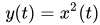
- This article is about intermodulation in general, not practical examples specifically. Whilst in most real-world applications, the transfer function will best be expressed by an infinite series; this is not a requirement for a non-linear system. In the general case, the power series expansion is not necessarily infinite. The simplest case is self-modulation, i.e. .
- Same as above.
- I don't see how talking about centre frequency helps. On the contrary, it just introduces another variable that the reader will have to keep track of.
- There is no requirement to leave in material that one thinks dubious. I have never seen these terms used, and can find no reference to them used in this context on the web. If you can show otherwise, then by all means provide a ref, and I'll be happy to re-add the discussion of them to the article.
- For active devices, it is simply not true (almost by definition) that "Conservation of power requires that the total power of the output signal must be less than or equal to the total power of the input signal".
- I've realised that I screwed up the section hierarchy in my series of edits. The majority of the "Intermodulation distortion" is still there; all I removed was the intro to that section, which was completely redundant. I'm in the process of sorting that out.
- Oli Filth 21:07, 12 September 2007 (UTC)
Zone number
On another look, it seems there are a few relevant references to e.g. "first zone" + intermodulation. However, I'm not sure that in this context, the "zone number" is defined by the sum of the intermod coefficients; instead, the "mth zone" would seem to be defined (I'm guessing here) as "the region of spectrum surrounding the m'-th harmonic of the carrier frequency".
Now, in the case where all the original frequency components are closely bunched around the carrier (e.g. in a radio context), then I can see that the formula for would more or less tally with this definition I just made up. However, in the more general case, where there is no bunching around a carrier (e.g. an audio signal, or a wideband transmission), such a relationship isn't meaningful.

Therefore, I'm still sceptical of the definition of zone number being "the sum of the intermod coefficients". Oli Filth 07:01, 13 September 2007 (UTC)
Linear systems
I made two changes to the section "causes of intermodulation".
- First, I deleted the leading words "By definition" because the definition of a linear system is that if f(x)=a and f(y)=b then f(x+y)=a+b and that f(kx)=kf(x). The definition doesn't mention the presence or absence of intermodulation.
- I also added the qualifier "time invariant" because this is a necessary condition for the statement to be true. A counter-example is a mixer, which multiplies its input by sin(wt). This is a linear, time varying system, with frequencies not present in the input.
Serrano24 15:03, 12 September 2007 (UTC)
- You are missing the point of the definition of a linear system. If a linear system has a sinusoidal input, the output by definition, is a sinusoid of the same frequency as the input sinusoid, but possibly a different amplitude or phase. Therefore, a linear system cannot have intermodulations, since the output will be the exact same frequencies of the input signals. --Mr. PIM 20:09, 12 September 2007 (UTC)
- I'm assuming that we're talking about LTI systems here, not just linear. I agree with Serrano24; the definition of an LTI system is, of course, that it obeys the properties of linearity and time-invariance. One resultant property of such systems is that complex exponentials (and therefore sinusoids) are eigenfunctions; but this is not in any way the definition. Oli Filth 20:18, 12 September 2007 (UTC)
- OK, changed from "by definition" to "a consequence". --Mr. PIM 20:29, 12 September 2007 (UTC)
- I'm assuming that we're talking about LTI systems here, not just linear. I agree with Serrano24; the definition of an LTI system is, of course, that it obeys the properties of linearity and time-invariance. One resultant property of such systems is that complex exponentials (and therefore sinusoids) are eigenfunctions; but this is not in any way the definition. Oli Filth 20:18, 12 September 2007 (UTC)
- "The consequence of a linear system is that it cannot produce intermodulations" doesn't really read properly. This could be re-worded as "One consequence of the property of linearity is that such a system cannot produce intermodulation". But what's wrong with just leaving it as it was: "A linear system cannot produce intermodulation"? Oli Filth 20:33, 12 September 2007 (UTC)
"Problems in live audio" section
I'm not convinced of the factual accuracy or relevance of this section. It seems to be more interference in general, rather than intermodulation. Can someone please tidy this up, and/or add an appropriate reference.
Regards, Oli Filth 21:16, 12 September 2007 (UTC)
- I've now removed the section. It may be retrieved, if necessary, from this edit. Oli Filth 18:34, 14 September 2007 (UTC)
- This section, as of May 2008, is completely incorrect. It is clearly describing gain compression and harmonic distortion, which should not be confused with intermodulation distortion. Nimur (talk) 16:11, 22 May 2008 (UTC)
- I have rewritten this section, I hope it clears up the important distinction between harmonic distortion in general, and intermodulation in particular. Nimur (talk) 16:15, 22 May 2008 (UTC)
- This section, as of May 2008, is completely incorrect. It is clearly describing gain compression and harmonic distortion, which should not be confused with intermodulation distortion. Nimur (talk) 16:11, 22 May 2008 (UTC)
- It seems that there's a widespread misconception about intermodulation for audio processing - I think because the word sounds cool, everyone wants to call everything "intermodulation" even when it clearly doesn't fit the definition. I just brought up this issue at User_talk:207.41.32.94, after these edits which were not factually correct. Nimur (talk) 15:23, 3 March 2009 (UTC)
- I'm confused. The result of a nonlinearity in an audio chain results is harmonic distortion if the driving signal is a single pure tone and IMD in every other case. How are harmonic distortion and IMD fundamentally different? Any differences are contextual distinctions. If I as an audio engineer apply a tube-like nonlinearity to a track, I am introducing IMD. I understand there's a practical distinction to be made with respect to desired effects, but the claim as stated refutes all the preceeding math and as such is confusing if not incorrect. Xiphmont (talk) 21:55, 18 January 2010 (UTC)
Intermodulation products of Intermodulation products
I will give a simple example. 3 equal signals, 50 Hz, 240 Hz and 1000 Hz and the intermodulation products at 950 and 760 Hz were both -40 db referenced the fundamental levels.
Would you expect the intermodulation products at 760 + - 50 Hz to be -80 dB below the same reference ?
If so, this is not the case with loudspeaker drivers. Please comment. Pm5057 (talk) 10:30, 4 March 2009 (UTC)
- I would expect the levels of second-order products to be even less than -80 dB. Why? Because intermodulation is a non-linear effect, and every real system gets more and more linear as the signals get smaller and smaller (pretty much by definition). —Keenan Pepper 23:37, 4 March 2009 (UTC)
- Not necessarily. See crossover distortion, for instance. Oli Filth(talk|contribs) 00:34, 5 March 2009 (UTC)
- That's a very good point, and in that case the second-order products could be much greater than -80 dB. So the conclusion is that you can't tell how strong they'll be without knowing other details of the system. —Keenan Pepper 15:18, 5 March 2009 (UTC)
I am not sure what to expect in a 'linear' distortion system with no discontinuities like crossover effects or hysteresis. I was hoping that the mathematicians out there could help. In the loudspeaker systems tested, distortion products vanish as the levels fall, 10dB drop in fundamental level causes a 20 dB decrease in intermodulation products. Pm5057 (talk) 23:19, 5 March 2009 (UTC)
Intermodulation vs Modulation vs Cross-modulation, and intentional/unwanted intermodulation
Intermodulation is a subset of (amplitude) modulation, in that lots said about modulation applies, and cross-modulation* is a subset of intermodulation. Well, mostly... It is not as easy as I first thought to differentiate between the three terms.
The simplest definition is pretty close to useful: Amplitude Modulation is the multiplication of one signal by another... loose ends in the definition include depth of modulation and the difference between pure multiplication (so either signal zero => output zero? or => normal strength level of other signal - as in normal AM modulators compared with DSB-suppressed carrier) and the other loose end is modulation which is pure, clean multiplication (only adds sum and difference frequencies) and the modulation that happens in non-linear devices (lots of A+2B, #A+6B, etc.). Then Intermodulation is modulation where the signals being modulated come via the same path, i.e. it is between components of a mixed frequency input, one component modulating another. That is good up to a point. But consider UHF mixer diodes, etc... the two signals to be modulated (mixed) may very well be mixed before going into a single non-linear device. Most people would not use the term "intermodulation" but modulation to describe what is going on there. Is popular usage "wrong" or inconsistent? Maybe. It is difficult.
- Cross modulation is intermodulation in that the two (or more) signals are now joined at (say) the input of the first RF stage, and will modulate each other to produce interference, but those signals came originally from different stations, and are only together because the receiving aerial picked them up (due to lack of directionality).
And it relates to the question of "good"/desirable intermodulation vs "bad"/unwanted. IMD is not desirable in the sense that people go out to generate it like they do with harmonic distortion. But they do generate IMD to some extent when they use a fuzz box or Marshall amp in overdrive. And they do add deliberate amplitude modulation, not what I'd call Intermodulation though, in tremolo and ring-modulation effects. The signal modulating the sound source is decidedly a separately generated signal. In implementing the effect they may very well (although it is rare) use a circuit that first mixes them and passes the combination to a single non-linear device (i.e. Intermodulation - but is it Intermodulation "DISTORTION" then??).
I tend to say "Intermodulation Distortion" is always unintentional, but intermodulation may be deliberate (as a way to achieve amplitude modulation for, say, frequency changer stages of superhet radios, for tremelo, and so on).
Thoughts??
Maitchy (talk) 05:37, 7 February 2010 (UTC)
Self-Promotion on Wikipedia?
It appears that changes made by the unknown user 128.46.215.128 were all but about a minor and very specific side of passive intermodulation (PIM), thus giving undue prominence to some otherwise quite minor effect (namely PIM due to nonlinear magnetization-inductance hysteresis). Not only this, but also the unknown user has inserted references to two obscure works, yet quoted as ref.1 and 2 in the main article (as if these were the most important sources for the article). Finally, when I checked the other contributions of the same unknown user, it transpired that they were again of similar nature, namely quotations of works from the very same authors (somebody Henrie, J., Christianson, A. and Chappell, W.). I find this to be self-promotion and use of original research, which both are prohibited on Wikipedia. Unless the unknown author steps forward and provides some reasonable arguments for their behaviour I suggest that the section on PIM is trimmed in order not to give the reader the false impression that the "nonlinear magnetization-inductance hysteresis" is the most important effect in PIM and that the two quoted original works are the most important works for the main article (plus, the links to the two works actually lead to a site which requires paid subscription in order to be viewed -- do the authors benefit from each purchased copy of their work?). Finally, Wikipedia should not be used as a means of increasing the authors "quotation index" and any edits of the articles should not be just inserting links to the the same author's original research works (as it appears to be the case with user 128.46.215.128).Plamen Grozdanov (talk) 12:45, 7 February 2010 (UTC)
- Or it could just be that someone has found an "eye opening experience" in some papers and is eager to share this with the Wikipedia.192.139.122.42 (talk) 23:26, 30 July 2012 (UTC)
PIM...not quite the minor effect!
Note that PIM is not the minor effect it is made out to be in the aforementioned paragraph # Self-Promotion on Wikipedia?. It is a very current topic, with specific interest to cellular operators and RF component manufacturers. PIM manifests itself as distortion/interference in the uplink (receive) band of cellular base-stations and as such this topic has gained all the more interest. Low PIM has become one of the important quality metrics for the construction of reliable cellular (RF) infrastructure. Expect to see more posts on this topic in future. --TiQuA (talk) 22:33, 15 May 2012 (UTC)
...
You would think that someone copy-pasting whole paragraphs from kaelus PIM testing guidelines sheet would have the decency to add it as a source/refer to it... http://www.kaelus.com/Kaelus/media/Site/QR%20Code%20Files/PIM-Testing-Guidelines_Brochure.pdf — Preceding unsigned comment added by 84.109.17.180 (talk) 04:17, 30 May 2013 (UTC)
SID
It is the same thing as TIM per the very references cited on that page. 86.121.137.79 (talk) 16:29, 29 December 2014 (UTC)
This subject should be split up
The subject of Intermodulation, which results in Intermodulation Distortion, is most relevant to the area of Telecommunications. Intermodulation, both active and passive (PIM) are key parameters in the performance of radio systems, including cellular, Private Mobile Radio (PMR) and satellite systems. Therefore I suggest that the main subject would be transferred to the Technology Portal, while the matters more relevant for the audio industry would be collected under a subject "Audio Distortion" (to distinguish it from the many other generic forms of distortion, like optical, mechanical, etc.) under a suitable portal. Under the Audio Distortion section, Intermodulation would form one section, where the others could be Harmonic Distortion and Slew-Induced Distortion, possibly adding passive distortion in e.g. loudspeakers. The very academic approach taken here is not necessary for the understanding of Intermodulation, while some level-dependent graphs would illustrate the subject much better. Telecommunication textbooks have ample material about IM.Seniortechie (talk) 06:45, 2 January 2015 (UTC)
- No. Intermodulation distortion is a thing that happens to signals. It doesn't matter if they are radio or audio signals. 71.167.59.26 (talk) 17:48, 17 April 2016 (UTC)
This subject, "Intermodulation" should ONLY be about "Electromagnetic Compatability"
The intermodulation known in the field of RF communications has NOTHING to do with the Audiophile term, "Intermodulation Distortion" ("IMD").
Intermodulation on the other hand is a known fact of life in the RF domain, and both active (within an analog amplifier) and passive ("rusty hardware") IM can cause serious EMC issues. At "Antenna Farm" locations, there are many frequencies that cannot be used for receiving, due to the complex Passive IM products being created by non-linear conduction (e.g.: rectification) caused by loose, dirty and corroded hardware on dozens of towers, as well as the Active IM products caused by transmitter Power Amplifiers receiving some of the RF from other nearby transmitters and combining all the signals in a non-linear region of the amplifier's operation. This can become a problem that simply cannot be fully resolved due to to the multitude of sources. When you add wind and weather to the equation, you can find yourself in a maddening world or random, intermittent IM interference, that for all practical purposes is impossible to solve without one or more of the transmitters or receivers changing frequency. — Preceding unsigned comment added by Joe Shupienis (talk • contribs) 20:04, 8 March 2015 (UTC)
- No, this article is about intermodulation, which occurs in both audio and radio. They are the same thing. 71.167.59.26 (talk) 17:49, 17 April 2016 (UTC)
Assessment comment
The comment(s) below were originally left at Talk:Intermodulation/Comments, and are posted here for posterity. Following several discussions in past years, these subpages are now deprecated. The comments may be irrelevant or outdated; if so, please feel free to remove this section.
| As for the audio aspect: While some engineers may introduce more intermodulation distortion into a recording, I doubt this is intentional. Additional "harmonic" distortion is what will add to the "pleasantness" of a sound (see below). Usually, IM distortion is regarded as a loss of clarity and depth, something that isn't desirable in a recording. Clarification: Only the even harmonics (2nd, 4th, etc.) are deemed "pleasant" (they are octave additions); odd harmonics (3rd, 5th, 7th, etc) are deleterious and avoided in good audio design. Of course, no harmonics add to fidelity, they just change the sound subjectively. Analogdino (talk) 16:42, 29 August 2012 (UTC) |
Last edited at 16:42, 29 August 2012 (UTC). Substituted at 19:00, 29 April 2016 (UTC)
Content Disclaimer
Informasi ini disarikan dari Wikipedia dan disajikan kembali untuk tujuan edukasi. Konten tersedia di bawah lisensi CC BY-SA 3.0. Kami tidak bertanggung jawab atas ketidakakuratan data yang bersumber dari kontribusi publik tersebut.
- The information displayed on this website is sourced in part or in whole from Wikipedia and has been adapted for the purpose of restating it. We strive to provide accurate and relevant information, however:
- There is no guarantee of absolute accuracy. Wikipedia is an open, collaborative project that can be edited by anyone, so information is subject to change.
- It is not intended to constitute professional advice. The content displayed is for informational and educational purposes only. For important decisions (e.g., medical, legal, or financial), please consult a professional.
- Content copyright. Wikipedia is licensed under the Creative Commons Attribution-ShareAlike License (CC BY-SA). This means that content may be reused with appropriate attribution and shared under a similar license.
- Responsible use. Any risk arising from the use of information from this website is entirely the responsibility of the user.