Talk:Hyperboloid

 | This article is rated C-class on Wikipedia's content assessment scale. It is of interest to the following WikiProjects: | ||||||||||
| |||||||||||


Wrong wire model

The wire model (at right) is wrong. In spite of what the source website claims, it is not a hyperboloid but a ruled surface that is generated by lines that connect two cricles traversed in *oposite* senses. It is a ruled *self-intersecting* surface with two pinch points. It contains only *one* family of straight lines, and one isolated straight line connecting the two pinch points. All the best, --Jorge Stolfi (talk) 21:27, 21 February 2010 (UTC)
- I removed the wire model pending confirmation. --Jorge Stolfi (talk) 21:52, 21 February 2010 (UTC)
- Please let's centralize the discussion of this image in Talk:ruled surface. Thanks, --Jorge Stolfi (talk) 22:23, 21 February 2010 (UTC)
Comment. The wire model was wrong. I have corrected the image at commons. Sławomir Biały (talk) 14:27, 22 August 2010 (UTC)
Elliptic?
The legend to this image states that it is elliptic. I thought that an elliptic surface had positive curvature and no parallel lines - this surface has negative curvature and lots of parallels. Can somebody explain what is going on? — Cheers, Steelpillow (Talk) 18:51, 23 October 2010 (UTC)
- Elliptic here means that horizontal sections are ellipses rather than circles. It's still a negatively-curved surface. —Tamfang (talk) 22:35, 29 June 2011 (UTC)
- Yes, I agree with Tamfang. However, it appears to me that this is the special case of an elliptic hyperboloid called a circular hyperboloid. Should we call it that instead? --DavidCary (talk) 03:55, 4 April 2012 (UTC)
roofs
- .... Examples include cooling towers, especially of power stations, and saddle roofs of large buildings.
I've heard of hyperbolic paraboloids as roofs; that's also doubly ruled and negatively curved. But has the hyperboloid of one sheet also been so applied? —Tamfang (talk) 22:35, 29 June 2011 (UTC)
- You're right. I was looking for other examples of structures and found roofs via hyperboloid structures, and assuming the section is a summary of that article added the above while trying to improve it. I've changed it to point to the list of structures.--JohnBlackburnewordsdeeds 23:09, 29 June 2011 (UTC)
hyperboloid vs hyperbolic paraboloid
It's pretty easy for me to look at a small part of a surface and distinguish between a hyperboloid of one sheet and a hyperboloid of two sheets (by looking at the local Gaussian curvature). Is it possible to look at a small part of a surface and distinguish between a hyperbolic paraboloid and hyperboloid of one sheet? In particular, how do you tell whether the roof of the Scotiabank Saddledome is (a small part of) a hyperbolic paraboloid or a hyperboloid of revolution of one sheet? --DavidCary (talk) 04:16, 4 April 2012 (UTC)
A Commons file used on this page has been nominated for deletion
The following Wikimedia Commons file used on this page has been nominated for deletion:
Participate in the deletion discussion at the nomination page. —Community Tech bot (talk) 08:37, 10 June 2019 (UTC)
Nonsense
The introductory section contains this paragraph:
"There are two kinds of hyperboloids. In the first case (+1 in the right-hand side of the equation), one has a one-sheet hyperboloid, also called hyperbolic hyperboloid. It is a connected surface, which has a negative Gaussian curvature at every point. This implies that the tangent plane at any point intersects the hyperboloid at two lines, and thus that the one-sheet hyperboloid is a doubly ruled surface. "
It is of course true that the hyperboloid of one sheet is a doubly ruled surface.
But it is nonsense to say:
"[The hyperboloid of one sheet] has a negative Gaussian curvature at every point. This implies that the tangent plane at any point intersects the hyperboloid at two lines"
Having negative Gaussian curvature at every point emphatically does not by itself imply that the tangent plane at any point intersects the surface in two lines.
For instance, consider the inner half of a torus of revolution, whose tangent planes never intersect the surface in even one line.50.205.142.35 (talk) 02:18, 4 February 2020 (UTC)
- Good point. In fact, this was a shortcut, and I have fixed it. D.Lazard (talk) 08:59, 4 February 2020 (UTC)
Choice of coordinate system
The article says:
- Given a hyperboloid, if one chooses a Cartesian coordinate system whose axes are the axes of symmetry of the hyperboloid and the origin is the center of symmetry of the hyperboloid, then the hyperboloid may be defined by one of the two following equations:
- or
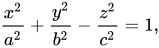
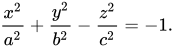


But I think we need to specify the choice of coordinate systems more precisely for this to be true. In both equations, the coefficients of x^2 and y^2 have the same sign, while that of z^2 has the opposite sign. All planes parallel to the xy-plane will intersect the hyperboloid in ellipses (or not at all), while planes parallel to the z axis (including all planes parallel to the xz- or yz-plane) will intersect in hyperbolas (or as a limiting case in a pair of intersecting straight lines).
I was tempted to add "and having the z axis as an axis of rotation", but unless a=b that is not true. One could say something like this:
- Given a hyperboloid, if one chooses a Cartesian coordinate system whose axes are the axes of symmetry of the hyperboloid and the origin is the center of symmetry of the hyperboloid. Planes perpendicular to one of the three axes of symmetry will intersect the hyperboloid in closed curves (or in a single point, or not at all). Let this be the z-axis. Then, the hyperboloid may be defined by one of the two following equations:
Or like this:
- Given a hyperboloid, if one chooses a Cartesian coordinate system whose axes are the axes of symmetry of the hyperboloid and the origin is the center of symmetry of the hyperboloid, then by choosing the right one of the three axes of symmetry to be the z-axis, the hyperboloid may be defined by one of the two following equations:
I'm not happy with either of these. Is there a less cumbersome way to make this correct?--Nø (talk) 09:31, 11 November 2022 (UTC)
- I have fixed the formulation. In fact, the problem was not that the coordinates system was not sufficiently specified. It lies in the formulation with "if one chooses" without saying how one can choose (this is a theorem that is not si easy, and does not belong to the lead.). So I have replaced "if one chooses" by "one can choose", and moved as a corollary the fact that the coordinate axes are axes of symmetry. D.Lazard (talk) 10:40, 11 November 2022 (UTC)
- I think that is a good solution! There was another small thing irritating me before; viz. the fact that the choice of x- and y-axes was open for rotational hypeboloids. That is no longer a problem. Thanks!--Nø (talk) 10:45, 11 November 2022 (UTC)
Content Disclaimer
Informasi ini disarikan dari Wikipedia dan disajikan kembali untuk tujuan edukasi. Konten tersedia di bawah lisensi CC BY-SA 3.0. Kami tidak bertanggung jawab atas ketidakakuratan data yang bersumber dari kontribusi publik tersebut.
- The information displayed on this website is sourced in part or in whole from Wikipedia and has been adapted for the purpose of restating it. We strive to provide accurate and relevant information, however:
- There is no guarantee of absolute accuracy. Wikipedia is an open, collaborative project that can be edited by anyone, so information is subject to change.
- It is not intended to constitute professional advice. The content displayed is for informational and educational purposes only. For important decisions (e.g., medical, legal, or financial), please consult a professional.
- Content copyright. Wikipedia is licensed under the Creative Commons Attribution-ShareAlike License (CC BY-SA). This means that content may be reused with appropriate attribution and shared under a similar license.
- Responsible use. Any risk arising from the use of information from this website is entirely the responsibility of the user.