Talk:Homogeneous coordinates
About One Point Is Affine And The Other At Infinity: I think this is misleading. After all, by a projective transformation one can put both points in general po

 | This article is rated C-class on Wikipedia's content assessment scale. It is of interest to the following WikiProjects: | ||||||||||
| |||||||||||

2004/5 discussion
About One Point Is Affine And The Other At Infinity: I think this is misleading. After all, by a projective transformation one can put both points in general position - which is the first case considered. In fact it is 'illegal' to speak about (0:0:0:0).
Charles Matthews 07:49, 14 Jul 2004 (UTC)
I believe the whole linear combinations paragraph is useless and inelegant. We already have the definition of scalar multiplication and addition - and exactly to avoid these problem, we do rescaling by multiplying for the last coordinate (w) of the other point - which avoids the = 0 special case. Additionally, the current text is probably incorrect when - and this brings an interesting point up: which is the result of ?

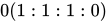
I do not see your point about applying the projective transformation - yes, we can apply the transformation, add the two points and transform them back, but there is no point in using that.
Paolo Giarrusso 18:01, 8 December 2005 (UTC)
The definition of addition for a pair of projected points doesn't look correct in the case that both of those points are in the plane at infinity.
left and right homogeneous coordinates
Homogeneous coordinates of quaternion vector spaces can be either left or right. That is one can specify that left multiplication by quaternions produces equivalent coordinates, or right multiplication does. Is left and right homogeneous coordinates, standard terminology to refer to both these situations? --MarSch 10:35, 19 October 2006 (UTC)
Notation and terminology
First, the term homogeneous coordinates has a generic meaning in addition to the one given here, namely any system of coordinates where multiplying by a constant does not affect the position of the point represented. So in this sense, barycentric coordinates and trilinear coordinates are homogeneous but aren't the same as the coordinates defined here. Perhaps projective coordinates would be a better term here.
Second, I couldn't find anything about square brackets vs. round brackets in the reference given. In any case, this seems to only apply to the context a specific work and is not a generally accepted notation.
Third, the use of colons for homogeneous coordinates is justifiable since they really represent ratios. But this article uses them with ordinary Cartesian coordinates which seems highly non-standard.
In general, there should be more sources used to insure that the notation and terminology follows accepted usage and not that of an individual source.--RDBury (talk) 23:54, 18 September 2009 (UTC)
- I addressed these and other issues, along with general expansion of the article.--RDBury (talk) 21:38, 30 April 2010 (UTC)
Equivalence relation symbol
Shouldn't the equivalence relation symbol (found in the Alternative Definition section) be ∼ (U+223C, like the that LaTeX generates) instead of ~ (the tilde, U+007E, to which the keyboard key is normally mapped)? In some fonts I suspect they are indistinguishable, and in others similar, but in e.g. the font in which I prefer to read Wikipedia the tilde appears very high up in the character box (as if it were an accent, but with no letter underneath). Is there some reason not to use the (arguably) more semantically correct code point (which is found in the Mathematical Symbols category of Unicode)? Maybe it doesn't render on some systems? I ask because I already made the change and was reverted. Archelon (talk) 22:34, 29 February 2016 (UTC)

- On my browser (Safari), ∼ (U+223C ) is so tiny that it is
almost unreadablehard to distinguish from "-" , and is lower than the middle of the line, while ~ (the tilde, U+007E) has the right size and position. This is the reason of my revert. On the other hand, Latex (with MathML rendering) produces a much larger symbol, that is above the middle of the line. Note also that ∼ (U+223C ) is not easily available for editors, as it does not appear in the symbols proposed by the WP engine. Also, rare unicode symbols may have a strange appearance im many fonts. For example, the double arrows (⇐ and ⇒) have different sizes and alignments on my browser. D.Lazard (talk) 10:56, 1 March 2016 (UTC)- Thanks for assuaging my curiosity. Quite possibly you and other Safari users could improve what you see for rare unicode characters by installing one or more fonts, but of course things should appear as correctly as possible by default for the most typical cases. It is unfortunate that there is so often no canonical solution for typesetting math in Wikipedia; someday perhaps I will look more deeply into this problem. Archelon (talk) 20:38, 4 March 2016 (UTC)
Change of coordinate systems
this need more clarification. so go back the R3, (a, b, c) is the normal vector, which determines the plane ax+by+cz = 0. and for any given z it is the line to represent the homogeneous line, specifically ax+by+c=0 when z=1. the matrix A is a coordinate system with 3 axial vectors, X=ax+by+cz is the new first coordinate of (x,y,z) in A system, which is the projection of (x,y,z) to (a,b,c) (the directional distance from the plane Z=ax+by+cz=0 to (x,y,z) ), and scales to |(a,b,c)|. in any plane of given z, A's 3 directional planes X=0,Y=0, Z=0 produce 3 directional lines, which again produce 3 directional homogeneous distances d1(z), d2(z), d3(z) to any homogeneous point (x,y,z) in the plane with given z. and d1(z):d2(z):d3(z) will not change with z. — Preceding unsigned comment added by 221.220.133.130 (talk) 03:58, 21 April 2018 (UTC)
- Your post is difficult to understand, as "homogeneous distance" is never defined. Nevertheless, the corresponding section of the article was not clearer. I have just edited it.
- It should emphasized that a homogeneous system of coordinates in the projective plane is uniquely defined by four points in the projective plane, any three of which being not collinear. These are the points with two coordinates equal to zero and the points with all coordinates equal. Thus three lines do not suffices for defining a homogeneous system. I have thus removed the confusing second part of the section, because there is no well-defined "triangle of reference". D.Lazard (talk) 10:32, 21 April 2018 (UTC)
Alternative definition
I find the second paragraph of this section confusing. ax + by + cz = 0 defines a plane in R3, but the text of a subsequent section (Line coordinates and duality) describes it as a line. If we interpret the coordinates of points in this plane as homogeneous coordinates, then we get many different equivalence classes. Is this a line in RP2 of lines in R3? I get confused about what 'line' means in these discussions. And what does the third sentence about the mapping (x, y) → (x, y, 1) have to do with the previous sentences? DavidRideout (talk) 18:51, 2 April 2021 (UTC)
Should there be pictures?
This is a quite extensive article about a topic in geometry which contains no explanations using pictures. This is in spite of the fact that homogenous coordinates have a very nice visual explanation: a point in projective space is a line through the origin in a higher dimensional vector space, and homogenous coordinates are the components of its direction vector. Also, there are nice visual explanations of how to embed affine space into projective space using homogenous coordinates: embed affine space in the next higher dimensional affine space and pick a point $P$ not on the embedded space, draw a line through $P$ with direction vector $(x,y,z)$, and the point where the line intersects the embedded space is the one that gets homogenous coordinates $[x:y:z]$. Geometry is one of the fields most suited to visual explanations. I think this suitability should be utilized. Vercassivelaunos (talk) 10:09, 11 November 2020 (UTC)
- A picture cannot replace a textual explanation. However, I agree that things are easier to understand if textual explanations are supported by figures. You are free to add pictures to this article if you find relevant ones in Wikipedia Commons or if you are able to design new ones and uploading them into Wikipedia Commons. D.Lazard (talk) 10:58, 11 November 2020 (UTC)
- Images representing the points in the projective lines over GF(5) and GF(7) are used in the article projective line over a ring. — Rgdboer (talk) 05:11, 12 November 2020 (UTC)
- A picture should always replace a textual explanation. 2603:8080:1000:39AC:7D08:926C:3DA7:DD5 (talk) 06:50, 11 May 2024 (UTC)
Content Disclaimer
Informasi ini disarikan dari Wikipedia dan disajikan kembali untuk tujuan edukasi. Konten tersedia di bawah lisensi CC BY-SA 3.0. Kami tidak bertanggung jawab atas ketidakakuratan data yang bersumber dari kontribusi publik tersebut.
- The information displayed on this website is sourced in part or in whole from Wikipedia and has been adapted for the purpose of restating it. We strive to provide accurate and relevant information, however:
- There is no guarantee of absolute accuracy. Wikipedia is an open, collaborative project that can be edited by anyone, so information is subject to change.
- It is not intended to constitute professional advice. The content displayed is for informational and educational purposes only. For important decisions (e.g., medical, legal, or financial), please consult a professional.
- Content copyright. Wikipedia is licensed under the Creative Commons Attribution-ShareAlike License (CC BY-SA). This means that content may be reused with appropriate attribution and shared under a similar license.
- Responsible use. Any risk arising from the use of information from this website is entirely the responsibility of the user.