Talk:Gerbe
As far as I know there is still no definition of "gerbe" (as with "stack") that is accepted by everyone. Giraud is one alternative, but there are probably almos

 | This article is rated Start-class on Wikipedia's content assessment scale. It is of interest to the following WikiProjects: | ||||||||||
| |||||||||||

Untitled
As far as I know there is still no definition of "gerbe" (as with "stack") that is accepted by everyone. Giraud is one alternative, but there are probably almost as many different definitions as people you can ask about them. At the moment I would feel more comfortable discussing "gerbes in the sense of Giraud...", "gerbes in the sense of Murray...", etc. instead of gerbes in general. - Gauge 04:22, 9 November 2005 (UTC)
Reply
The definitions are in fact reasonably close to each other, even though this is not necessarily apparent at the outset. At least as things stood a few years ago, Giraud's gerbes are the general ones, and the other definitions are essentially reworked definitions of special cases. I'll try to explain briefly, and will try to find time to expand this properly some time later.
The background is that for a sheaf G of groups on a space X the first cohomology classifies G-torsors (principal bundles) on X. Easy example: isomorphism classes of (holomorphic) -principal bundles on a complex manifold are the same as isomorphis classes of (holomorphic) line bundles. The sheaf of sections of the (relative) group is just . And classifies the (holomorphic) line bundles.


Importantly, the cocycle-description of first cohomology leads quickly to the interpretation of the first cohomology with noncommutative coefficient sheaf as isomorphism classes of torsors over the noncommutative group. This leads to the question of whether second cohomology with nonommutative coefficients could be given meaning as a set of isomorphism classes of some new geonetric structures. Giraud's gerbes are these structures.
A gerbe (definition will go to the article when have time, but essentially a sheaf of groupoids (categories with all morphism isomorphisms) with certain gluing and local non-emptiness conditions) defines an associated object called band (lien in French). A band in general is represented as a collection of (possibly noncommutative) sheaves of groupes on an open cover of X, satisfying certain relations modulo inner automorphisms (produced from the sheaves of isomorphisms of objects in the section-groupoids of the gerbe). The important point is that a meaningful noncommutative second cohomology theory (with long exact sequence extending to the third cohomology of an abelian sheaf when applicable) can be built where the second cohomology with coefficients in a band L classifies gerbes with band L. There is also a cocle-type description of the cohomology classes, similar to the one associated with ordinary (commutative or not) first cohomology.
Now if the sheaves that make up the band are commutative, they glue to give a normal abelian sheaf. In this case the cocycles are normal Cech cocycles for the sheaf, and the theory gives them and "interpretation" as the gerbe that corresponds to the cohomology class.
So finally to Brylinski's gerbes: he gives alternative descriptions / interpretations of gerbes where the band is the commutative group sheaf , or in other words of -gerbes.
As can be seen from the above, the Brylinski-type gerbe stays quite far from the seriously involved parts of the theory.
Stca74 15:43, 15 May 2007 (UTC)
Where did the word come from?
Is there any funny story about this? Is gerbe similar to some word in French or Flemish? Or did the inventor just put five random letters together and hope they were pronouncable?
With other items of jargon -- sorry, "terms of art" -- like "stack" and "groupoid" and "band" at least there is a sense of some horrifically-distant everyday concept to hang onto the thing, but "gerbe"? If it's not a small animal reputedly stuffed into Jerry Penacoli's bottom then I don't know what it is. 69.248.200.36 02:16, 30 August 2007 (UTC)
- The word gerbe in the mathematical context is directly adapted to English from French, but the word actually existed in both langages long before Giraud decided to use it for the basic construct in his theory of non-abelian (second) cohomology. In French the word with today's orthography dates from the XIV century, preceded by jarbe in the XII century. The etymology of the word goes back to Frankish garba (or garbe). The present French meaning of the word is:
- a sheaf of cereals (e.g., wheatsheaf);
- by extension, a bouquet of flowers etc; and
- by further extension, a similar form or shape in expressions such as "gerbe d'eau".
- In English the word has been used (borrowed from French) since the late XVI century. Current meaning according to the OED is "something resembling a wheatsheaf in form or appearance; esp. a kind of firework"; the original literal meaning (wheatsheaf) has been obsolete since early XIX century (again according to the OED).
- In a way, there is a subtle mismatch in the French and English terminologies for "bundle-like" geometrical objects. What is called bundle (e.g., a fibre bundle or a vector bundle) in English is fibré (e.g., espace fibré, fibré vectoriel) in French. Thus when translating faisceau into English the word bundle, although it would be arguably a more precise translation, was not available anymore, and the objects introduced by Leray became known as sheaves in English. This, in turn, meant that when Giraud introduced gerbes in the late sixties, the more easily recognisable word sheaf was not available, and translators have had to settle with the more obscure (if etymologically accurate) word gerbe in English as well. Stca74 12:19, 2 September 2007 (UTC)
Note that 'Gerbe' is also the German word for 'sheaf' both with the mathematical and with the agricultural meaning. —Preceding unsigned comment added by Quarague (talk • contribs) 14:14, 26 May 2010 (UTC)
- This would actually be Garbe, not Gerbe. But, as in English, Garbe had already been used as a translation of faisceau because Bündel had already been used ... --129.132.146.194 (talk) 13:46, 10 December 2012 (UTC)
Can anybody please give the correct pronunciation of gerbe (in IPA if possible)? VladimirReshetnikov (talk) 20:02, 10 February 2012 (UTC)
Assessment comment
The comment(s) below were originally left at Talk:Gerbe/Comments, and are posted here for posterity. Following several discussions in past years, these subpages are now deprecated. The comments may be irrelevant or outdated; if so, please feel free to remove this section.
* See the Reply point on the talk page for a quick summary on what needs to be developed regarding the various definitions.
|
Last edited at 15:46, 15 May 2007 (UTC). Substituted at 02:09, 5 May 2016 (UTC)
Examples
- Section 31 of https://stacky.net/files/written/Stacks/Stacks.pdf
- https://mathoverflow.net/questions/19290/why-do-gerbes-live-in-h2
- On Gromov-Witten theory of root gerbes - https://arxiv.org/abs/0812.4477
- Counting twisted sheaves and S-duality - https://arxiv.org/abs/1909.04241
Rational and complex twists of line bundles
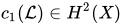
- Basically, twisted differential operators can be interpreted as Gerbe's. For example, is a twisted differential operator whose Atiyah class is an integral value in . Since there is a bijection between atiyah classes and twisted differential operators, a gerbe is formed from any rational or complex value. On this gives examples of Gerbes from the classes ! These can be pulled back to other projective varieties. Can every twisted coherent sheaf be formed by an exact sequence of such gerbes?
- https://mathoverflow.net/questions/1721/what-do-gerbes-and-complex-powers-of-line-bundles-have-to-do-with-each-other
- https://mathoverflow.net/questions/37926/what-is-a-twisted-d-module-intuitively
- http://people.math.harvard.edu/~gaitsgde/grad_2009/Ginzburg.pdf



Higher Gerbers
- An Invitation to Higher Gauge Theory - https://arxiv.org/abs/1003.4485
- Notes on 1- and 2-gerbes - https://arxiv.org/abs/math/0611317
Content Disclaimer
Informasi ini disarikan dari Wikipedia dan disajikan kembali untuk tujuan edukasi. Konten tersedia di bawah lisensi CC BY-SA 3.0. Kami tidak bertanggung jawab atas ketidakakuratan data yang bersumber dari kontribusi publik tersebut.
- The information displayed on this website is sourced in part or in whole from Wikipedia and has been adapted for the purpose of restating it. We strive to provide accurate and relevant information, however:
- There is no guarantee of absolute accuracy. Wikipedia is an open, collaborative project that can be edited by anyone, so information is subject to change.
- It is not intended to constitute professional advice. The content displayed is for informational and educational purposes only. For important decisions (e.g., medical, legal, or financial), please consult a professional.
- Content copyright. Wikipedia is licensed under the Creative Commons Attribution-ShareAlike License (CC BY-SA). This means that content may be reused with appropriate attribution and shared under a similar license.
- Responsible use. Any risk arising from the use of information from this website is entirely the responsibility of the user.