Talk:General frame
In the definition (quoting the article), I see this:

 | This article is rated Start-class on Wikipedia's content assessment scale. It is of interest to the following WikiProjects: | ||||||||||
| |||||||||||

Sigma algebra? Cardinality?
In the definition (quoting the article), I see this:
- A modal general frame is a triple , where is a Kripke frame (i.e., is a binary relation on the set ), and is a set of subsets of that is closed under the following:
- the Boolean operations of (binary) intersection, union, and complement,
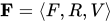


Based on my reading, this means that is a sigma algebra (the elements of are Borel sets). Is there some reason technical reason not to state this? OK, well, I see one: sigma algebras are closed under countable intersections and unions, whereas this article makes no statements about cardinality, one way or the other.
Am I supposed to assume that the statements in this article are valid for sets of arbitrary cardinality? e.g. for ? Or is this intended to work for only or ? Defining the set correctly seems to require a walk up the Borel hierarchy and you'll immediately bump into analytic sets.


The reason I ask is because in Bayesian inference, each Bayesian "prior" is an element of , each possible inference is in , and then is just the normal probability space. So its all hunky-dorey for small-enough sets. Whether any of this works out for higher order logic is not clear. 67.198.37.16 (talk) 21:31, 31 May 2024 (UTC)
Content Disclaimer
Informasi ini disarikan dari Wikipedia dan disajikan kembali untuk tujuan edukasi. Konten tersedia di bawah lisensi CC BY-SA 3.0. Kami tidak bertanggung jawab atas ketidakakuratan data yang bersumber dari kontribusi publik tersebut.
- The information displayed on this website is sourced in part or in whole from Wikipedia and has been adapted for the purpose of restating it. We strive to provide accurate and relevant information, however:
- There is no guarantee of absolute accuracy. Wikipedia is an open, collaborative project that can be edited by anyone, so information is subject to change.
- It is not intended to constitute professional advice. The content displayed is for informational and educational purposes only. For important decisions (e.g., medical, legal, or financial), please consult a professional.
- Content copyright. Wikipedia is licensed under the Creative Commons Attribution-ShareAlike License (CC BY-SA). This means that content may be reused with appropriate attribution and shared under a similar license.
- Responsible use. Any risk arising from the use of information from this website is entirely the responsibility of the user.