Talk:Gaussian integral

 | This article is rated C-class on Wikipedia's content assessment scale. It is of interest to the following WikiProjects: | ||||||||||||||||||||
| |||||||||||||||||||||

.jpg)


Possible mistake
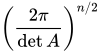
I think that there is a mistake in the equations of the section 'n-dimensional and functional generalization'. If you do the integral
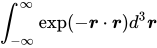
with the first equation of this section, the obtained result is not the correct result. I think that the term must be replaced with another thing. Maybe ?

Formulas not rendering correctly
Hi, a number of formulas (5 as far as I can tell) in this article don't render correctly, producing latex errors displayed instead of the formulas. First occurence of these errors is under the heading By polar coordinates: On the other hand, Failed to parse(unknown function '\begin'): {\begin{aligned}\iint _{{{\mathbf {R}}^{2}}}e^{{-(x^{2}+y^{2})}}\,d(x,y)&=\int _{0}^{ {2\pi } }\int _{0}^{{\infty }}e^{{-r^{2}}}r\,dr\,d\theta \\&=2\pi \int _{0}^{\infty }re^{{-r^{2}}}\,dr\\&=2\pi \int _{{-\infty }}^{0}{\tfrac {1}{2}}e^{s}\,ds&&s=-r^{2}\\&=\pi \int _{{-\infty }}^{0}e^{s}\,ds\\&=\pi (e^{0}-e^{{-\infty }})\\&=\pi ,\end{aligned}}
In an external latex editor, the same latex source used in the Wikipedia article looks fine. Unfortunately, I'm no expert on this and cannot fix it. I hope someone with more expertise might be able to help.
Please provide references!
I see many useful results and formulae in the multivariate case, but there are no references to textbooks or other published material where to find the proofs! Can someone add references?
Someone in the talk above says that some results are "standard textbook material". Well, then provide a reference to a standard textbook. Someone else says "you can easily derive such and such by...": again, give references to literature!
Remember that this is a Wikipedia article: a starting point, not a self-contained book or paper.
(Unsigned comment by Special:Contributions/87.236.195.22)
- Some of the material that was in the higher-order polynomials section was included without reference and turns out to be wrong. See this math.stackexchange.com question for details. Makes it clear why references are absolutely necessary. Eigenbra (talk) 05:49, 17 June 2015 (UTC)
Is there really a proof using Cauchy's Integral Theorem?
Whereas it says under the heading Proof by complex integral that ″A proof also exists using Cauchy's integral theorem″, I haven't seen one and have read the contrary: ″On the other hand, quite simple definite integrals exist whch cannot be evaluated by Cauchy's method, being a case in point.″ [1]

Cauchy's integral theorem is often used to find other definite integrals knowing the Gaussian integral,[2][3] but that's not quite the same thing.
GeordieMcBain (talk) 01:37, 23 April 2015 (UTC)
- Sorry for the delay.
- I was confused when I read your remark since I remember doing exactly this as a homework assignment during my introductory course in complex analysis at university. I went looking for a source and found it in right away; Remmert's book contains a proof on page 414 (It's in the third subsection of the third section of chapter 14). Interestingly, Remmert mentions Copson (and Watson 1914). Remmert claims the proof using residue calculus comes from Kneser, in 1960.
- Conclusion: it is trivial. — xo Ergur (talk) 21:55, 27 December 2025 (UTC)
Proof by Risch algorithm?
The article states that there is no elementary function, proof by Risch Algorithm. The Wiki page for Risch Algorithm states that it is a semi-decision procedure, i.e. there are cases where it doesn't terminate. Has someone shown in a paper that Risch algorithm terminates on Gaussian integral with limits and that trace of the algorithm constitutes a proof that there is no elementary function? Erxnmedia (talk) 14:14, 9 August 2017 (UTC)
Content Disclaimer
Informasi ini disarikan dari Wikipedia dan disajikan kembali untuk tujuan edukasi. Konten tersedia di bawah lisensi CC BY-SA 3.0. Kami tidak bertanggung jawab atas ketidakakuratan data yang bersumber dari kontribusi publik tersebut.
- The information displayed on this website is sourced in part or in whole from Wikipedia and has been adapted for the purpose of restating it. We strive to provide accurate and relevant information, however:
- There is no guarantee of absolute accuracy. Wikipedia is an open, collaborative project that can be edited by anyone, so information is subject to change.
- It is not intended to constitute professional advice. The content displayed is for informational and educational purposes only. For important decisions (e.g., medical, legal, or financial), please consult a professional.
- Content copyright. Wikipedia is licensed under the Creative Commons Attribution-ShareAlike License (CC BY-SA). This means that content may be reused with appropriate attribution and shared under a similar license.
- Responsible use. Any risk arising from the use of information from this website is entirely the responsibility of the user.