Talk:F-distribution
The second line of TeX on this page is not working. Why not? Michael Hardy 00:20, 2 Oct 2003 (UTC)

 | This  level-5 vital article is rated Start-class on Wikipedia's content assessment scale. level-5 vital article is rated Start-class on Wikipedia's content assessment scale.It is of interest to the following WikiProjects: | ||||||||||||||||||||
| |||||||||||||||||||||


Problem with TeX in article
The second line of TeX on this page is not working. Why not? Michael Hardy 00:20, 2 Oct 2003 (UTC)
- There's only one line of TeX on the page. I've tried to fix it but failed; the TeX system here has been tempremental recently, I think... Dysprosia 00:26, 2 Oct 2003 (UTC)
F-statistics
I've split out F-statistics into a population genetics article, but I'd like a proper statistician to go over it and explain how they are related :) Dunc|☺ 21:26, 25 Feb 2005 (UTC)
Questionable external links? Input please
Greetings all,
Recently User:128.135.17.105 removed several external links (Critical F Calculator, Fisher F Calculator for Hierarchical Multiple Regression, and Fisher F Calculator for Multiple Regression) that I had placed on this page to several F distribution-related online calculators that are available for free on my website. The reason given for this removal by User:128.135.17.105 is that the links are questionable. I would like to hear whether or not this is the majority opinion, as I believe that the free calculators provide a great deal of value to the page. Here's why:
- 1. The table of critical F-values linked to from this page (Table of critical values of the F-distribution) is not exhaustive. The free calculator that I propose linking to can compute critical F-values for a much wider range of research needs.
- 2. The other external link (Online significance testing with the F-distribution) computes probabilities for F-values, but not critical values of the F-distribution.
- 3. There are currently no external links on the page to F-distribution calculators designed for multiple regression and hierarchical multiple regression analyses -- the proposed links would fill this void.
Out of respect for the opinion of User:128.135.17.105, I will not repost the links right away. If anyone agrees that there is value in the external links that User:128.135.17.105 removed, please let the community know by posting your thoughts here. I would particularly enjoy discussing this issue further with User:128.135.17.105, as I believe that (in the spirit of Wikipedia) we can resolve this issue amicably. :-)
--DanSoper 00:08, 23 June 2006 (UTC)
I am researcher in africa and find f-distribution calculators very useful. Plaese repost! --202.72.105.130 22:05, 23 June 2006 (UTC)
I agree that the links should be reposted, with a few reservations. Please see my comments on the matter here: Talk:Chi-square distribution. -J.K., Kings College
Several of the current links to F distribution critical values are not very useful (as of February 2007). Posted excerpts from text books do not exploit the ability to publish cheaply on the web; I expected more complete tables if not calculators. However, I cannot judge well the reliability of such tables made available through links.
- the main discussion is at Talk:Chi-square distribution. Nobody who is logged in has commented yet. 128.135.226.222 00:34, 28 June 2006 (UTC)
Kurtosis formula and the sidebar together cause a lot of blank space
Since the kurtosis formula does not fit into the space to the left of the sidebar, a lot of space is left blank immediately before the formula. Is there a TeX command (e.g. \smfrac, or such) to make the fraction smaller? /*EnumaElish*/ —Preceding unsigned comment added by 66.92.175.254 (talk) 19:13, 7 September 2007 (UTC)
- I made some improvements. Not a great solution but at least the article looks a little nicer now (i think).Bluemaster (talk) 18:39, 6 July 2008 (UTC)
Absence of a lay definition and summary
This article is quite technical, and does not have a simple summary of the concept in plain English. What does it measure? When is it used? What are the strengths/weaknesses? Someone please add these details to make this article more accessible. —Preceding unsigned comment added by 67.193.142.111 (talk) 19:07, 11 February 2010 (UTC)
- The article is technical because the mathematics behind the distribution are rather technical. In its simplest form, the F-distribution arises when we want to compare two independent variances derived from sampling Gaussian populations. In reality, this application is an artifice: the resulting test and confidence intervals are not distributionally robust. The real importance of the F-distribution comes from the partition of total variance into variance due to a statistical model and the residual variation. This application is ubiquitous, but its mathematical justification requires more than passing familiarity with distribution theory and linear algebra.
75.184.34.105 (talk) Dennis Clason —Preceding unsigned comment added by 75.184.34.105 (talk) 05:18, 28 December 2010 (UTC)
- I think the article could benefit from at least a passing lay-accessible discussion of the theory behind the F-distribution, especially in regard to it's common usage in inferential statistics (F-test). Currently, this article is completely useless except to those who already operating a fairly high mathematical proficient and understand the F-distribution to begin with. /my 2 cents —Preceding unsigned comment added by 137.54.25.125 (talk) 19:46, 7 May 2011 (UTC)
I looked here instead http://stattrek.com/probability-distributions/f-distribution.aspx much more useful for me. — Preceding unsigned comment added by 80.231.29.105 (talk) 12:20, 17 December 2013 (UTC)
No calculators?
Is there a reason that external links to F-value calculators are removed from this article? Calculators are provided on the normal, Student's T, and Chi-square distribution pages, and I would think that having a calculator for F-values (as opposed to a table) is even more useful than for other distributions since the tables become *huge* with two degrees of freedom. The last user cited WP:EL, but there is nothing in WP:EL that says anything about the links that were removed. For full disclosure, I made this calculator, but this problem is the exact reason I made it. JokeySmurf (talk) 13:42, 19 September 2010 (UTC)
- Thanks for pointing those out, I tried to clean them up. Are there others? 018 (talk) 03:50, 20 September 2010 (UTC)
Naming the F-distribution
Fisher's correspondence [1] (the relevant letters are on pages 319 and 323) makes a couple of things quite clear. One is that he didn't think Snedecor's naming the variance-ratio distribution F was really intended to honor RAF, except as an afterthought. The other is that the variance-ratio was not Fisher's preferred solution to the problem. Fisher preferred to tabulate the log of the variance-ratio distribution (Fisher refers to this as the z-test, which should not be confused with the Gaussian Z-test).
The point is at least somewhat moot now, but given that Fisher cared for neither the honorific nor the testing procedure it seems misleading to cite this distribution as the Snedecor-Fisher distribution. Snedecor's F seems most accurate in my opinion. 75.184.34.105 (talk) 05:11, 28 December 2010 (UTC) Dennis Clason
the mean
anything wrong with the mean d2/(d2-2)??? when d2 goes to infinity, the F approximate chi square (d1), so the mean should converges to d1, but this mean converges to 1. So something must be wrong. missing d1 in the mean???
- sorry my mistake, not F approximate chisquare (d1), but d1*F approximate chi square (d1).
Jackzhp (talk) 16:14, 9 February 2011 (UTC)
k-th moment
I have added the formula for the k-th moment. As it is rather simple, there seemed to be no reason not to include it (also in view of the fact that the mgf does not exist). I have added a reference to an on-line source where the formula is proved. — Preceding unsigned comment added by 2.27.72.102 (talk) 10:30, 25 June 2011 (UTC)
This is a formula for the kth RAW moment. Under usual notational conventions \mu_k refers to the kth CENTRAL moment (and \mu_k' refers to the kth raw moment). The cited source fails to follow the usual notational convention, but Wikipedia still should. — Preceding unsigned comment added by 67.170.104.155 (talk) 08:05, 11 September 2013 (UTC)
Minor Characteristic function error
The last comma is missing; the one before "is" Rrogers314 (talk) 17:23, 23 April 2012 (UTC)
Inconsistent, or at least confusing, representation in terms of normal variables
- Equivalently, the random variable of the F-distribution may also be written
-
- where s12 and s22 are the sums of squares S12 and S22 from two normal processes with variances σ12 and σ22 divided by the corresponding number of χ2 degrees of freedom, d1 and d2 respectively.
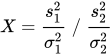
As "the corresponding number of χ2 degrees of freedom, d1 and d2 respectively" do not appear anywhere in the formula , it is not clear how to interpret this statement. --Livingthingdan (talk) 14:33, 1 February 2014 (UTC)
- s12 = S12 / d1; s22 = S22 / d2. Jheald (talk) 23:16, 1 February 2014 (UTC)
I think it's very unorthodox and confusing to use chi-squared as an adjective for degrees of freedom. I can fathom what it might mean, but it's a very convoluted way to describe things. Craniator (talk) 05:46, 19 May 2015 (UTC)
I think the correct formula, according the previous context, should be , where Si2 are the sample sums of square.14.200.87.16 (talk) 08:37, 27 July 2016 (UTC)
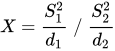
I think the correct formula, according the previous context, should be , where Si2 are the sample sums of square. 156.18.70.68 (talk) 14:31, 8 November 2016 (UTC)
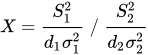
I' rather write: where is the sum of squares of normal random variables with variances and is the sum of squares of normal random variables with variances . And it is implied here that means are zero. Кирилл С1 (talk) —Preceding undated comment added 13:11, 8 February 2020 (UTC)


weird gap
Definition have a very long gap, really weird to watch at...--36.225.99.68 (talk) 15:56, 18 December 2015 (UTC)
Clarification needed in lead—F-test ≠ ANOVA
The lead seems to equate ANOVA with F-tests when it says "analysis of variance (ANOVA), e.g., F-test". As I understand it, the two are distinct; ANOVA uses F-tests. Can anyone weigh in to clarify this? Benny White (talk) 15:46, 14 June 2019 (UTC)
Move discussion in progress
There is a move discussion in progress on Talk:Student's t-distribution which affects this page. Please participate on that page and not in this talk page section. Thank you. —RMCD bot 04:01, 24 August 2021 (UTC)
FYI: I'm updating the structure of the page
This is so that the article uses a consistent naming for sections, such as in other articles about distributions. Tal Galili (talk) 14:18, 30 November 2024 (UTC)
Content Disclaimer
Informasi ini disarikan dari Wikipedia dan disajikan kembali untuk tujuan edukasi. Konten tersedia di bawah lisensi CC BY-SA 3.0. Kami tidak bertanggung jawab atas ketidakakuratan data yang bersumber dari kontribusi publik tersebut.
- The information displayed on this website is sourced in part or in whole from Wikipedia and has been adapted for the purpose of restating it. We strive to provide accurate and relevant information, however:
- There is no guarantee of absolute accuracy. Wikipedia is an open, collaborative project that can be edited by anyone, so information is subject to change.
- It is not intended to constitute professional advice. The content displayed is for informational and educational purposes only. For important decisions (e.g., medical, legal, or financial), please consult a professional.
- Content copyright. Wikipedia is licensed under the Creative Commons Attribution-ShareAlike License (CC BY-SA). This means that content may be reused with appropriate attribution and shared under a similar license.
- Responsible use. Any risk arising from the use of information from this website is entirely the responsibility of the user.