Talk:Equivariant map
I think there are no sources in the article. — Preceding unsigned comment added by 87.161.21.168 (talk) 12:49, 2 October 2013 (UTC)Reply

 | This article is rated Start-class on Wikipedia's content assessment scale. It is of interest to the following WikiProjects: | ||||||||||
| |||||||||||

Sources
I think there are no sources in the article. — Preceding unsigned comment added by 87.161.21.168 (talk) 12:49, 2 October 2013 (UTC)
- No longer true, except perhaps in the § Generalization section. yoyo (talk) 15:25, 8 July 2018 (UTC)
Flawed example
I removed the example of an intertwiner because the language was confusing. It seemed to suggest that there was a nontrivial intertwiner between the fundamental rep. of SU(2) and the adjoint which is impossible according to Schur's lemma. The example really gives a (invertible) intertwiner between the adjoint (given as traceless Hermitian matrices) and the adjoint (given as R3) which is perhaps not all that interesting. -- Fropuff 22:34, 10 October 2007 (UTC)
- Currently, the example in § Representation theory section of an intertwiner is quite clear, and demonstrates the value of constructing this equivariant map between linear reps. in proving those reps are "effectively the same". yoyo (talk) 15:25, 8 July 2018 (UTC)
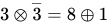
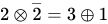
- ?? Intertwiners in algebras are permutations, i.e. , see for example the axioms of a Hopf algebra. Intertwiners for a symmetric space are those things that reverse the direction of a geodesic. Since SU(2) is the sphere S^3 and S^3 is a symmetric space SO(4)/SO(3), the intertwiner here would be the Cartan involution. Right?! For representation theory, we have that there are two fundamental reps for SU(3) which are conjugate to one-another. They're "effectively the same" but if you want to write real forms e.g. the adjoint rep, you have to use one of each, i.e. the Littlewood-Richardson coefficient equation for SU(3) is . Even for SU(2), it is conventional to write (in the physics literature) that which is how you get isospin, i.e. the pion from a quark and an anti-quark; the anti-quark transforming in the conjugate representation . (Fropuff removed the example that but perhaps a example would be sufficiently non-trivial to evade his comment). Example four (an extension of example one) the "cat theoretic" defn of a Lie bracket as aka the Jacobi identity where σ is the cyclic permutation braiding and the morphism is the interchange morphism which is often called "the intertwiner". Hmm... but if I look at braided monoidal category, I see it being called the "interchange morphism" instead of "the intertwiner" ... I've always taken it to be a synonym.


![{\displaystyle [\cdot ,\cdot ]\circ ([\cdot ,\cdot ]\otimes id)\circ (id+\sigma +\sigma ^{2})=0}](https://wikimedia.org/api/rest_v1/media/math/render/svg/fac6398f9a60febb82194e149222923ec4890768)



- Example five: the SO(4) symmetry of orbital mechanics is called the Laplace–Runge–Lenz vector and that article (its a featured article!) does explain how SO(4)/Z_2 = SO(3) times SO(3) (see section entitled "Poisson brackets"). It does not relate this to symmetric spaces nor to the Cartan involution. But it does say things like this: and I quote "which distinguishes between positive values and negative values" so it's already laid the groundwork (while distinguishing between elliptic and hyperbolic orbits). If I recall correctly, this corresponds to the eigenvalues of the involution and also to the compact vs. non-compact parts in symmetric space definitions. This also works for the spectrum of the hydrogen atom i.e. solutions to the schrodinger equation. There's even a way of writing the discrete spectrum of the hydrogen atom as distinct Casimir invariants on a homogenous space (basically, just the angular momentum of the orbitals, i.e. the spherical harmonics) so you get the full split of the Lie algebra of G/H as where the are the odd-eigenvalue parts (orbitals of angular momentum ), and is the even-eigenvalue part (the algebra of the involution invariant subgroup H). Last time I saw a detailed exposition of this was decades ago, so my recollections are (cough, cough) questionable, but I think everything I said is correct... with some elbow-grease, I guess this could make a great practical example of something that is otherwise pointless abstraction in Riemannian geometry textbooks... 67.198.37.16 (talk) 03:28, 7 November 2020 (UTC)



- So this section that is "quite clear" fails to mention the number one, two, three and four most important examples, leaving things quite murky, unless you already happen to be aware of all of these examples, and how to correctly articulate them. 67.198.37.16 (talk) 22:10, 6 November 2020 (UTC)
Examples
I suspect a rather long list of very concrete examples could be written and would help understanding. For example, ordinary differentiation is shift-equivariant. When you think of stuff like that, you see how down-to-earth the concept is. Michael Hardy (talk) 14:21, 21 September 2008 (UTC)
- @Michael Hardy: – Yes, some extra concrete examples would help to motivate readers, and also help prevent the fatigue brought on by a too-abstract exposition. What other ones, beside differentiation, come to mind? yoyo (talk) 15:25, 8 July 2018 (UTC)
- The triangle geometry examples in the article aren't concrete enough? —David Eppstein (talk) 16:57, 8 July 2018 (UTC)
Content Disclaimer
Informasi ini disarikan dari Wikipedia dan disajikan kembali untuk tujuan edukasi. Konten tersedia di bawah lisensi CC BY-SA 3.0. Kami tidak bertanggung jawab atas ketidakakuratan data yang bersumber dari kontribusi publik tersebut.
- The information displayed on this website is sourced in part or in whole from Wikipedia and has been adapted for the purpose of restating it. We strive to provide accurate and relevant information, however:
- There is no guarantee of absolute accuracy. Wikipedia is an open, collaborative project that can be edited by anyone, so information is subject to change.
- It is not intended to constitute professional advice. The content displayed is for informational and educational purposes only. For important decisions (e.g., medical, legal, or financial), please consult a professional.
- Content copyright. Wikipedia is licensed under the Creative Commons Attribution-ShareAlike License (CC BY-SA). This means that content may be reused with appropriate attribution and shared under a similar license.
- Responsible use. Any risk arising from the use of information from this website is entirely the responsibility of the user.