Talk:Dirichlet beta function
It may be worth mentioniong that:

 | This article is rated Start-class on Wikipedia's content assessment scale. It is of interest to the following WikiProjects: | ||||||||||
| |||||||||||

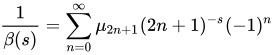
Reciprocal of this function - is this worth adding to the main section?
It may be worth mentioniong that:
1/beta(s) = sum(n=1..infinity((-1)^n * mu(n+1)/(2*n+1)^s));
which is valid for Re(s)>1. Hair Commodore (talk) 20:05, 28 July 2008 (UTC). Note that mu(*) is the Mobius mu function. (It certainly converges to 4/Pi when s=1)
- This formula is wrong! I tried checking it for 's'=1, 's'=2, and 's'=3, and it works at none of them! 81.102.15.200 (talk) 13:36, 18 August 2008 (UTC)
Apologies - I should have said that:
1/beta(s) = sum(n=1..infinity,(((-1)^n * mu(2*n+1))/(2*n+1)^s))
in Maple notation - rather than what I typed previously.The anaonymous user who questioned it was quite correct. I made a wally error, so I have now corrected it. (It is still correct for 'Re'(s)>1) Hair Commodore (talk) 19:24, 18 August 2008 (UTC)
- yes, from the Euler product I just added :
- I'd still like to know if the Riemann hypothesis for would imply (or be implied by) the one for , or if the two are completely independent. 78.227.78.135 (talk) 17:10, 4 January 2016 (UTC)


Definition
The formula for beta(s) in terms of the polygamma function only seems to be valid at even positive integers. I believe multiplying this formula by (-1)^s makes it valid at odd positive integers as well as even positive integers. The conditions for the validity of the polygamma formula for beta(s) need to be specified or the reader may assume the formula is valid for all complex values of s similar to the two preceding formulas which express beta(s) in terms of the Hurwitz zeta function and the Lerch transcendent.StvC (talk) 16:22, 2 April 2021 (UTC)
I corrected and clarified the polygamma formula.StvC (talk) 17:06, 4 April 2021 (UTC)
Content Disclaimer
Informasi ini disarikan dari Wikipedia dan disajikan kembali untuk tujuan edukasi. Konten tersedia di bawah lisensi CC BY-SA 3.0. Kami tidak bertanggung jawab atas ketidakakuratan data yang bersumber dari kontribusi publik tersebut.
- The information displayed on this website is sourced in part or in whole from Wikipedia and has been adapted for the purpose of restating it. We strive to provide accurate and relevant information, however:
- There is no guarantee of absolute accuracy. Wikipedia is an open, collaborative project that can be edited by anyone, so information is subject to change.
- It is not intended to constitute professional advice. The content displayed is for informational and educational purposes only. For important decisions (e.g., medical, legal, or financial), please consult a professional.
- Content copyright. Wikipedia is licensed under the Creative Commons Attribution-ShareAlike License (CC BY-SA). This means that content may be reused with appropriate attribution and shared under a similar license.
- Responsible use. Any risk arising from the use of information from this website is entirely the responsibility of the user.