Talk:Delta potential
This article should be linked with the "Delta function potential" article.

 | This  level-5 vital article is rated C-class on Wikipedia's content assessment scale. level-5 vital article is rated C-class on Wikipedia's content assessment scale.It is of interest to the following WikiProjects: | ||||||||||
| |||||||||||
.jpg)

Untitled
This article should be linked with the "Delta function potential" article.
- Not sure what you mean. If you mean "merge" with Delta function potential, please note that the potential well and potential barrier are physically quite different. Bamse 14:55, 6 December 2006 (UTC)
Can someone, not I, remove all the first person pronouns in this article? This is not a physics lecture in which we all have our notebooks and pens out. Please reduce the size of the centrefold in the middle of the article too. Rintrah 16:52, 10 December 2006 (UTC)
copyedit to this difficult article, revert if I have screwed it up!
I did a copyedit as the article sounds like a lecture rather than an article. i will post a request at wikiproject physics for someone to take a look at it. --killing sparrows (chirp!) 05:44, 24 April 2007 (UTC)
Why the "Delta potential barrier" section?
The only bloody difference the sign of λ makes is whether the bound state exists, so why do we have to duplicate all that stuff? -- Army1987 – Deeds, not words. 20:28, 6 December 2008 (UTC)
Redundancy concerning the Delta potential barrier
I recognize the difference between the potential wells and potential barriers; and I can understand why both should be there. However, the solution to the time-independent Schrodinger equation for a delta potential barrier is derived twice in this article. If someone could combine these two derivations, I would greatly appreciate it. 11, December 2008 —Preceding unsigned comment added by 76.104.28.65 (talk) 22:06, 11 December 2008 (UTC)
Error in Derivation Section
I think there's an error. If then the left-hand side after integration should be [ψ′R(0) − ψ′L(0)] + λψ(0). And the signs in the following coefficients are also wrong. Could someone please check this. Thanks 201.255.79.161 (talk) 15:26, 16 February 2009 (UTC)
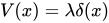

- You are right. I checked it again on paper. It also agrees with what I wrote a long time ago when creating this article. It seems some editor messed up the signs. You may want to compare the rest of the article with the old version I linked to above. bamse (talk) 15:57, 16 February 2009 (UTC)
Error in "Double-well Dirac delta function model" Section
I don't understand the d- solution for the double delta function potential. I thought one property of the Lambert W function was W(a*exp(a)) = a. This would mean the d- solution was zero for equal charges, not just for q = 1 / 2*R. Dickvidal (talk) 18:13, 16 September 2010 (UTC)
- The property is actually W(a)*exp(W(a)) = a. Look at Lambert W function. The energy is E - d^2/2 and there are 2 solutions. The d solution is not zero for all internuclear distances for equal charges.TonyMath (talk) 19:30, 19 November 2010 (UTC)
- This is a different property of the Lambert W function - calculate W(a*exp(a)) for any value a > -1/e - you will see that it is true --> by definition y = W(x) <--> x = y*exp(y); let x = a*exp(a), then y=a... I think it means the d- solution was zero for equal charges (not just for q = 1 / 2*R) as long as -qR > -1/e. That is, I considered only real value of W(z)... —Preceding unsigned comment added by Dickvidal (talk • contribs) 15:41, 22 November 2010 (UTC)
- The d=0 solution is the trivial solution for the -ve case. But there are 2 other non-trivial solutions, one for the +ve case and one for the -ve case. You can check these out with a computer algebra system. Do you have access to Maple or Mathematica? BTW, You have to be careful with this. x = W(x*exp(x)) in a certain range but W(x*exp(-x)) does not simplify to "x". The -ve d solution is correct and applies to a regime where e.g. q=1 and R is large. TonyMath (talk) 19:43, 22 November 2010 (UTC)
- I think you might me missing on the fact that the Lambert W function is multivalued i.e. has a infinite number of solutions. The two solutions given are solutions in the real plane valid for large values of R (asymptotic regime) that are real. The +ve d solution is valid for 0<R<infinity. The solution for the -ve "d" is a bit peculiar that the energy does go to zero (ie. vacuum) at a particular value of R but you can recover the solution at a different branch. See Lambert W function for more details. TonyMath (talk) 19:52, 22 November 2010 (UTC)
- Ok, I think I understand - both q and R are positive, and given that the arguement of the Lambert W function is -qR*e**(-qR), relatively small, and negative, there are two real values of the Lambert W function...only one gives d- equal to zero... —Preceding unsigned comment added by Dickvidal (talk • contribs) 12:33, 23 November 2010 (UTC)
- There is one thing though which I think is wrong: when q=1/(2*R), d- becomes zero but not for d+. That part needs to be fixed, I think. —Preceding unsigned comment added by TonyMath (talk • contribs) 20:40, 23 November 2010 (UTC)
error in bound state section?
isn't k^2 rather than k should be equal to -m*lambda/hbar^2 ? —Preceding unsigned comment added by 79.182.47.67 (talk) 10:01, 17 October 2010 (UTC)
For article
An important and interesting fact to add to the article would be that using the infinit square well with a finit wide of "a" we can find the energy and the wave function of the delta potential if we take the limiting case of the wide of the infinit potential to go to zero (a->0). If we do this we find that the infinit square well having countably many energy levels for a non zero width goes to only having only one possible bound state (only one energy level). Explaining the why is very insightful. —Preceding unsigned comment added by 209.183.22.138 (talk) 00:55, 25 November 2010 (UTC)
Error in the Bound State Section
I think the first equation mixes up the coefficients. The text correctly says that AL=BR=0, but the equation still uses AL and BR instead of AR and BL. 93.193.15.36 (talk) 11:39, 17 May 2012 (UTC)
- I think AL=BR=0 is wrong and should be AR=BL=0 because for E<0 k=iκ and AR*exp(ikx)=AR*exp(i*iκx)=AR*exp(-κx) which diverges for x<<0. While the term with AL does not diverge for x<<0. It's the same with BL and BR for x>>0. — Preceding unsigned comment added by 92.204.81.91 (talk) 22:37, 20 May 2012 (UTC)
Duplicated text from different Wikipedia article
The section "Remarks and Applications" is essentially copy and pasted from the article on Rectangular Potential Barrier.
[[1]] — Preceding unsigned comment added by 2607:B400:24:8006:9495:8FF4:C3D7:D901 (talk) 18:24, 1 September 2015 (UTC)
Assessment comment
The comment(s) below were originally left at Talk:Delta potential/Comments, and are posted here for posterity. Following several discussions in past years, these subpages are now deprecated. The comments may be irrelevant or outdated; if so, please feel free to remove this section.
| ==Article name==
I think it is important to be clear. These steps should be taken 1. Rename to "Dirac Delta function potential" 2. Either merge or link properly to the Dirac delta function page as a search for one may stop you finding the other etc. —The preceding unsigned comment was added by 129.234.4.10 (talk • contribs) on 17:13, 20 April 2007. |
Substituted at 21:39, 26 June 2016 (UTC)
"In any one-dimensional attractive potential there will be a bound state."
This is non-trivial and no source is given. It is not necessary to the argument, since an explicit eigenfunction is constructed. Keith McClary (talk) 15:34, 25 August 2019 (UTC)
Content Disclaimer
Informasi ini disarikan dari Wikipedia dan disajikan kembali untuk tujuan edukasi. Konten tersedia di bawah lisensi CC BY-SA 3.0. Kami tidak bertanggung jawab atas ketidakakuratan data yang bersumber dari kontribusi publik tersebut.
- The information displayed on this website is sourced in part or in whole from Wikipedia and has been adapted for the purpose of restating it. We strive to provide accurate and relevant information, however:
- There is no guarantee of absolute accuracy. Wikipedia is an open, collaborative project that can be edited by anyone, so information is subject to change.
- It is not intended to constitute professional advice. The content displayed is for informational and educational purposes only. For important decisions (e.g., medical, legal, or financial), please consult a professional.
- Content copyright. Wikipedia is licensed under the Creative Commons Attribution-ShareAlike License (CC BY-SA). This means that content may be reused with appropriate attribution and shared under a similar license.
- Responsible use. Any risk arising from the use of information from this website is entirely the responsibility of the user.