Talk:Cubic function/Archive 7
Very good article in general but I have one quibble. Why does the article say "Cardano imposed..." and "Cardano assumed..." when Cardano himself openly state

 | This is an archive of past discussions about Cubic function. Do not edit the contents of this page. If you wish to start a new discussion or revive an old one, please do so on the current talk page. |
| Archive 1 | ← | Archive 5 | Archive 6 | Archive 7 | Archive 8 |
Why credit Cardano?
Very good article in general but I have one quibble. Why does the article say "Cardano imposed..." and "Cardano assumed..." when Cardano himself openly stated that he was reporting the accomplishments of other mathematicians, (Ferro and Tartarglia) and that it wasn't his own work? ( One can, of course, admire his honesty in giving credit in an era when that wasn't customary) 73.137.170.88 (talk) 21:30, 13 May 2016 (UTC)
- Because it was Cardano who provided the theoretical justification for the formula that bears his name. All he got from Scipiono del Ferro and from Tartaglia was the formula and nothing else. He proved that it worked, he extended it to other cases (there were several cases, since the coefficients were always positive), he explained how to pass from general cubic equations to depressed ones, he created the concept of multiple root, and so on. JCSantos (talk) 18:07, 30 May 2016 (UTC)
Font for set-off equations
Regarding the recent edits, the font for equations that are set off on separate lines should be consistent with the rest of the math articles in English Wikipedia and consistent with the rest of this article—it should be LaTeX (<math>...</math>). Thanks for all your work on this article, @User:JCSantos. Loraof (talk) 15:47, 30 May 2016 (UTC)
Referring to equation numbers versus the rewritten equation
Recent edits by @JCSantos: have replaced the use of previously encountered equations being written again in a sentence, with simply an equation number being put in the sentence. I'm going to revert this in each case in which the equation itself does not appear very soon before the sentence, because it makes reading extremely difficult when the reader has to stop reading and scroll up and up and up in order to find out what equation is being referred to. Also, it is common practice in English Wikipedia math articles to avoid numbering equations.
Please abide by WP:BRD: boldly edit, revert, discuss. The new version will prevail only if a talk page consensus develops for it. Thanks again for all your work on this page! Loraof (talk) 15:31, 31 May 2016 (UTC)
- When I started doing this, equations (1) and (2) already existed. For instance, in this this version of the article, whose last edition was done by you, equation (1) is mentioned nine times. Indeed, when I started editing this article the equality u3 + v3 + (3uv + p)(u + v) + q = 0 was numbered as (3), but since it was mentioned only once and right after the equality, I deleted this number and altered the text so that there was no need to mention it. JCSantos (talk) 17:48, 31 May 2016 (UTC)
- I'm not responsible for the nine appearances of "(1)" in the version last edited by me. Since you've pointed them out, I'll fix them too, along with the ones you introduced. Loraof (talk) 20:11, 31 May 2016 (UTC)
Ancient egyptians and cubic equations
I am disturbed by the fact that the article quotes Lucye Guilbeau's article The History of the Solution of the Cubic Equation (Mathematics News Letter, Vol. 5, No. 4 (Dec., 1930), pp. 8–12), from which this sentence is taken: “The Egyptians considered the solution impossible, but the Greeks came nearer to a solution.” It turns out that she doesn't tell us where she took this idea from. Furthermore, Richard J. Gillings Mathematics in the time of the pharaohs has no mention of cubic equations in ancient Egypt and the same thing occurs with Otto Neugebauers's The exact sciences in antiquity. Should this quotation be eliminated? I suppose so. JCSantos (talk) 17:22, 6 June 2016 (UTC)
- I agree. Guilbeau's sweeping assertion is not supported by any quotations from Egyptian or Greek texts. — Preceding unsigned comment added by 86.151.50.197 (talk) 10:28, 20 October 2016 (UTC)
Sorry about being a pain in the posterior.
Thanks JCSantos for fixing the brain farts that I had with my corrections. I really hate making such large changes as I did, particularly to a page that has an editor that knows what they are doing. But we have two different approaches to the article. My goal is to make the article as accessible as possible to high school students even. I don't want to speak to someone else's motivation but it seems that want to make it as technically correct and as engaging to a semi-expert as possible. In my mind these are both valid and complimentary approaches that can lead to lots of frustration if care is not taken. If taken too far both violate the spirit and the law of wikipedia.
In my last, admittedly very large and likely including a few errors, revision I attempted to make a compromise of sorts by factoring out a practical section. This too has its pitfalls and perhaps the only solution is to factor out some of it into a separate article. For example, in order to help more with accessibility I would eventually like to do an example using complex numbers. This is perilously close to violating the mission of wikipedia and if I did so I would feel probably feel obligated to split out a separate article due to issues with length and not overwhelming your good work.
The good news is that I am aware that I am making a mess. From now on my plan is to start cleaning up some of the mess that I made, instead of just making more.
I appreciate any patience that you can have with me. TStein (talk) 20:15, 7 June 2016 (UTC)
- I like the way the article has come to look in the past few days. I had always thought that the article had so much content that it would be too intimidating to someone not already familiar with the topic. But the new organization is nice--just giving the various solutions first, then going into details. Thanks to both of you for all your work! Loraof (talk) 23:01, 7 June 2016 (UTC)
Numerical solution
I notice that my contribution—a fast numerical method for finding the real roots—was deleted twice. One of the reasons given was that the method is not widely used. Do you have statistics to prove that? Even if this were true: The method may become popular in the future. Solving cubic equations numerically is a major issue in chemical engineering, therefore this page should not be restricted to “exact” methods.
Thermo53 (talk) 12:28, 22 July 2016 (UTC)
- Your contribution is original research, which has not been reliably published. As such, wikipedia is not a place for publishing it. See WP:No original research. D.Lazard (talk) 13:37, 22 July 2016 (UTC)
Hard-to-understand graphic

The section Cubic function#Trigonometric solution for three real roots had this graphic added to it on 12 October 2016. I just can't make heads or tails out of it. Can someone expand the caption to explain what the various colors (red, blue, green, black) are, how to interpret it, and so forth? Or, would there be any objection to my removing it? Loraof (talk) 21:18, 18 January 2017 (UTC)
- I agree for removing the image. I cannot understand why it is a 3D plotting, when there is only 2 variables, t and the value of a root. The generating program appearing in the file is of no help, and seems to not correspond to the image (or to generate only a part of the image, as there is no plot instruction for a red curve nor for a blue curve). D.Lazard (talk) 21:53, 18 January 2017 (UTC)
Geometric interpretation of the roots
Is it possible that somebody puts into the section "Geometric interpretation of the roots" info about my new interpretation of the roots?
Please, see "Cubic polynomial roots" GeoGebra page and "Circumcircle of a polynomial" GeoGebra book
There is a paper in Russian
Yu. V. Vyazovetskii, A. S. Tikhonov, “Окружность, описанная вокруг многочлена”, Mat. Pros., Ser. 3, 15, MCCME, Moscow, 2011, 107–113 (in Russian)
(Ю. В. Вязовецкий, А. С. Тихонов, “Окружность, описанная вокруг многочлена”, Матем. просв., сер. 3, 15, Изд-во МЦНМО, М., 2011, 107–113)
see the paper or its dublicate.
I am afraid my English is imperfect to do this work. — Preceding unsigned comment added by Ast cubic (talk • contribs) 06:27, 19 August 2017 (UTC)
- Apparently, this is your own research, which has not been reliably published (published in international peer reviewed journals), and is not referred to in any WP:secondary source. Therefore, this has not its place in Wikipedia, by the policy WP:NOR. D.Lazard (talk) 08:17, 19 August 2017 (UTC)
- OK. I have no actual objections. I wish only to note that the paper is published in national (not international, but not deeply domestic) and peer reviewed (by E.B.Vinberg, the author of A Course in Algebra) journal and those journal volume (#15) contains an article written by Vladimir Arnold. I will look for another place to present paper's results since I am absolutely sure that the ideas and construction of the paper can be interesting to many lovers of mathematics. I would appreciate your advice. — Preceding unsigned comment added by Ast cubic (talk • contribs) 10:56, 19 August 2017 (UTC)
Another comment on a geometric interpretation of cubic function
Would it be possible to add some information on how the geometric solutions "worked"? That is, how they were constructed, interpreted, presented? For example, the article mentions Archimedes using the intersection of cones to approach the problem. What did that look like? Did he make physical, 3-dimensional cones, or did he use a 2-d representation of a cone (with perspective, perhaps?) What tools did he permit himself? I believe he made use of a "neusis construction" at some point, which allowed the solution of problems impossible with straight-edge and compass. How did this work? Why is a neusis more powerful? What algebraic tools does it add? How is this related to origami construction, which can also solve some cubic equations? There are so many interesting directions for this article to grow! Thanks greatly for reading. :) JonathanHopeThisIsUnique (talk) 19:51, 15 September 2017 (UTC)
- Perhaps one of these directions could be the following:
This URL of Graphical Function Explorer (GFE) enables all real solutions of any normalized cubic equation to be graphically revealed as abscissas of the points where symmetrical straight lines are intercepting parent cubic function.
- The conversion to normalized cubic equation can be obtained through Taylor series about point of rotational symmetry
- along with the substitution
- Moving the sliders (a, b, c and d) up-down and setting the cursor as precisely as possible to the interception points we should insert these values back to the substitution formula getting either three or one real solution of initial cubic equation
- .
- 77.77.216.219 (talk) 04:35, 5 November 2018 (UTC)Stap
- I have tried to slightly improve your awful formatting, simply for being able to read it. You have partially reverted my edit. Thus I'll not change your post anymore
- This post cannot be used for answering the questions set more than a year ago by another editor, for several reasons. Firstly, it is written in a way which makes it difficult to understand, even for a professional mathematician. As far as I can understand, it is a description of how one must transform a cubic equation for studying it with a specific software. Secondly, this seems a tentative for promoting this specific software, and as such, it is not acceptable in an encyclopedia. Thirdly, this is WP:OR, which is not allowed in Wikipedia per Wikipedia policies. D.Lazard (talk) 17:54, 5 November 2018 (UTC)


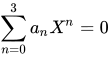
"If all of the coefficients a, b, c, and d of the cubic equation are real numbers, then it has at least one real root" ?
The opening paragraphs state:
- If all of the coefficients a, b, c, and d of the cubic equation are real numbers, then it has at least one real root (this is true for all odd degree polynomials).
But doesn't "a" also have to be non-zero for this to be true? — Preceding unsigned comment added by 195.226.136.112 (talk) 15:32, 19 February 2018 (UTC)
- You must read the first sentence of the article: if a = 0, this is not a cubic equation. D.Lazard (talk) 15:54, 19 February 2018 (UTC)
Error in formula
In the section "Trigonometric solution for three real roots", the formula given for tk is wrong I believe. There's a -b/3a missing at the end of it right after the closing parenthesis, before the "k = 0, 1, 2". This page seems to have the correct formula Cardano Formula. After implementing both myself, it seems Wikipedia's is wrong indeed. — Preceding unsigned comment added by Inigo.quilez (talk • contribs) 06:42, 1 March 2019 (UTC)
- In the section "Trigonometric solution for three real roots", a and b do not appear at all. So they cannot be missing in a formula. In this section, the cubic is supposed to be in depressed form For finding how apply the resulting formula to a cubic of the form see the section "Reduction to a depressed cubic". D.Lazard (talk) 09:31, 1 March 2019 (UTC)


Are external links to YouTube permitted?
Mathologer published on this topic today—and links to this article in his text. Tony (talk) 03:30, 25 August 2019 (UTC)
- So much for politely asking. Our friend D.Lazard can't be bothered to respond after weeks, but reverts my insertion. Guess how highly I think of him. Tony (talk) 09:09, 5 September 2019 (UTC)
- To editor Tony1: Previous post was an information, not a request for inserting this as an external link. So it did not need an explicit answer. The general question asked in the heading is not specific to this article and has been answered by the community in WP:ELNO and WP:YOUTUBE. For the specific case of mathematics, it result from several discussions in the WikiProject Mathematics (see the archives of WT:WPM) that online videos are acceptable only if they provide information that is not available in printed textbooks, and satisfy the general guidelines on reliability and notability of sources (see WP:Reliable sources). It is clear that this video does not satisfies these criteria. D.Lazard (talk) 09:30, 5 September 2019 (UTC)
- No, that's entirely irrelevant. It's your rudeness in not communicating with me, but simply reverting. Don't assume every editor wants to waste their time finding out what some wikiproject thinks. That's why I posted a QUESTION here. Don't bother responding. You're simply rude and inconsiderate. If ever there's a chance to shaft you, count on being shafted. Tony (talk) 11:16, 5 September 2019 (UTC)
- Hi Tony, I see that when D. Lazard undid your edit, they left an edit summary with links to information that answers your question. As such, they did their responsibility to inform you why your edit was not in line with the spirit of this website (Wikipedia in general, not just this particular section), and provided an answer to your question. While a response to your post here would have been courteous, it is entirely unfair and uncalled for to use disrespectful language in this situation. -Ramzuiv (talk) 06:14, 6 September 2019 (UTC)
- No, that's entirely irrelevant. It's your rudeness in not communicating with me, but simply reverting. Don't assume every editor wants to waste their time finding out what some wikiproject thinks. That's why I posted a QUESTION here. Don't bother responding. You're simply rude and inconsiderate. If ever there's a chance to shaft you, count on being shafted. Tony (talk) 11:16, 5 September 2019 (UTC)
- To editor Tony1: Previous post was an information, not a request for inserting this as an external link. So it did not need an explicit answer. The general question asked in the heading is not specific to this article and has been answered by the community in WP:ELNO and WP:YOUTUBE. For the specific case of mathematics, it result from several discussions in the WikiProject Mathematics (see the archives of WT:WPM) that online videos are acceptable only if they provide information that is not available in printed textbooks, and satisfy the general guidelines on reliability and notability of sources (see WP:Reliable sources). It is clear that this video does not satisfies these criteria. D.Lazard (talk) 09:30, 5 September 2019 (UTC)
Splitting Cubic Formula into new page
Hi, I recently took steps to split information about the solutions to a cubic function to its own page, but my edit was undone to allow this to be discussed here. I would therefore like to formally propose that we split these two topics into distinct pages. This current page is around 80,000 characters, which WP:WHENSPLIT says "Probably should be divided (although the scope of a topic can sometimes justify the added reading time)". Beyond pure length, these two subjects deserve independent treatment - the cubic formula is interesting in and of itself, for reasons that are distinct from why cubic functions are interesting. We have separate articles for Quadratic formula and Quadratic function, and various other language Wikipedias treat Cubic Functions and the Cubic Formula independently, including German, Spanish, French, Chinese, and Russian, among others. As such, this split follows an established precedent, and I strongly recommend splitting these two subjects.
I would also like to ask for potential names for the new page. My original edit called the page "Cubic Formula", but I am open to alternative names. For the record, several other language wikis use some variation on "Cardano's Formula", but I do not feel this is appropriate, since the page treats other methods of finding cubic roots other than just Cardano's original formula.
Thoughts? -Ramzuiv (talk) 06:45, 6 September 2019 (UTC)
- I agree to split the article, but, as I said in my edit summary, this is a major edit that require a consensus and a discussion on some details. Here are some of them
- What should be moved away? There are two possible choices: 1/ Moving all the content relative to the cubic equation. The drawback is that the remainder article would be very short (this was the motivation of a merge in 2007). 2/ Moving away only the cubic formula and its derivation. If this is chosen, many things that are in you article Cubic formula must be kept in Cubic function, such as the reduction to a depressed cubic (misplaced in the present version), the nature of the roots as a function of the discriminant, the Galois group, trigonometric solutions, etc.
- Which summary of the splitted article must be kept in Cubic function? The summary provided in your edit is not convenient, as being wrong in all cases where cubic roots are not well defined. In other words, it is correct only in the case of real coefficients and a single real root.
- My opinion is that it is worth to split away the cubic formula, but that, before splitting, one must reorganize the article for making a correct split simpler. This means having a single section "Cubic formula (for depressed cubics) and its derivations", and the other results regrouped in other sections. D.Lazard (talk) 09:04, 6 September 2019 (UTC)
Restructuration
As suggested before, this article is a mess. I have started to fix it. However, the number of issues makes the work harder than I thought previously. Here are the main issues:
- The order of presentation is not related to the importance of the the content nor to its technicality. For example, the section on depressed cubics was (before my edits) a subsection of an unrelated section, while reduction to a depressed cubic is fundamental for simplifying everything.
- Proof are presented with a lot of details (including very elementary computations, and proofs of side results that are better described in specific articles, generally not linked) that are confusing by making the exact results difficult to find, as well as the main ideas of the proofs.
- Some basic facts are lacking, such as that, up to translations and directional scalings along the axes, there is only three cubic functions, and thus three shapes for their graph.
So, restructuring the article will take some time, and the global reason of my edits needs to be explicited.
I would appreciate feedback on the section that I have already rewritten. D.Lazard (talk) 09:16, 22 September 2019 (UTC)
Splitting suggestion
In a preceding thread is has been suggested to split the article.
In december 2007, Cubic equation were merged into Cubic function, with almost no discussion. The main reason was that the "function" part was very short. This is no more true, specially after my recent additions, and my restructuration for grouping together the "function" sections. On the other hand, the "equation" part is very long. It can certainly be dramatically shortened by giving less details in the proofs, per MOS:MATH#Proofs. Nevertheless, even after this, the article would remain very long. This makes obsolete the argument for the past merge.
Another argument in favor of splitting is that the coefficients are always real in the "function" part, while most of the "equation" part does not depend on the nature of the coefficients.
My suggestion is to split the article into Cubic function and Cubic equation. Another suggestion would be to split out the various proofs of the cubic formula into a subpage. I am not convinced by this. In any case, such a split must be decided after having simplified the proofs, as suggsted above.
I could be bold, and proceed, but, as it is a strong restructuration, some further opinions would be helpful. D.Lazard (talk) 10:18, 24 September 2019 (UTC)
- This proposal sounds sensible to me. --JBL (talk) 11:13, 24 September 2019 (UTC)
- At first, I was confused as to which parts of the article would go to cubic function and which would go to cubic equation, since I would call "y = x^3 + px" a cubic equation (but not a cubic equation in one variable as defined in the lead). The suggestion seems reasonable otherwise though, and perhaps its implementation would be clearer than what I imagine right now. I'd say go for it. — MarkH21 (talk) 11:41, 24 September 2019 (UTC)
 Done D.Lazard (talk) 17:25, 24 September 2019 (UTC)
- Your split looks good to me. --
{{u|Mark viking}} {Talk}18:08, 24 September 2019 (UTC) - Thanks for taking care of this - Ramzuiv (talk) 00:41, 25 September 2019 (UTC)
- Your split looks good to me. --

Solution section
Why has the solution section been removed from this page? The formulas in that section were so helpful in solving cubic polynomials Aminabzz (talk) 18:40, 26 September 2019 (UTC)
- To editor Aminabzz: The solution section has not been removed. It has been rewritten and renamed Cardano's formula for the depressed case, and General cubic formula for the general case. If you find the old version better, please, explain why. I'll try to solve your concerns, if any. By the way, this article has been splitted, and everything that concern equations is in Cubic equation except for a link in the lead of Cubic function. D.Lazard (talk) 20:09, 26 September 2019 (UTC)
Thank you for your answer. I've seen the other article and I found it very good too. Aminabzz (talk) 21:00, 26 September 2019 (UTC)
Redirects to this page for solution of cubic need to be updated after split
Most of those now should point to the page on cubic equations. 73.89.25.252 (talk) 16:34, 6 August 2020 (UTC)
- I changed the redirects that clearly should go to the page cubic equation or its section on the Cardano formula. Some of the others could use attention but this solves most of the problem for now. 73.89.25.252 (talk) 21:26, 6 August 2020 (UTC)
Content Disclaimer
Informasi ini disarikan dari Wikipedia dan disajikan kembali untuk tujuan edukasi. Konten tersedia di bawah lisensi CC BY-SA 3.0. Kami tidak bertanggung jawab atas ketidakakuratan data yang bersumber dari kontribusi publik tersebut.
- The information displayed on this website is sourced in part or in whole from Wikipedia and has been adapted for the purpose of restating it. We strive to provide accurate and relevant information, however:
- There is no guarantee of absolute accuracy. Wikipedia is an open, collaborative project that can be edited by anyone, so information is subject to change.
- It is not intended to constitute professional advice. The content displayed is for informational and educational purposes only. For important decisions (e.g., medical, legal, or financial), please consult a professional.
- Content copyright. Wikipedia is licensed under the Creative Commons Attribution-ShareAlike License (CC BY-SA). This means that content may be reused with appropriate attribution and shared under a similar license.
- Responsible use. Any risk arising from the use of information from this website is entirely the responsibility of the user.