Talk:Confluent hypergeometric function
Is U(a,b,z) the Whittaker function? (anon, Oct 2006)

 | This article is rated Start-class on Wikipedia's content assessment scale. It is of interest to the following WikiProjects: | ||||||||||
| |||||||||||

Whittaker function
Is U(a,b,z) the Whittaker function? (anon, Oct 2006)
- I don't know, that's not what A&S calls them.linas 00:43, 11 December 2006 (UTC)
I am certainly not an expert, but I now know a bit about Kummer/Whittaker functions. Enough to find severe discrepancies between A&S and maple. Anybody have an opinion about whether I should tack some things up on the main page?
Kummer's function
I am interested in the real part of Kummmer's function in the case a=2n+1, b=a+1 (real part of incomplete gamma). From a numerical point of view, which is cheaper to approximate, what is the convergence like for each and what methods are used? (anon, Nov 2006)
a sub n is defined in this article, but what is b sub n? — Preceding unsigned comment added by 213.122.105.23 (talk) 12:11, 29 April 2015 (UTC)
continuous fraction for ez
The original text used to say
by setting b = 0 and c = 1
It is hard to tell what it meant because there was no c around.
M(1, 2, z)⁄M(0, 1, z)
= 1/
1 − 1⁄2 z/
1 + 1⁄6 z/
1 − 2⁄12 z/
1 + 2⁄20 z/
…
1 − k⁄(2 k − 1) (2 k) z/
1 + k⁄(2 k) (2 k + 1) z/
…
= 1 + 1/ 1 − 1⁄2 z/
1 + 1⁄6 z/
1 − 1⁄6 z/
1 + 1⁄10 z/
…
1 − 1⁄2 (2 k − 1) z/
1 + 1⁄2 (2 k + 1) z/
…
Transforming this fraction with the sequence (1, 2, 3, 2, …, 2 k + 1, 2, …) gives
1/
1 − z/
2 + z/
3 − z/
2 + z/
…
(2 k − 1) − z/
2 + z/
…
=
(ez − 1)⁄z
which is not quite what was postulated.
--Yecril (talk) 13:47, 3 October 2008 (UTC)
Formal power series?
The following is simply too cryptic for inclusion as it stands
- Moreover,
- where the hypergeometric series degenerates to a formal power series in z (which converges nowhere).


Please explain precisely what it is that this is supposed to convey, including a reference. Sławomir Biały (talk) 18:37, 3 July 2009 (UTC)
- Addendum: Presumably this is supposed to hold as an asymptotic series as z→0 in the right half-plane. But a reference (or at least a clarification) is needed to establish this. Sławomir Biały (talk) 19:05, 3 July 2009 (UTC)
Referring to @book{andrews2000special,
 title={Special functions},
 author={Andrews, G.E. and Askey, R. and Roy, R.},
 year={2000},
 publisher={Cambridge Univ Pr}
} Page 189 They agree, the formal form above diverges and they provide a convergent alternative solution by taking limits on 2F1.

Rrogers314 (talk) 20:53, 16 July 2009 (UTC)
- No one is disagreeing that the "formal form" diverges. The question is, what exactly is intended by the string of symbols
- Because a power series it most certainly is not. Sławomir Biały (talk) 03:03, 21 July 2009 (UTC)

It's the result of various transformations and limits giving a asymptotic series for x "large". The above reference covers this and computes R_n(x) as O(1/x^n) . If you would like I could try to capture the reasoning or result. To give credit; how much can I quote before violating copyright? The book is succinct and I have a tendency to wander off; this means that quoting is probably preferred in some instatnces. My guess about your request is:
1) How does this form, both as symbols and series, come about
2) The effectiveness as a asymptotic series.
3) Skipping the actual intermediate details
?? Rrogers314 (talk) 15:17, 18 August 2009 (UTC)
Clarification request
This section seems confusing
... .Similarly
- When a is a non-positive integer, this equals where θ is a Bessel polynomial.
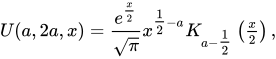

It isn't clear what the function is supposed to be. The preceding text would incline me guess at Kelvin function, but it really shouldn't have to be a guess. Could somebody please add an appropriate definition? Thank you.

I am pretty sure its the modified Bessel function

https://en.wikipedia.org/wiki/Bessel_function#Modified_Bessel_functions:_I%CE%B1_,_K%CE%B1
Rrogers314 (talk) 14:35, 9 December 2017 (UTC)
Multiplication theorem
It's obvious the written equation is wrong. The left-hand side doesn't contain t and the right-hand side doesn't seem to match DLMF. I will wait for other comments/references or edits before changing it though. Perhaps the author had some other formula completely in mind? [[1]] — Preceding unsigned comment added by Rrogers314 (talk • contribs) 14:40, 9 December 2017 (UTC)
Use Pochammer symbol for consistency with other pages
Content Disclaimer
Informasi ini disarikan dari Wikipedia dan disajikan kembali untuk tujuan edukasi. Konten tersedia di bawah lisensi CC BY-SA 3.0. Kami tidak bertanggung jawab atas ketidakakuratan data yang bersumber dari kontribusi publik tersebut.
- The information displayed on this website is sourced in part or in whole from Wikipedia and has been adapted for the purpose of restating it. We strive to provide accurate and relevant information, however:
- There is no guarantee of absolute accuracy. Wikipedia is an open, collaborative project that can be edited by anyone, so information is subject to change.
- It is not intended to constitute professional advice. The content displayed is for informational and educational purposes only. For important decisions (e.g., medical, legal, or financial), please consult a professional.
- Content copyright. Wikipedia is licensed under the Creative Commons Attribution-ShareAlike License (CC BY-SA). This means that content may be reused with appropriate attribution and shared under a similar license.
- Responsible use. Any risk arising from the use of information from this website is entirely the responsibility of the user.