Talk:Complex differential form
Great job, SR!. Charles Matthews 12:44, 18 November 2005 (UTC)Reply

 | This article is rated C-class on Wikipedia's content assessment scale. It is of interest to the following WikiProjects: | ||||||||||
| |||||||||||

Great job, SR!. Charles Matthews 12:44, 18 November 2005 (UTC)
A few things:
- Sorry about the awkward sectioning. I (or someone) will fix it later. Furthermore, I know the intro to the Complex differential forms section is a bit redundant with the article intro. I imported this from differential form.
- Thanks for pointing my in the right direction, Charles. I did a search for complex differential form, but got nothing. Speaking of which, complex differential form is probably a more appropriate title for the article.
- Also, this article, including my own contributions, is prejudiced towards complex forms on complex manifolds. There are cases in which one may want to consider complexified forms where the underlying manifold does not carry a complex structure (e.g., CR manifolds.) Anyway, I'll see if I can find a way to remove this bias unobtrusively.
Best Regards, Silly rabbit 12:58, 18 November 2005 (UTC)
Stable
The article states:
- By the Cauchy-Riemann equations, one can show that if we used a different holomorphic coordinate system wj, the spaces Ω1,0 and Ω0,1 are stable.
What does the word "stable" mean here? I can guess that maybe its a synonym for "invariant" or "complete". However "stable" also connotes the idea that its immune to small perturbations, and I don't think that that is what is meant. linas 23:13, 18 November 2005 (UTC)
- Ok, after nearly eight months... My inclination is to leave the word stable. To be completely precise, one would have to say "stabilized under the biholomorphism group" which is sort of a mouthful. Invariant is not correct, since the spaces are not invariant. They are equivariant, but that opens a whole other can of worms. I've changed the sentence structure and added a bit of clarification. Let me know if it's okay. Thanks for pointing it out. Silly rabbit 21:26, 9 June 2006 (UTC)
Tensorially
What does it mean to "transform tensorially"? I've never seen this terminology used before. 2620:101:F000:700:223:6CFF:FE98:4D1 (talk) 14:26, 8 September 2013 (UTC)
- It means "transforms like a tensor", as opposed to something more complicated. Tensors always transform in a characteristic way: you relabel the base-point, and then contract the indexes with a linear transform. 67.198.37.16 (talk) 17:59, 7 May 2019 (UTC)
"D-bar operator" listed at Redirects for discussion
 The redirect D-bar operator has been listed at redirects for discussion to determine whether its use and function meets the redirect guidelines. Readers of this page are welcome to comment on this redirect at Wikipedia:Redirects for discussion/Log/2024 April 26 § D-bar operator until a consensus is reached. 1234qwer1234qwer4 21:36, 26 April 2024 (UTC)
Is this right?
The last paragraph in the section One-forms begins as follows:
"Let Ω1,0 be the space of complex differential forms containing only 's and Ω0,1 be the space of forms containing only 's. One can show, by the Cauchy–Riemann equations, that the spaces Ω1,0 and Ω0,1 are stable under holomorphic coordinate changes. In other words, if one makes a different choice wi of holomorphic coordinate system, then elements of Ω1,0 transform tensorially, as do elements of Ω0,1."


But it is not correct to say that elements of Ω1,0 "transform" at all. They are independent of any choice of coordinates.
It is the coordinates of the one-forms that transform, not the differential forms themselves.
This is a fundamental conceptual error.
I hope someome familiar with this subject can fix this.
Another possible problem
The section The Dolbeault operators begins as follows:
"The usual exterior derivative defines a mapping of sections via

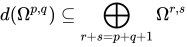
The exterior derivative does not in itself reflect the more rigid complex structure of the manifold.'"
But the symbol has not yet been defined anywhere in the article.

Because the article has before this point stated:
- "Ek is the space of all complex differential forms of total degree k,"
it appears that this symbol may mean the same thing as Ek when k = r. But I am not at all sure of this.
I hope someone familiar with this subject can fix this infelicity.
Content Disclaimer
Informasi ini disarikan dari Wikipedia dan disajikan kembali untuk tujuan edukasi. Konten tersedia di bawah lisensi CC BY-SA 3.0. Kami tidak bertanggung jawab atas ketidakakuratan data yang bersumber dari kontribusi publik tersebut.
- The information displayed on this website is sourced in part or in whole from Wikipedia and has been adapted for the purpose of restating it. We strive to provide accurate and relevant information, however:
- There is no guarantee of absolute accuracy. Wikipedia is an open, collaborative project that can be edited by anyone, so information is subject to change.
- It is not intended to constitute professional advice. The content displayed is for informational and educational purposes only. For important decisions (e.g., medical, legal, or financial), please consult a professional.
- Content copyright. Wikipedia is licensed under the Creative Commons Attribution-ShareAlike License (CC BY-SA). This means that content may be reused with appropriate attribution and shared under a similar license.
- Responsible use. Any risk arising from the use of information from this website is entirely the responsibility of the user.