Talk:Complex-base system
There is a discussion about the use of this idea in image compression. [1]

 | This article is rated Start-class on Wikipedia's content assessment scale. It is of interest to the following WikiProjects: | |||||||||||||||||||||||
| ||||||||||||||||||||||||


Image compression
There is a discussion about the use of this idea in image compression. [1]
periodic?
I preserved the phrase "is one of periodic cases" – but what does it mean? —Tamfang (talk) 00:32, 5 December 2008 (UTC)
- Seeing no clarification, I'll remove the phrase but keep the footnote. —Tamfang (talk) 04:45, 16 December 2009 (UTC)
improve translation
- Listed below are those of the system (as a special case shown above systems) and shows code numbers 2, -2, -1.
Whatever language this came from, it's not clear in English. Can someone improve it? —Tamfang (talk) 17:38, 3 May 2011 (UTC)
General notation:
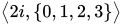
Instead of:
![{\displaystyle <\rho =\pm i{\sqrt {2}},[0,1]>}](https://wikimedia.org/api/rest_v1/media/math/render/svg/2396481db9f7c5d77b5a1d84e6e099d224b6fb60)
I would like to propose the notation:
- .
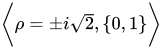
The because it is a set, so that one can say: set of digits and , and the because of optics.


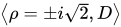

Text below:
Shouldn't one split up
- , example, (see also section "Base −1±i" below).

![{\displaystyle <\rho =[-1\pm i],[0,1]>}](https://wikimedia.org/api/rest_v1/media/math/render/svg/048811aedbef9e85240366b3803c91d83ae50216)
into
- , example, .
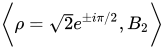

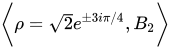
and
- , example, (see also section "Base −1±i" below). -- Nomen4Omen (talk) 11:42, 2 August 2011 (UTC)

Added reference
The inline reference to Penney's paper was wrong - it linked to some other paper. Unfortunately the system for inline references on Wikipedia is complicated enough that I don't have time to figure out how it works! So I added the bibliographical information on Penney's paper to the 'References' section in a very crude way. I hope someone can fix things up. John Baez (talk) 16:07, 8 November 2012 (UTC)
mixed radix
I've experimented with mixing the radices -1+i and -1-i. If they alternate, the rounding domain is a parallelogram with vertices at 0, 1, i, -1+i (or the conjugates); other sequences give other pretty shapes. —Tamfang (talk) 03:46, 3 March 2019 (UTC)
- You mean radices alternating between -1+i and -1-i ?
- Isn't a0*(-1+i)+a1*(-1+i)*(-1-i) = a0*(-1+i)+a1*2 very close to ? Which looks almost like the Quater-imaginary base system ? --Nomen4Omen (talk) 11:04, 3 March 2019 (UTC)

animation
%3Dsqrt(2)_complex-base_numeral_systems.gif)
There may be a place for this – with a better caption – but not filling the top of the page. —Tamfang (talk) 06:14, 4 May 2024 (UTC)
rounding
The rounding region of an integer – i.e., a set of complex (non-integer) numbers that share the integer part of their representation in this system – has in the complex plane a fractal shape: the twindragon.
I would call it the truncation region. Rounding, it seems to me, is an arithmetic operation independent of base. —Tamfang (talk) 18:38, 1 July 2024 (UTC)
Content Disclaimer
Informasi ini disarikan dari Wikipedia dan disajikan kembali untuk tujuan edukasi. Konten tersedia di bawah lisensi CC BY-SA 3.0. Kami tidak bertanggung jawab atas ketidakakuratan data yang bersumber dari kontribusi publik tersebut.
- The information displayed on this website is sourced in part or in whole from Wikipedia and has been adapted for the purpose of restating it. We strive to provide accurate and relevant information, however:
- There is no guarantee of absolute accuracy. Wikipedia is an open, collaborative project that can be edited by anyone, so information is subject to change.
- It is not intended to constitute professional advice. The content displayed is for informational and educational purposes only. For important decisions (e.g., medical, legal, or financial), please consult a professional.
- Content copyright. Wikipedia is licensed under the Creative Commons Attribution-ShareAlike License (CC BY-SA). This means that content may be reused with appropriate attribution and shared under a similar license.
- Responsible use. Any risk arising from the use of information from this website is entirely the responsibility of the user.