Talk:Compact operator
I have corrected the statement of the spectral theorem. It read

 | This article is rated C-class on Wikipedia's content assessment scale. It is of interest to the following WikiProjects: | ||||||||||
| |||||||||||

I have corrected the statement of the spectral theorem. It read
- The spectral theory for compact operators in the abstract was worked out by Frigyes Riesz. It shows that a compact operator K has a discrete spectrum, with finite multiplicities (so that K − λI has a finite-dimensional kernel for all complex λ).
Which is close, but case where the spectrum has 0 as a limit point is not a discrete subset of C. Moreover, 0 need not be an eigenvector even though it is always in the spectrum (e.g. Volterra operator) and if 0 is an eigenvector it may have infinite multiplicity (e.g. 0 operator)
It might be worth expanding on volterra operator, either here or in a new page, but I don't have time now. --AndrewKepert 07:57, 7 Apr 2004 (UTC)
OK, fine. 'Discrete spectrum' as opposed to 'continuous spectrum' is sort of lax terminology, I guess.
Charles Matthews 08:23, 7 Apr 2004 (UTC)
Some properties of compact operators
In the following, X,Y,Z,W are Banach spaces, B(X,Y) is space of bounded operators from X to Y. K(X,Y) is space of compact operators from X to Y. B(X)=B(X,X), K(X)=K(X,X). is the unit ball in X.

- A bounded operator is compact if and only if any of the following is true
- there exists a neighbourhood of 0, , and compact set such that .
- is relatively compact
- Image of any bounded set under T is relatively compact
- Image of any bounded set under T is totally bounded in Y.
- For any sequence from the unit ball, , the sequence contains a Cauchy subsequence.
- K(X,Y) is closed subspace of B(X,Y)
- This is a generalization of the statement that K(X) forms a two-sided operator ideal in B(X)
- is compact if and only if X has finite dimension
- For any , is closed.
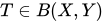





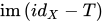
- this property immediately above somehow didn't get added. i will do so shortly. Mct mht 08:45, 3 April 2007 (UTC)
- It was not missed, it follows trivially from the properties of Fredholm operators. ((Igny 13:34, 3 April 2007 (UTC))—the preceding unsigned comment is by Igny (talk • contribs)
- ok, Fredholm operators have closed range and Fredholm-ness is preserved by homotopy, in the set of Fredholm operators. seems to me that the latter fact is not entirely trivial. just wanted to note that the property can also be shown directly. Mct mht 03:51, 5 April 2007 (UTC)
- It was not missed, it follows trivially from the properties of Fredholm operators. ((Igny 13:34, 3 April 2007 (UTC))—the preceding unsigned comment is by Igny (talk • contribs)
- this property immediately above somehow didn't get added. i will do so shortly. Mct mht 08:45, 3 April 2007 (UTC)
- You are welcome to add this to the article, as it fits nicely overall in the article. Oleg Alexandrov (talk) 20:21, 7 December 2005 (UTC)
- Done. (Igny 21:44, 7 December 2005 (UTC))
- Thanks! Oleg Alexandrov (talk) 01:08, 8 December 2005 (UTC)
- A question: The article says "A bounded operator is compact if and only if any of the following is true". This seems to suggest boundedness is necessary for the following conditions to be equivalent to compactness. Is this true? —Preceding unsigned comment added by 130.207.197.164 (talk) 17:40, 25 October 2010 (UTC)
- Thanks! Oleg Alexandrov (talk) 01:08, 8 December 2005 (UTC)
- Done. (Igny 21:44, 7 December 2005 (UTC))
Finite spectrum
Article said:
- It shows that a compact operator K on an infinite-dimensional Banach space has spectrum that is either a finite subset of C which includes 0 (in that case, the operator has finite rank)
This is wrong. A compact operator may have spectral radius 0, hence finite spectrum without being of finite rank. Consider for example the integration operator

![{\displaystyle f\rightarrow \{x\in [0,1]\rightarrow \int _{0}^{x}f(t)\,dt\}}](https://wikimedia.org/api/rest_v1/media/math/render/svg/f03b1dd3619a869eb64b2afd6a3c3b65e2ebfca8)
on --Bdmy (talk) 22:31, 28 February 2009 (UTC)
![{\displaystyle L^{2}([0,1]).}](https://wikimedia.org/api/rest_v1/media/math/render/svg/363bb35acc635331c6593f035d5a8da1dc37d6fa)
- This is the Volterra operator, mentioned previously on this talk page. linas (talk) 03:46, 15 November 2010 (UTC)
Compact operator on Hilbert spaces
There is something wrong here. As it stands it would imply the identity is compact. Surely it needs to say the singular values tend to zero. I will look for a good reference then fix it.Billlion (talk) 08:06, 2 May 2013 (UTC)
- No, the text is OK, even if not formulated in the clearest way. It's OK because you need infinitely many orthonormal vectors to represent the identity in an infinite dimensional Hilbert space, and then the will accumulate at a non zero value, which has been excluded in the text. Bdmy (talk) 08:19, 2 May 2013 (UTC)

Examples
- By Riesz's lemma, the identity operator is a compact operator if and only if the space is finite-dimensional.
- It seems that this is wrong, because because if X is rational numbers, closed unit ball is not compact, so image of closed unit ball is not relatively compact, therefore identity on rational numbers is not compact. I think that the equivalence holds only on complete spaces.
--195.113.30.252 (talk) 15:05, 25 January 2017 (UTC)
Unclear symbol
Under the section Important properties, the third bullet point reads as follows:
" In particular, K(X) forms a two-sided ideal in B(X)."

But no explanation is given for the circle symbol .

Can someone who knows what this means please include an explanation?2600:1700:E1C0:F340:7967:7502:8C03:5EC0 (talk) 18:31, 30 September 2018 (UTC)
- It's the compact operator, isn't it? Plokmijnuhby (talk) 17:06, 30 March 2020 (UTC)
- Clarified. 1234qwer1234qwer4 12:29, 9 September 2024 (UTC)
Juliusz Schauder
@Roffaduft, you don't link to "Stefan Banach" when talking about "Banach space"
– you actually do in the Banach space article, just not in any others because you can link to "Banach space" directly (any other article would not need to explain the concept of a Banach space). This article seems to be the only one explaining this result of Schauder, and so it is appropriate to link whom it is named after. link[ing] to the specific theorem
would therefore only result in a WP:Circular redirect. This has nothing to do with WP:NOTDICTIONARY, since it is an encyclopaedic historical fact. 1234qwer1234qwer4 12:26, 9 September 2024 (UTC)
you actually do in the Banach space article,
- And if this was an article on Schauder's theorem, a link to Juliusz Schauder would be appropriate. But this article is about Compact operators.
This article seems to be the only one explaining this result of Schauder, and so it is appropriate to link whom it is named after.
- First, this article just references the theorem as being a property, it does not explain anything. It is also not appropriate to link the theorem to Juliua Schauder: It is way to idiosynractic and has nothing to do with either the property or compact operators i.e. WP:NOTEVERYTHING
- The theorem is referred to as "Schauder's Theorem" on page 174 of Conway 1990. I moved the reference, which sufficiently covers the subject.
- Also, page 174 of Conway is most likely the reason "(Schauder's theorem)" was added in the first place, otherwise there would be additional references. Roffaduft (talk) 12:58, 9 September 2024 (UTC)
this article just references the theorem as being a property
– that's a lot more of an explanation (maybe I should have said "description", if it matters) than would be needed when mentioning a Banach space in any article, for instance (and a lot of stubs on theorems do just that, describe its statement and mention who proved it). Whether or not a theorem warrants a standalone article should not matter to be able to link its namesake. 1234qwer1234qwer4 02:50, 12 September 2024 (UTC)- It's just an unnecessary segway as per WP:NOTEVERYTHING:
- Information should not be included solely because it is true or useful. An article should not be a complete presentation of all possible details, but a summary of accepted knowledge regarding its subject.
- That is: The fact that Schauder's theorem is named after Juliusz Schauder has nothing to do with compact operators and should therefore be omitted.
- Kind regards, Roffaduft (talk) 03:21, 12 September 2024 (UTC)
- The fact that Schauder's theorem is named in the article begs the question whose name it is bearing, and a short mention (or even just a wikilink as I did in my original edit, which does not actually violate WP:EASTEREGG as I'm only linking the name) of the namesake in my opinion has due weight in the sole paragraph on the English Wikipedia discussing the topic and name. And of course the fact has to do with compact operators, as the theorem is directly related to those and Schauder was evidently studying them. 1234qwer1234qwer4 21:43, 14 September 2024 (UTC)
The fact that Schauder's theorem is named in the article begs the question whose name it is bearing
- "Information should not be included solely because it is true or useful"
the fact has to do with compact operators, ... Schauder was evidently studying them
- "An article should not be a complete presentation of all possible details"
- I'm done discussing this any further.
- Kind regards, Roffaduft (talk) 05:29, 15 September 2024 (UTC)
- The fact that Schauder's theorem is named in the article begs the question whose name it is bearing, and a short mention (or even just a wikilink as I did in my original edit, which does not actually violate WP:EASTEREGG as I'm only linking the name) of the namesake in my opinion has due weight in the sole paragraph on the English Wikipedia discussing the topic and name. And of course the fact has to do with compact operators, as the theorem is directly related to those and Schauder was evidently studying them. 1234qwer1234qwer4 21:43, 14 September 2024 (UTC)
- It's just an unnecessary segway as per WP:NOTEVERYTHING:
 Response to third opinion request: Response to third opinion request:
|
| Roffaduft has variously cited WP:NOTDICTIONARY, WP:NOTEVERYTHING, and MOS:LINKCLARITY as justification for reverting. The first two are utterly irrelevant, having nothing to do with linking—including a link is neither including information or a dictionary definition. The latter is more relevant, but it makes no sense as the link goes exactly where you would expect it to go. If there is no article for Schauder's theorem itself, the link to Schauder should certainly be reinstated as a pathway which increases readers' knowledge of the topic at hand. ~~ AirshipJungleman29 (talk) 18:02, 15 September 2024 (UTC) |
- @AirshipJungleman29 I was under the impression that adding hyperlinks is a form of adding information. Apparntly this is not the case and I'll apologize for incorrectly referring to WP:NOTEVERYTHING.
- However, I still disagree with the "next best thing" approach when it comes to adding hyperlinks. If there is no article on "Schauder's theorem" then a WP:REDLINK would be more appropriate instead of an arbitrary segway to an article about Juliusz Schauder. Or, even better, elaborate on the theorem and/or add relevant references.
- If the article on Juliusz Schauder had any mention of compact operators or "Schauder's theorem" then you could rightfully say that adding a hyperlink is:
a pathway which increases readers' knowledge of the topic at hand
. But this is not the case. There is no mention of operator theory at all in the Juliusz Schauder article. In fact, it just creates ambiguity as the article mentions various theorems named after Schauder, none of which are the one discussed in the Compact operator article. - On the other hand, I've already spend way too much time on this back-and-forth about something as simple as a hyperlink, so do whatever you like.
- Kind regards, Roffaduft (talk) 08:04, 16 September 2024 (UTC)
If there is no article on "Schauder's theorem" then a WP:REDLINK would be more appropriate
– not really, since the article already has enough information on it for it to be a WP:REDIRECT (though Schauder theorem is ambiguous and therefore is not a redirect). We could still create a redirect like Schauder's theorem (compact operators) and list that in the article on Juliusz Schauder as well, though I'm not sure this is relevant to the question at hand. 1234qwer1234qwer4 19:50, 21 September 2024 (UTC)- The question at hand is whether a link to Juliusz Schauder
increases readers' knowledge of the topic at hand.
I've argued that it clearly doesn't. - Also, a mathematical theorem is nothing more than a logical statement. The fact that someone at some point wrote down the proof is a lot less relevant compared to scientific disciplines subject to scientific method. That is, it doesn't incease the readers knowledge of compact operators as, e.g., the historical context is less relevant.
- If you disagree, please argue why a segway to Juliusz Schauder increases readers' knowledge on either compact operators or Schauder's theorem other than the trivially obvious fact that Schauder's theorem is named after a guy called Schauder.
- If it's not worth writing down the proof of the theorem, it is definitely not worth linking to the author who first published said proof. This is also the reason I suggested removing "(Schauder's theoreom)" altogether.
- If you're actually willing to compromise, I suggest one of the following options:
- Remove "(Schauder's theorem)"
- Elaborate on the theorem by writing out the proof, citing the original paper and only then link to Juliusz Schauder
- Explicitly mention the theory and its connection to compact operators in the article on Juliusz Schauder
- Write a line or two about the contributions of Schauder in the introduction of the compact operator article
- If you neither willing to compromise, nor want to provide counterarguments, then please be so kind to include verifiable proof that Schauder's theorem is named after "Juliusz Schauder" (as opposed to anyone else named Schauder) when you edit the article.
- Kind regards, Roffaduft (talk) 08:01, 22 September 2024 (UTC)
- The question at hand is whether a link to Juliusz Schauder
Example of non-compact linear operator
It would be useful to have some non-examples, such as a non-compact linear operator (differentiation?) and a non-compact bounded linear operator (??), along with an explanation. LachlanA (talk) 02:58, 14 June 2025 (UTC)
Content Disclaimer
Informasi ini disarikan dari Wikipedia dan disajikan kembali untuk tujuan edukasi. Konten tersedia di bawah lisensi CC BY-SA 3.0. Kami tidak bertanggung jawab atas ketidakakuratan data yang bersumber dari kontribusi publik tersebut.
- The information displayed on this website is sourced in part or in whole from Wikipedia and has been adapted for the purpose of restating it. We strive to provide accurate and relevant information, however:
- There is no guarantee of absolute accuracy. Wikipedia is an open, collaborative project that can be edited by anyone, so information is subject to change.
- It is not intended to constitute professional advice. The content displayed is for informational and educational purposes only. For important decisions (e.g., medical, legal, or financial), please consult a professional.
- Content copyright. Wikipedia is licensed under the Creative Commons Attribution-ShareAlike License (CC BY-SA). This means that content may be reused with appropriate attribution and shared under a similar license.
- Responsible use. Any risk arising from the use of information from this website is entirely the responsibility of the user.