Talk:Cokernel
I went ahead and put the definition for vector spaces before that for categories. I think that the most fundamental example should be before the definition in

 | This article is rated Start-class on Wikipedia's content assessment scale. It is of interest to the following WikiProjects: | ||||||||||
| |||||||||||

Vector spaces before categories
I went ahead and put the definition for vector spaces before that for categories. I think that the most fundamental example should be before the definition in full generality. It is important to realize that not every mathematician is comfortable with the language of categories, whereas all are familiar with vector spaces. Furthermore, the most common versions of the cokernel (abelian groups and modules over a commutative ring) do not require this level of generality, and can be extrapolated from the vector space definition. silly rabbit (talk) 12:41, 14 March 2008 (UTC)
- It currently reads a little bit strangely; it gives the definition in the case of vector spaces, but then does nothing with it. The article is on cokernels in category theory throughout; perhaps this definition would be better suited to an example section. 129.2.164.85 (talk) 06:05, 15 February 2010 (UTC)
Is this about linear algebra?
I came to this page because "left null space" redirects here, and I wanted to read up on that concept from linear algebra. However, to one uninitiated in category theory, this page is incomprehensible to the extent that I can't even tell if it's about a concept that maps to the one I know as "left null space" or something completely different.
If the page is about left null spaces in linear algebra, it should be re-written to at least give an introduction that doesn't require advanced math from a different field; if it's about a different concept, the redirect should be removed. 131.112.112.6 (talk) 03:02, 23 October 2015 (UTC)
- Agreed. Left null space gives a better linear algebra perspective. Wqwt (talk) 07:21, 13 March 2018 (UTC)
- This is super interesting. Technically, the left null space () is a subspace of whereas the cokernel () is a quotient space. There are however related. The first thing that comes to the mind is chose a basis of . This defines the surjection :
- and by the first isomorphism theorem, one has a bijection . But .
- This is super interesting. Technically, the left null space () is a subspace of whereas the cokernel () is a quotient space. There are however related. The first thing that comes to the mind is chose a basis of . This defines the surjection :


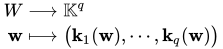


- There may be a better link but at least here is something. Noix07 (talk) 12:12, 17 April 2018 (UTC)
universal property diagram clipped harmfully
The universal property diagram is clipped such that the Q' looks like Q. This is super misleading. (Sorry I do not know how to fix svg file.) — Preceding unsigned comment added by Simple Symbol (talk • contribs) 00:58, 6 March 2019 (UTC)
- @Simple Symbol: Strange, it looks okay to me on the normal page display and when I view just the .svg file in-browser, but not when I click on the picture and see it in the image viewer. It might be worth bringing up at WP:VPT, but on the other hand, the couple commutative diagrams on this page aren't all that great (like normal ones rendered with xypic), so it might be worth redoing them anyway. –Deacon Vorbis (carbon • videos) 01:43, 6 March 2019 (UTC)
Broken Link
In the second reference (the one to the Emily Riehl book) - the link that purports to be to a pdf of the book goes nowhere. No idea what should be done here so I'll leave it alone. 2A00:23C6:ABE4:4D01:4C44:F29E:CD6:47F9 (talk) 23:10, 10 June 2025 (UTC)
Content Disclaimer
Informasi ini disarikan dari Wikipedia dan disajikan kembali untuk tujuan edukasi. Konten tersedia di bawah lisensi CC BY-SA 3.0. Kami tidak bertanggung jawab atas ketidakakuratan data yang bersumber dari kontribusi publik tersebut.
- The information displayed on this website is sourced in part or in whole from Wikipedia and has been adapted for the purpose of restating it. We strive to provide accurate and relevant information, however:
- There is no guarantee of absolute accuracy. Wikipedia is an open, collaborative project that can be edited by anyone, so information is subject to change.
- It is not intended to constitute professional advice. The content displayed is for informational and educational purposes only. For important decisions (e.g., medical, legal, or financial), please consult a professional.
- Content copyright. Wikipedia is licensed under the Creative Commons Attribution-ShareAlike License (CC BY-SA). This means that content may be reused with appropriate attribution and shared under a similar license.
- Responsible use. Any risk arising from the use of information from this website is entirely the responsibility of the user.