Talk:Chakravala method

 | This article is rated Start-class on Wikipedia's content assessment scale. It is of interest to the following WikiProjects: | |||||||||||||||||||||||
| ||||||||||||||||||||||||


The example
There is something wrong with the example. In the very first iteration, we have "and take t so that the absolute value of m^2 − 67 is minimized. The result is t = − 2, m = 7, m^2 − 67 = − 18." But if we had taken t = 3 instead, then m = -8 and m^2 - 67 = -3, whose abs value is lower than -18. 91.189.72.18 (talk) 18:43, 21 February 2009 (UTC)
- Hmm, that seems right! The article needs to be fixed... How did you happen to catch it? Shreevatsa (talk) 19:41, 21 February 2009 (UTC)
- I've added an explanation. Xanthoxyl (talk) 19:53, 21 February 2009 (UTC)
- Makes sense now. Perhaps we should include a general description of the method before the examples, including details like this. Shreevatsa (talk) 20:03, 21 February 2009 (UTC)
- I've added an explanation. Xanthoxyl (talk) 19:53, 21 February 2009 (UTC)
- There's a similar problem with the second iteration t = -2 would produce a smaller value. The first exception (new x would be 0) doesn't apply. Why is it discarded? —Preceding unsigned comment added by 64.213.65.34 (talk) 09:31, 1 April 2009 (UTC)
- Another problem in the second iteration, I think. The reasoning includes: "... |m2 − 67| is minimal for m = 5" but in the new solution from this iteration, m has been changed to 11: 90^2 - 67*11^2 = -7. The working for the next iteration uses m = 11 so this requires either a re-writing of the third iteration and subsequent working, or an explanation in the second iteration of why m = 11 is chosen although m = 5 gives the smallest value of |m^2 - 67| (excluding negative values of m). 115.69.35.19 (talk) 15:23, 1 January 2021 (UTC)
- http://cs.annauniv.edu/insight/insight/maths/algebra/indet/chakra.htm shows a method that actually works —Preceding unsigned comment added by 64.213.65.34 (talk) 10:28, 1 April 2009 (UTC)
- I guess that's the method now found at: http://cs.annauniv.edu/insight/Reading/algebra/indet/chakra.htm. 115.69.35.19 (talk) 15:32, 1 January 2021 (UTC)
- It looks like t is also being chosen such that . This makes sense, since we want x and y to be increasing, so I've added a small change to point this out, but this should probably be explained better. It's not explicitly mentioned in the version you linked, either, but it seems it is also necessary that when following that version. Asztal (talk) 18:31, 4 May 2009 (UTC)


Question
How did Brahmagupta use this method to get the answer for N=61, because this method can be used to find other solutions for the equation Nx^2 + k = y^2 if and only if one set of value for x and y are known? The solution set for N=61 is the first set of solution using which other set of solutions can be found. So this simply means that Brahmagupta had used other method to solve. Can anyone explain? Ranjitr303 (talk) 05:26, 25 June 2010 (UTC)
- No, the method can be used to solve Nx² + 1 = y² starting from a solution to Nx² + k = y² for any k. Thus for N=61, we have a solution (61)1² + 3 = 8², i.e. a solution x=1, y=8, k=3. Now iterate, etc. BTW, Brahmagupta did not solve the N=61 case; the article states it was solved by Jayadeva and Bhaskara II. Shreevatsa (talk) 21:24, 25 June 2010 (UTC)
The cases where k is up to sign 1,2,4
The sentences " Optionally, we can stop when k is ±1, ±2, or ±4, as Brahmagupta's approach gives a solution for those cases." and "but since the right-hand side is among ±1, ±2, ±4, we can also use Brahmagupta's observation directly." are a bit unclear to me. What exactly is the observation, and how does one proceed? Evilbu (talk) 13:39, 13 August 2012 (UTC)
Amendments to the Chakravala Method for Solving Pell's Equation
Amendments to the Chakravala Method for Solving Pell's Equation
Amendment 1 - Addition of Variable, f, to Vector
The current method uses a vector ( x_current, y_current, k_current) with k_current = x_current^2-Ny_current^2
I propose to use a new vector ( f_new, x_new, y_new, k_new) with:
f_new = gcd(x_current, N) x_new = x_current/gcd(x_current, N) y_new = y_current and k_new = f_new.x_new^2-N.y_new^2/f_new
The result of combining 2 vectors (f1, x1, y1, k1) and (f2, x2, y2, k2) is (1, f1x1f2x2+Ny1y2, f1x1y2+f2x2y1, f1f2k1k2)
Reduction of a vector is a 2-step process. The first step is the current reduction step ( f, x, y, k)->( f'=f, x'=x/gcd(x, y), y'=y/gcd(x, y), k'=k/gcd(x, y)^2) The second step is (f', x', y', k')->( f=f'.gcd( x', N/f'), x=x'/gcd( x', N/f'), y=y', k=k'/gcd( x', N/f')
The method for finding a starter vector and for finding a vector through the BIG M method now should search for the optimum by using all factors of N < sqrt(N) for f.
Sometimes after a combination and reduction f > N/f. To keep f < N/f it might be necessary to employ a transpose transformation. ( f, x, y, k) -> ( f_transpose = N/f, x_transpose = y, y_transpose = x, k_transpose = -k)
Amendment 2 - Direct Solutions When |k| is in {1, 2, 4}
The current method would require that when k satisfies the condition above that the vector combine with itself (or sometimes - when |k| = 4 - the first vector encountered with |k|=4) until k=1.
In the following cases the solution can be obtained directly:
k=1 and f=1 - x_solution = x , y_solution = y |k| in { 1, 2} and not ( f=1 and k=1 ) - x_solution = (2fx^2-k)/|k| , y_solution = 2xy/|k| |k| = 4 and f is even - x_solution = (fx^2-2sgn(k))^2/2-1 , y_solution = xy(fx^2-2sgn(k))/2 k=4 and f=1 - x_solution = x(x^2-3)/2 , y_solution = y(x^2-1)/2 |k| = 4 and f is odd and f > 1 - x_solution = fx^2(fx^2-3sgn(k))^2/2-1, y_solution = xy(fx^2-sgn(k))(fx^2-3sgn(k))/2
If N is of the form f^2.x^2 plus or minus 1, 2 or 4 times f then a solution can be obtained without needing to look for a starter.
Amendment 3 - Before Resorting to Using BIG M, Search Previously Encountered Vectors for a Vector With Which to Combine
With the current method, if |k| is not in { 1, 2, 4}, the only option is to employ the BIG M method to obtain a vector.
However, a previously encountered vector would be suitable for combining with the current vector, if:
1) it is not the current vector or its transpose; and |k_prev.k_current| equals
i) 64 or 128 ( and mod( f_prev.x_prev.y_curr+f_curr.x_curr.y_prev, 4)=0); or ii) 1, 2 or 4 times a prime squared; or iii) 1, 2 or 4 times prime_1^2.prime_2 ( and there is a second previously encountered vector where |k| = prime_2 )
In light of this, if no direct solution is possible, one of a pair (or triplet for iii) of candidate vectors that satisfy one of the above conditions is a better starter vector than the one with lowest |k|.
Working Examples
N=28 (example of direct solution with |k|=4 and f is even) Current Method
Starter find ( floor(sqrt(N)), 1, floor(sqrt(N))^2-N)
and ( ceil(sqrt(N)), 1, ceil(sqrt(N))^2-N)
( 5, 1, -3) ( 6, 1, 8) neither vector has |k| in { 1, 2, 4}, so choose vector with lower |k| ( 5, 1, -3) |k| not in { 1, 2, 4}, so use BIG M ( M, 1, M^2-N) (5M+28, 5+M, -3(M^2-28)) we want mod(y=M+5,|-3|)=0 and |-3(M^2-N)| to be minimised => M=4 ( 48, 9, 36) reduce ( 16, 3, 4) |k| = 4, so combine with self ( 16, 3, 4) ( 508, 96, 16) reduce ( 127, 24, 1) k = 1, so solve x_solution = x = 127 y_solution = y = 24
New Method
Starter find ( f, floor(sqrt(N)/f), 1, f.floor(sqrt(N)/f)^2-N/f)
and ( f, ceil(sqrt(N)/f), 1, f.ceil(sqrt(N)/f)^2-N/f)
for f = all factors of N < sqrt(N) Set f=1 ( 1, 5, 1, -3) ( 1, 6, 1, 8) ignored because gcd( x, N/f ) > 1 Set f=2 ( 2, 2, 1, -6) ignored because gcd( x, N/f ) > 1 ( 2, 3, 1, 4) |k| is in { 1, 2, 4} so we can stop and use this vector to solve the equation directly x_solution = (fx^2-2sgn(k))^2/2-1 = 127 y_solution = xy(fx^2-2sgn(k))/2 = 24
N=46 (example where a previous candidate satisfies a condition in Amendment 3) Current Method
Starter find ( floor(sqrt(N)), 1, floor(sqrt(N))^2-N)
and ( ceil(sqrt(N)), 1, ceil(sqrt(N))^2-N)
( 6, 1, -10) ( 7, 1, 3) neither vector has |k| in { 1, 2, 4}, so choose vector with lower |k| ( 7, 1, 3)|k| not in { 1, 2, 4}, so use BIG M ( M, 1, M^2-N) ( 7M+46, M+7, 3(M^2-N)) we want mod(y=M+7,|3|)=0 and |3(M^2-46)| to be minimised => M=8 ( 102, 15, 54) reduce ( 34, 5, 6)|k| not in { 1, 2, 4}, so use BIG M ( M, 1, M^2-N) ( 34M+230, 5M+34, 6(M^2-46)) we want mod(y=5M+34,|6|)=0 and |6(M^2-46)| to be minimised => M=4 ( 34M+230, 5M+34, 6(M^2-46)) ( 366, 54, -180) ( 61, 9, -5)|k| not in { 1, 2, 4}, so use BIG M ( M, 1, M^2-N) ( 61M+414, 9M+61, -5(M^2-46)) we want mod(y=9M+61,|-5|)=0 and |-5(M^2-46)| to be minimised => M=6 — Preceding unsigned comment added by 203.13.3.89 (talk) 08:48, 5 September 2014 (UTC)
Improving the description of the method
I think that the decription of the method can be made more clear and compact. For example, the paragraph starting with In the general method, ... can be changed to the following:
- The chakravala method takes as an input a non-square number and some solution for that such that . In every iteration, is composed with some trivial solution triple . For appropriate , the composition can be scaled down by applying Bhaskara's lemma


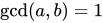
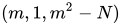


The major additions and modifications are:
- "N cannot be a square", otherwise can get zero.
- "for appropriate m the composition can be scaled down". As the decription mentions below, must be divisible by k for the scaling to work.
- the solution triple , is now refered to as a "composition". This is to avoid repeating the phrase "solution triple", and show that it is an intermediate result.


In the next paragraph it can be mentioned that the m that minimizes is unique, but this is not very important. Nxavar (talk) 08:23, 1 April 2015 (UTC)

- I think we should be careful about remaining true to the historical sources, and not imposing our own understanding on it. Different authors had slightly varying methods, and it would be better to talk of how they used it, rather than projecting modern terminology onto it. (For example they'd never say "we use Bhaskara's lemma here" -- they had a procedure, and now (with our Greek-inspired axiomatic-deductive conception of mathematics) we can justify the steps and make it seem as if the steps follow logically from other known facts, but in truth probably the steps came first (with some understanding and justification no doubt) and a formal justification later. So that is my concern. Shreevatsa (talk) 20:25, 1 April 2015 (UTC)
Content Disclaimer
Informasi ini disarikan dari Wikipedia dan disajikan kembali untuk tujuan edukasi. Konten tersedia di bawah lisensi CC BY-SA 3.0. Kami tidak bertanggung jawab atas ketidakakuratan data yang bersumber dari kontribusi publik tersebut.
- The information displayed on this website is sourced in part or in whole from Wikipedia and has been adapted for the purpose of restating it. We strive to provide accurate and relevant information, however:
- There is no guarantee of absolute accuracy. Wikipedia is an open, collaborative project that can be edited by anyone, so information is subject to change.
- It is not intended to constitute professional advice. The content displayed is for informational and educational purposes only. For important decisions (e.g., medical, legal, or financial), please consult a professional.
- Content copyright. Wikipedia is licensed under the Creative Commons Attribution-ShareAlike License (CC BY-SA). This means that content may be reused with appropriate attribution and shared under a similar license.
- Responsible use. Any risk arising from the use of information from this website is entirely the responsibility of the user.