Talk:Camera matrix
This article mentions but does not define "focal point". I don't think this is the optics meaning. Does this article really mean the center of of the entrance p

 | This article is rated B-class on Wikipedia's content assessment scale. It is of interest to the following WikiProjects: | ||||||||||
| |||||||||||
.jpg)
"Focal point"?
This article mentions but does not define "focal point". I don't think this is the optics meaning. Does this article really mean the center of of the entrance pupil (which is often the principle point? —Ben FrantzDale (talk) 22:26, 9 May 2008 (UTC)
- I'v added a wikilink to camera focal point (pinhole camera) which redirects to pinhole camera model where the camera focal point concept is defined: the entrance pupil of the pinhole camera. In the references that I have access to "pincipal point" is used to refer to the intersection of the optical axis and the image plane, not the entrance pupil. Which references are you using? --KYN (talk) 18:31, 11 May 2008 (UTC)
Derivation
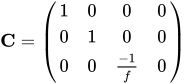
where is the camera matrix, which here is given by

, and the corresponding camera matrix now becomes
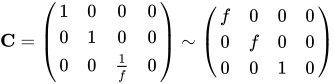
Question: why and how is the minus-sign in the third row and column of matrix C removed??
to ??


--213.101.253.178 (talk) 22:47, 9 June 2009 (UTC)
Where does the minus sign (-f/x3) comes from in the second formula in this section??
--86.176.122.44 (talk) 10:36, 28 March 2010 (UTC)
Seems to be some remains from previous inconsistent edits. Should be fixed now. --KYN (talk) 20:38, 28 March 2010 (UTC)
Citations needed.
This article is poorly sourced. It cites only one reference, Hartley and Zisserman's 2003 book. However, that book used a completely different notation in its chapter on camera models. Further, the content of that chapter is nowhere close the content of this article. For example, the Derivation section appears to be very different from the corresponding section in the source, see its page 154. glopk (talk) 18:04, 5 July 2010 (UTC)
Null space and projectability
The discussion of which points have a projection in the “focal point” section is broken. In order for the projection to exist, there need to exist solutions to the equation
- i.e. for some (real) scaling factor .
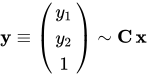
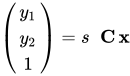

In the first two rows, and are not constrained, but the third row lets us calculate


![{\displaystyle s={\frac {1}{[0\,0\,1]\;\mathbf {C} \;\mathbf {x} }}}](https://wikimedia.org/api/rest_v1/media/math/render/svg/f9bb8dc31321121670b2ee3fa294405759beb00a)
For a solution to exist, the denominator must be non-zero, so must be in the null space of . That null space is the entire plane (the focal plane), and of course includes the null space of .

![{\displaystyle [0\,0\,1]\;\mathbf {C} =[0\,0\,1\,0]}](https://wikimedia.org/api/rest_v1/media/math/render/svg/f42c1afbfad3e056acc5ea34ed7bf8da944658c2)

This result makes intuitive sense, too. For the focal point, the projection line is indeterminate, as pointed out in the article. For any other point in the focal plane, the projection line is well-defined but does not intersect the image plane.
Of course, I have no references for this stuff, so it can't possibly be true. >=) --96.237.6.249 (talk) 21:07, 15 June 2012 (UTC)
- I've tried to resolve this issue. The bottom line is that when we use a homogeneous representation of point, lines, and planes, it makes sense to interpret the intersection of parallel lines as "points at infinity". These points do not exist in the underlying Euclidean space but are well-defined and can in principle be treated as any other points in the algebraic framework that emerges as a consequence of using homogeneous representations. --KYN (talk) 12:57, 16 June 2012 (UTC)
- That's a good point. I thought that the use of was meant to specifically exclude points at infinity, but now I'm not so sure-- it's more likely it was just a “canonical” representation of homogeneous coordinates.

- But it still feels like we're adding more and more original research and moving away from verifiable sources. --96.237.6.249 (talk) 14:27, 16 June 2012 (UTC)
- I wish this was my idea, but if you look in the single source that is actually in the article, the book by Hartley and Zisserman, you will find a nice presentation of homogeneous representation of geometry, including the camera matrix. --KYN (talk) 09:40, 17 June 2012 (UTC)
- I'll try to get my hands on the book at some point.
- Also, the new paragraph seems unnecessarily wordy for something that should, at best, be a minor point in the discussion of the camera matrix. Can I suggest something more compact, like this?
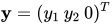
- For any other 3D point with , the result is well-defined but has the form . This corresponds to a point at infinity in the projective image plane (even though, if the image plane is taken to be a Euclidean plane, no corresponding intersection point exists).

- Yes, this is more to the point! --KYN (talk) 18:40, 26 June 2012 (UTC)
Comments
The lead mentions the degrees of freedom and claims that the camera matrix is "...involved in the mapping between elements of two projective spaces..." I can think of no good reason for this to be in the lead. I'm not even sure it is correct => it seems to me that the cm is defined as mapping between "the world" - which is NOT a projective space, and a plane (which is). I think the offending sentence should be removed. ... On another subject, it might be useful/informative to briefly explain that while a 3x3 matrix can handle changing the coordinate system (frame of reference) in 3d space when rotations or boosts (zooming in or out) are considered, it can NOT handle translation (the most common type of movement). (That is; rotation of points around the origin, or expanding/shrinking their distances is easily handled, but moving, for example from point x,y,z to point x+c,y,z, can't be done using a 3x3 matrix.) (Classical Physics states that the physical laws are invariant (unaffected by) rotation (of coordinate system), boost, or translation.) Homogeneous coordinates are able to handle all Galilean transformations and so are quite useful when dealing with points in (3d) space.40.142.185.108 (talk) 11:55, 19 August 2019 (UTC)
Content Disclaimer
Informasi ini disarikan dari Wikipedia dan disajikan kembali untuk tujuan edukasi. Konten tersedia di bawah lisensi CC BY-SA 3.0. Kami tidak bertanggung jawab atas ketidakakuratan data yang bersumber dari kontribusi publik tersebut.
- The information displayed on this website is sourced in part or in whole from Wikipedia and has been adapted for the purpose of restating it. We strive to provide accurate and relevant information, however:
- There is no guarantee of absolute accuracy. Wikipedia is an open, collaborative project that can be edited by anyone, so information is subject to change.
- It is not intended to constitute professional advice. The content displayed is for informational and educational purposes only. For important decisions (e.g., medical, legal, or financial), please consult a professional.
- Content copyright. Wikipedia is licensed under the Creative Commons Attribution-ShareAlike License (CC BY-SA). This means that content may be reused with appropriate attribution and shared under a similar license.
- Responsible use. Any risk arising from the use of information from this website is entirely the responsibility of the user.