Talk:Arg max
Links to LaTeX style guides are needed, as I doubt this is the only such Wikipedia entry with LaTeX discussion.

 | This article is rated Start-class on Wikipedia's content assessment scale. It is of interest to the following WikiProjects: | ||||||||||
| |||||||||||

Untitled
Links to LaTeX style guides are needed, as I doubt this is the only such Wikipedia entry with LaTeX discussion.
LaTeX
The LaTeX in this article needs to be improved (as noted in the second section of the article itself). Currently it seems that the MediaWiki software doesn't support enough LaTeX or TeX to be able to improve it, though. The TeX way doesn't work:
\mathop{\rm argmax}\limits_x f(x)

The LaTeX solution given in the article doesn't work, either:
\operatornamewithlimits{argmax}_x f(x)- Failed to parse (unknown function "\operatornamewithlimits"): {\displaystyle \operatornamewithlimits{argmax}_x f(x)}
—Bkell (talk) 00:08, 29 November 2006 (UTC)
I don't agree that the space between arg and max is undesirable. I'd just leave "centering below argmax rather than just max" as motivation, but with two variants in the definition, one with space and one without. Furthermore using \operatornamewithlimits seems inferior to \DeclareMathOperator. I'm voting for only using that. 128.208.3.75 02:58, 28 December 2006 (UTC)
I vote for deleting the "centering below max" paragraph, because it is mathmatically plainly nonsense. This implies arg(max_x f(x)), and in that case the arg function is undefined. Furthermore wasn't that the default behavior of \arg\max_x? So no need for this, we're not explaining how to use \newcommand on this page!! 128.208.3.75 03:01, 28 December 2006 (UTC)
Wikipedia not a guide to LaTeX
We need to remove the section on how to use argmax in LaTeX from the enrty. OliAtlason (talk) 23:31, 7 May 2008 (UTC)
Removed reference material for the typesetting language LaTeX, it is not appropriate for an encyclopedia. OliAtlason (talk) 15:25, 21 May 2008 (UTC)
= not \in
There should be an "=" symbol not an \in one in equation one. —Preceding unsigned comment added by 24.223.134.177 (talk) 16:10, 18 June 2008 (UTC)
Merge with mathematical optimization
I think this article should be merged with Mathematical optimization#Notation. Any opposite views? Isheden (talk) 17:00, 22 May 2011 (UTC)
- In my opinion, Arg max is too large to be merged. In Mathematical optimization#Notation there is a summary of Arg max, in a section which refers to Arg max as the main article. That's the best way to make sure that the readers who do not want details are given only the most interesting information, while those who want details can get it from the main article. Paolo.dL (talk) 14:30, 15 July 2011 (UTC)
- If you mean to remove this article, I disagree. Arg max isn't just about optimization. I have three coefficients, . Which one has the greatest value? Coefficient index does. This isn't about optimization per se, just a little step inside a bigger algorithm that needs to know the largest coefficient. Arg max is convenient notation to do that. Comfortably Paranoid (talk) 03:51, 12 August 2011 (UTC)


Merge with argument of a function
How about merging with argument of a function? Isheden (talk) 22:16, 12 October 2011 (UTC)
Empty set and singletons
A discussion of the empty set (and conventions about positive or negative infinity for unattained values) is needed.
The article overloads arg max. An explicit type conversion from singletons to points is needed. Kiefer.Wolfowitz 17:32, 22 May 2011 (UTC)
Arg sup and inf?
Paolo.dL asked me about the difference between arg sup/inf and arg max/min, but I was not able to give a complete answer. Help appreciated! Rinconsoleao (talk) 11:10, 19 July 2011 (UTC)
The min is the smallest value in a set. The inf is the greatest lower bound on the set. Frequently the two are the same, but in tricky cases there is an inf even if the min fails to exist. The relation between max and sup is analogous. Examples:
- minimize by choosing x in . In this case the min is y=5 at the arg min x=0. Also the inf is y=5, at the arg inf x=0.


- minimize by choosing x in . In this case the min and the arg min do not exist because you would like to choose x=1, but that's not in the choice set. In this case the inf is 6, which is the largest number less than or equal to for all x in .


- Unfortunately in this second example, I'm not sure whether it's technically correct to say that the arg inf is 1, or that the arg inf is undefined. Rinconsoleao (talk) 10:57, 19 July 2011 (UTC)
Summarizing: arg inf and arg sup are not synonyms for arg min and arg max, but in the cases when they fail to be equivalent I am not sure whether arg inf and arg sup are well-defined. Help appreciated. Rinconsoleao (talk) 11:07, 19 July 2011 (UTC)
- Probably we need a separate article Argument (mathematics) to sort this out. According to MathWorld, "An argument of a function is one of the n parameters on which the function's value depends." Since in your example there is only one argument x, I guess arg inf f(x), where f(x)=y, is well defined. Isheden (talk) 11:44, 19 July 2011 (UTC)
- However, if the domain of f(x) is , then the infimum is attained also for x=-1, so arg inf f(x) = {-1, 1}. Isheden (talk) 11:56, 19 July 2011 (UTC)
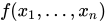

- I just discovered that inf stands for infimum, and sup for supremum. The two articles provide interesting information. Paolo.dL (talk) 16:44, 19 July 2011 (UTC)
I left another question about this here: Talk:Supremum#arg?. Rinconsoleao (talk) 12:05, 20 July 2011 (UTC)
Inconsistent Definition
The two expressions:


cannot both work. In the first, the subexpression ocurring as parameter to argmax is a variable. In the second, the parameter is the predicate , something completely different. Moreover, the second expression is unclear as to what is to be optimised, it could as well be or the membership of in .


I would suggest a clearer definition for instance: with the intended meaning that is the parameter for optimisation, and a predicate that must be satisfied for any considered value of . — Preceding unsigned comment added by 188.107.64.31 (talk) 11:31, 9 October 2011 (UTC)

- I don't see the inconsistency. It is a standard convention that the domain of the function max is written below, not just the argument x. This means that the function is maximized over the argument x which can be any real number. In the first example however, it is actually not needed to specify x since f(x) has only one argument. Isheden (talk) 22:13, 12 October 2011 (UTC)
Misleading use of y
I find that the current expression is misleading to the reader and is inconsistent with the conventional notation y = f(x).
Instead, I suggest the definition be re-expressed as:
- 𝑓(x) := {xᵢ | 𝑓(xᵢ) ≥ 𝑓(x), ∀x ∈ X}
or in LaTeX...

Content Disclaimer
Informasi ini disarikan dari Wikipedia dan disajikan kembali untuk tujuan edukasi. Konten tersedia di bawah lisensi CC BY-SA 3.0. Kami tidak bertanggung jawab atas ketidakakuratan data yang bersumber dari kontribusi publik tersebut.
- The information displayed on this website is sourced in part or in whole from Wikipedia and has been adapted for the purpose of restating it. We strive to provide accurate and relevant information, however:
- There is no guarantee of absolute accuracy. Wikipedia is an open, collaborative project that can be edited by anyone, so information is subject to change.
- It is not intended to constitute professional advice. The content displayed is for informational and educational purposes only. For important decisions (e.g., medical, legal, or financial), please consult a professional.
- Content copyright. Wikipedia is licensed under the Creative Commons Attribution-ShareAlike License (CC BY-SA). This means that content may be reused with appropriate attribution and shared under a similar license.
- Responsible use. Any risk arising from the use of information from this website is entirely the responsibility of the user.