Smooth dynamics
Smooth dynamics is a subfield of dynamical systems and often studied with tools from ergodic theory and Topological dynamics.

Smooth dynamics is a subfield of dynamical systems and often studied with tools from ergodic theory and Topological dynamics.
Introduction
Smooth dynamics [1] assumes a differential structure on top of manifold M or generically on Banach spaces over M. This can be piece-wise affine (I.e with constant derivatives), differentiable (e.g. or , or smooth I.e. . Typically one studies dynamical systems in order of complexity and with different techniques, for example the typical setup of newtonian mechanics requires time evolution maps , a fractal attractor or a brownian motion may be continuous but not differentiable in a countable number of points and a piece-wise affine map may be studied with techniques of algebraic geometry.


The hyperbolicity condition, I.e having stretching and contracting directions, has a relation with chaos theory and therefore was studied extensively. Important subbranches are Hyperbolic dynamics, non uniform hyperbolicity[2] and partial hyperbolicity.[3]
Simple example
Assume a two dimensional manifold, and a real (or complex) smooth map on it, after diagonalization I.e after a coordinate transformation, the map can be approximated locally by a linear map of the plane given by the matrix

There are 4 important cases:
- The dissipative case,where 0<λ<μ <1 and the orbits converge towards a stable point or an attractor
- The case where both eigenvalues are divergent 1<λ<μ and dynamics is divergent like for an unstable point
- The case where one or more the eigenvalues have modulus 1: if all eigenvalues have modulus one, the matrix is unitary and there is typically a conserved quantity.
- The hyperbolic case where the eigenvalues are 0<λ<1<μ and in one direction there is convergence and in the other direction there is divergence.
To give a visual local intuition of the motion the unitary case (3) is a stable orbit such as a circle, in the dissipative case (1) the orbit is spiralling inwards towards the centre, and in the divergent case spiralling outwards (2), the hyperbolic case (4) is a mixed scenario which depends on the direction of motion.
Hyperbolic dynamics
Different types of hyperbolicity
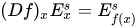
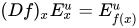
Given a manifold that splits into a stable (s) and unstable (u) part and given the diffeomorphism splits also naturally into two endomorphisms and for all


| * | Stable manifold & forward | Unstable manifold & backward | Condition on eigenvalues |
|---|---|---|---|
| uniform hyperbolic[1] | , and | , and | |
| non uniform hyperbolic[2] | and | and | |
| partial hyperbolic[3] | and | , and |


Uniform hyperbolic is the case of Anosov diffeomorphisms and Hyperbolic sets, the definition is based on the boundness of the diffeomorphism, this case shows all common properties of Hyperbolic dynamics. The non uniform case generalizes evidencing the exponential divergence of close orbits and the dependence of the boundness condition on the position. The partial hyperbolic case is still based on boundness but generalizes instead for general eigenvalues. These last two cases instead are relevant for applications.
Properties of Hyperbolic systems
An initial goal of studying chaotic systems was to clarify the relationships between entropy and chaos. The initial intuition behind the Kolmogorov-Sinai entropy was that there were two classes of systems, the probabilitistic ones with entropy non zero and the deterministic ones with entropy zero, this is actually not true and hyperbolicity is linked to entropy. This also leads to the theory of deterministic chaos, which is "rigid" in structure but still unpredictable.[4]
A second goal from the Smale school was to identify chaotic systems that are robust to perturbation, and the relationships between chaos and dynamical billiards which are in general hyperbolic. This has lead to the concept of structurally stable systems. Anosov diffeomorphism are proven to be structurally stable, i.e. the dynamics is robust to perturbations, by a theorem of Anosov.
A third goal was to understand the relationships between mixing, eigenvalues and phase transitions, this has lead to the "Thermodynamic formalism" from David Ruelle,[5] where Topological entropy is defined formally starting from measure theory. This has allowed to understand it's relationships with information entropy through the variational principle. The work of Ruelle and Sinai was expanded by Rufus Bowen on anosov systems,[6] their entropy and the introduction of Sinai-Ruelle-Bowen measures, ultimately leading Donald Ornstein to prove that Bernoulli shifts with the same entropy are isomorphic.[7]
References
- ^ a b Hasselblatt, Boris; Pesin, Yakov (June 25, 2008). "Hyperbolic Dynamics". Scholarpedia. 3 (6): 2208. Bibcode:2008SchpJ...3.2208H. doi:10.4249/scholarpedia.2208.
- ^ a b Pesin, Yakov; Hasselblatt, Boris (January 9, 2008). "Nonuniform hyperbolicity". Scholarpedia. 3 (1): 4842. Bibcode:2008SchpJ...3.4842P. doi:10.4249/scholarpedia.4842.
- ^ a b Hasselblatt, Boris; Pesin, Yakov (October 19, 2011). "Partial hyperbolicity". Scholarpedia. 6 (10): 4845. Bibcode:2011SchpJ...6.4845H. doi:10.4249/scholarpedia.4845.
- ^ Yakov Sinai: Now everything has been started? The origin of deterministic chaos YouTube · The Abel Prize 7 Feb 2020
- ^ David Ruelle, Thermodynamic Formalism: The Mathematical Structure of Equilibrium Statistical Mechanics, 2010, cambridge university press https://www.cambridge.org/core/books/thermodynamic-formalism/3CDB86DA1B33B0C2EB87A87E3880D1A9
- ^ Equilibrium States and the Ergodic Theory of Anosov Diffeomorphisms, Springer link, https://link-springer-com.wikipedialibrary.idm.oclc.org/book/10.1007/978-3-540-77695-6
- ^ Ornstein, Donald (1970). "Bernoulli shifts with the same entropy are isomorphic". Advances in Mathematics. 4 (3): 337–352. doi:10.1016/0001-8708(70)90029-0.
Further reading
- Katok Hasselblatt An introduction to dynamical systems
| Concepts |
|   | ||||||||
|---|---|---|---|---|---|---|---|---|---|---|
Theorems |
| |||||||||
| Systems |
| |||||||||
| Theoretical branches |
| |||||||||
| Ergodic theorists | ||||||||||
| Related branches | ||||||||||
Content Disclaimer
Informasi ini disarikan dari Wikipedia dan disajikan kembali untuk tujuan edukasi. Konten tersedia di bawah lisensi CC BY-SA 3.0. Kami tidak bertanggung jawab atas ketidakakuratan data yang bersumber dari kontribusi publik tersebut.
- The information displayed on this website is sourced in part or in whole from Wikipedia and has been adapted for the purpose of restating it. We strive to provide accurate and relevant information, however:
- There is no guarantee of absolute accuracy. Wikipedia is an open, collaborative project that can be edited by anyone, so information is subject to change.
- It is not intended to constitute professional advice. The content displayed is for informational and educational purposes only. For important decisions (e.g., medical, legal, or financial), please consult a professional.
- Content copyright. Wikipedia is licensed under the Creative Commons Attribution-ShareAlike License (CC BY-SA). This means that content may be reused with appropriate attribution and shared under a similar license.
- Responsible use. Any risk arising from the use of information from this website is entirely the responsibility of the user.