Peperomia toroi

| Peperomia toroi | |
|---|---|

| |
Scientific classification 
| |
| Kingdom: | Plantae |
| Clade: | Embryophytes |
| Clade: | Tracheophytes |
| Clade: | Angiosperms |
| Clade: | Magnoliids |
| Order: | Piperales |
| Family: | Piperaceae |
| Genus: | Peperomia |
| Species: | P. toroi
|
| Binomial name | |
| Peperomia toroi | |
Peperomia toroi is a species of epiphyte in the genus Peperomia that is endemic in Colombia.[1][2] It primarily grows on wet tropical biomes.[1] Its conservation status is Threatened.[3]
Description
The first specimens where collected in Antioquia, Colombia.[4]
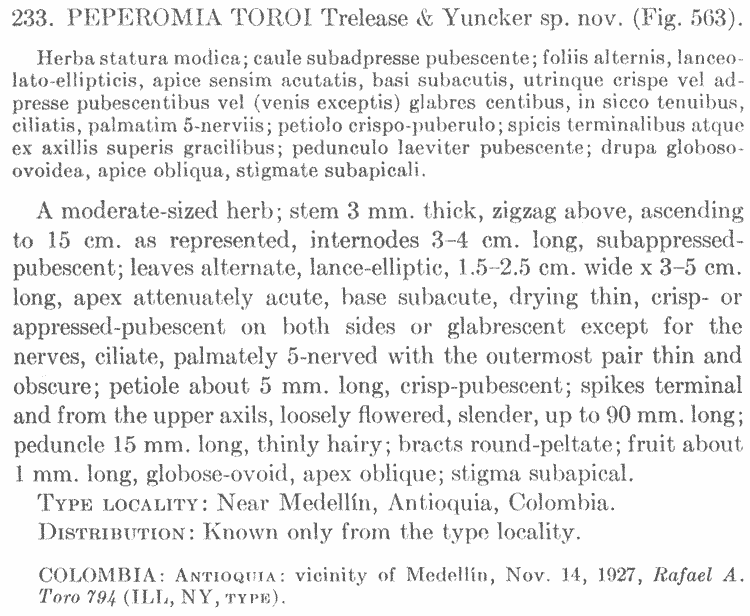
Peperomia toroi is a moderately sized herb. Its stems are 3 mm thick with a zigzag above that ascends to 15 cm. The internodes are 3–4 cm long, supappressed-pubescent. The leaves alternate, lance-elliptic, that is 1.5-2.5 cm wide and 3–5 cm long. Its tip is acute. Its base is subacute. It is appressed on both sides or glabrescent except for the nerves. The leaves is a ciliate 5-nerved with the outermost pair being thin. Its petioles is a 5 mm long pubescent crip. It has spikes at the tip. From the upper axils, it is loosely flowered and up to 90 mm long. Its peduncles is a 15 mm long with hairs that are thin. Its bracts are round. Its fruits shape is a spherical that is 1 mm long. Its stigma is subapical.[4]
Taxonomy and naming
It was described in 1950 by Trel. & Yunck. in The Piperaceae of northern South America, from specimens collected by Rafael Andres Toro.[5] It got its name from the botanist who collected the first specimen, who was Rafael Andres Toro.[5]
Distribution and habitat
It is endemic in Colombia.[2] It grows on an epiphyte environment and is a herb.[1][4] Its elevation range is 1500–1600 meters.[1] It grows on wet tropical biomes.[1]
Conservation
This species is assessed as Threatened, in a preliminary report.[3]
References
- ^ a b c d e "Peperomia toroi Trel. & Yunck". Plants of the World Online. Royal Botanic Gardens, Kew. Retrieved 1 March 2026.
- ^ a b "Peperomia toroi Trel. & Yunck". Global Biodiversity Information Facility. Retrieved 1 March 2026.
- ^ a b Bachman, Steven P.; Brown, Matilda J. M.; Leão, Tarciso C. C.; Lughadha, Eimear Nic; Walker, Barnaby E. (2024). "Extinction risk predictions for the world's flowering plants to support their conservation". New Phytologist. 242 (2): 797–808. doi:10.1111/nph.19592. PMID 38437880.
- ^ a b c Trelease, William; Yuncker, Truman George. "The Piperaceae of northern South America 2: 453–454, f. 451. 1950". Piperac. N. South Amer. 2: 640–641.
- ^ a b "Peperomia toroi Trel. & Yunck". Tropicos. Retrieved 1 March 2026.
Content Disclaimer
Informasi ini disarikan dari Wikipedia dan disajikan kembali untuk tujuan edukasi. Konten tersedia di bawah lisensi CC BY-SA 3.0. Kami tidak bertanggung jawab atas ketidakakuratan data yang bersumber dari kontribusi publik tersebut.
- The information displayed on this website is sourced in part or in whole from Wikipedia and has been adapted for the purpose of restating it. We strive to provide accurate and relevant information, however:
- There is no guarantee of absolute accuracy. Wikipedia is an open, collaborative project that can be edited by anyone, so information is subject to change.
- It is not intended to constitute professional advice. The content displayed is for informational and educational purposes only. For important decisions (e.g., medical, legal, or financial), please consult a professional.
- Content copyright. Wikipedia is licensed under the Creative Commons Attribution-ShareAlike License (CC BY-SA). This means that content may be reused with appropriate attribution and shared under a similar license.
- Responsible use. Any risk arising from the use of information from this website is entirely the responsibility of the user.