Biweight midcorrelation
In statistics, biweight midcorrelation (also called bicor) is a measure of similarity between samples. It is median-based, rather than mean-based, thus is less …

 | This article is an orphan, as no other articles link to it. Please introduce links to this page from related articles. (July 2026) |
In statistics, biweight midcorrelation (also called bicor) is a measure of similarity between samples. It is median-based, rather than mean-based, thus is less sensitive to outliers, and can be a robust alternative to other similarity metrics, such as Pearson correlation or mutual information.[1]
Derivation
Here we find the biweight midcorrelation of two vectors and , with items, representing each item in the vector as and . First, we define as the median of a vector and as the median absolute deviation (MAD), then define and as,







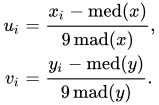
Now we define the weights and as,


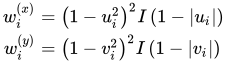
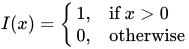
where is the identity function where,

Then we normalize so that the sum of the weights is 1:
![{\displaystyle {\begin{aligned}{\tilde {x}}_{i}&={\frac {\left(x_{i}-\operatorname {med} (x)\right)w_{i}^{(x)}}{\sqrt {\sum _{j=1}^{m}\left[(x_{j}-\operatorname {med} (x))w_{j}^{(x)}\right]^{2}}}}\\{\tilde {y}}_{i}&={\frac {\left(y_{i}-\operatorname {med} (y)\right)w_{i}^{(y)}}{\sqrt {\sum _{j=1}^{m}\left[(y_{j}-\operatorname {med} (y))w_{j}^{(y)}\right]^{2}}}}.\end{aligned}}}](https://wikimedia.org/api/rest_v1/media/math/render/svg/4ddaa71533c2d782bdd2b7812536299d3ccc19b9)
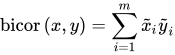
Finally, we define biweight midcorrelation as,
Applications
Biweight midcorrelation has been shown to be more robust in evaluating similarity in gene expression networks,[2] and is often used for weighted correlation network analysis.
Implementations
Biweight midcorrelation has been implemented in the R statistical programming language as the function bicor as part of the WGCNA package[3]
Also implemented in the Raku programming language as the function bi_cor_coef as part of the Statistics module.[4]
See also
References
- ^ Wilcox, Rand (January 12, 2012). Introduction to Robust Estimation and Hypothesis Testing (3rd ed.). Academic Press. p. 455. ISBN 978-0123869838.
- ^ Song, Lin (9 December 2012). "Comparison of co-expression measures: mutual information, correlation, and model based indices". BMC Bioinformatics. 13 (328): 328. doi:10.1186/1471-2105-13-328. PMC 3586947. PMID 23217028.
- ^ Langfelder, Peter. "WGCNA: Weighted Correlation Network Analysis (an R package)". CRAN. Retrieved 2018-04-06.
- ^ Khanal, Suman. "Statistics: Raku module for doing statistics". GitHub. Retrieved 2022-03-11.
Content Disclaimer
Informasi ini disarikan dari Wikipedia dan disajikan kembali untuk tujuan edukasi. Konten tersedia di bawah lisensi CC BY-SA 3.0. Kami tidak bertanggung jawab atas ketidakakuratan data yang bersumber dari kontribusi publik tersebut.
- The information displayed on this website is sourced in part or in whole from Wikipedia and has been adapted for the purpose of restating it. We strive to provide accurate and relevant information, however:
- There is no guarantee of absolute accuracy. Wikipedia is an open, collaborative project that can be edited by anyone, so information is subject to change.
- It is not intended to constitute professional advice. The content displayed is for informational and educational purposes only. For important decisions (e.g., medical, legal, or financial), please consult a professional.
- Content copyright. Wikipedia is licensed under the Creative Commons Attribution-ShareAlike License (CC BY-SA). This means that content may be reused with appropriate attribution and shared under a similar license.
- Responsible use. Any risk arising from the use of information from this website is entirely the responsibility of the user.