Battalia (formation)

From the late 16th century into the 18th century battalia, was a description used both for the positioning of units in an army (or navy) on a battle field and the formation in which individual units deployed for battle (battle array or battle order).[1][2] Sometimes it was used to describe the main body of an army deploy for battle but excluding the wings and other units such as those deployed in front of the main line in skirmishing formation etc.[3] Battalia differs from battalion which is generally the smallest military unit capable of independent operations and would have formed up in its battalia when going into battle.[4]
See also
- Pike and shot for details of different formation used in a battalia at the time the word was in common usage.
Gallery
-
 A plan of the Royalist battalia at Marston Moor, drawn up by Sir Bernard de Gomme
 -
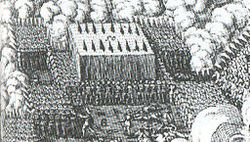 A tercio in "bastioned square," in battle


Notes
- ^ Curtis 1829, p. 666.
- ^ Battalia is derived from the Italian word battaglia or the Spanish word batalla (OED staff, "Battalia").
- ^ OED staff, "Battalia".
- ^ Battalion is derived from the French battaillon which is derived from the Italian battaglione "augmentative or diminutive of battaglia battle n.; compare Spanish batallon 'a pettie battell or army'." (OED staff, "Battalion")
References
- OED staff, Oxford English Dictionary (online ed.)
- Curtis, Thomas (1829), "battalia", The London encyclopaedia: or Universal dictionary of science, art, literature, and practical mechanics, comprising a popular view of the present state of knowledge, vol. 3, Thomas Tegg, p. 666
Further reading
- Lenihan, Pádraig (2001), "The Infantry Battle", Confederate Catholics at War, 1641–1649 (illustrated ed.), Cork University Press, ISBN 9781859182444 — "What does it mean to say that Preston drew his army into battalia?"
 | This military-related article is a stub. You can help Wikipedia by adding missing information. |
Content Disclaimer
Informasi ini disarikan dari Wikipedia dan disajikan kembali untuk tujuan edukasi. Konten tersedia di bawah lisensi CC BY-SA 3.0. Kami tidak bertanggung jawab atas ketidakakuratan data yang bersumber dari kontribusi publik tersebut.
- The information displayed on this website is sourced in part or in whole from Wikipedia and has been adapted for the purpose of restating it. We strive to provide accurate and relevant information, however:
- There is no guarantee of absolute accuracy. Wikipedia is an open, collaborative project that can be edited by anyone, so information is subject to change.
- It is not intended to constitute professional advice. The content displayed is for informational and educational purposes only. For important decisions (e.g., medical, legal, or financial), please consult a professional.
- Content copyright. Wikipedia is licensed under the Creative Commons Attribution-ShareAlike License (CC BY-SA). This means that content may be reused with appropriate attribution and shared under a similar license.
- Responsible use. Any risk arising from the use of information from this website is entirely the responsibility of the user.